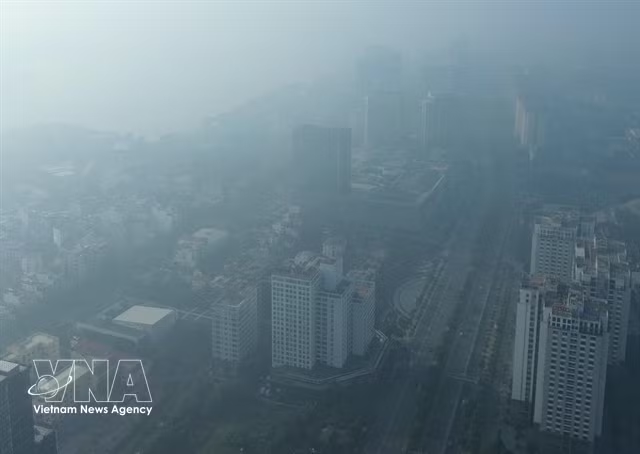
Hanoi (VNS/VNA) – Air pollution concerns for the autumn and dry seasons are a top priority in the capital.
Nguyen Minh Tan, Deputy Director of the Hanoi Department of Agriculture and Environment, said that local air pollution was mainly fine dust particulate matter 2.5 (PM2.5).
Monitoring results from the first nine months of this year show that Hanoi’s air quality has improved significantly compared with the same period last year. From January 1 to September 29, the proportion of days with good and moderate air quality reached 74.42%, nearly meeting the target of over 75% for the whole year.
“Compared with the same period last year, the city’s air quality has improved significantly. However, that does not mean we have fully met the set requirements, because professional monitoring shows that the time when pollution episodes begin to appear is usually from October, especially in the dry season from November to March of the following year,” Tan said.
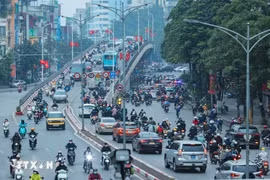
According to Tan, this period is high risk with three threats. One is emissions from traffic, usually dust swept up from the road surface by vehicles in areas with high traffic density. Construction, demolition and transport of materials also generate dust if not properly contained. Burning in the harvest season also adds heavy ash and smoke to the dust.
“We have identified three main sources: traffic, construction and uncontrolled open burning. On that basis, the city is building a peak period to focus on controlling these emission sources,” Tan said.
To curb pollution from burning, the city needs more supervision from residents and businesses and time for strict inspections by authorities to handle violations.
In response, the city has launched open-burning monitoring systems and intensified local inspections.
Dust construction reduction measures now require investors, construction units and management agencies to strengthen supervision, strictly implement shielding measures, spray water, and wash vehicles before entering or leaving construction sites to minimise dust dispersal.
Hanoi now requires all 126 communes and wards to strengthen street-cleaning work, watering and road washing to reduce fine air particles.
Green transition
From July 1, Hoan Kiem ward began a pilot low-emission zone which has delivered resilient results for residents and city planners.
This complements the city's green transport transition that began emissions testing for cars earlier this March. To date, the whole city has more than 2,300 charging-station locations with 10,209 charging ports and about 1,650 battery-swap cabinets.
For buses, the capital city has 156 routes with 1,977 vehicles. Of these, 875 vehicles have been converted, reaching 44.3%, exceeding this year’s plan.
However, Tan said the green transport transition still had much work to do. Within Ring Road 1 alone, petrol motorcycles still accounted for about 94–97%, while petrol cars accounted for about 75–over 80%.
“This is a lesson in green transition, traffic organisation and vehicles. The city will continue to carry out appropriate solutions to promote this transition process,” Tan said.
Hanoi is also controlling emission sources from industry, craft villages and production activities. Through the first review round, the city identified 53 facilities causing pollution that need to be handled or relocated.
Earlier this March, authorities inspected seven facilities, ordering two to stop production and relocate, with one facility having done so so far. The capital has also set targets to complete the handling of major polluting facilities before the end of 2030.
According to Tan, the city is also strengthening coordination with the Ministry of Agriculture and Environment, along with other regional provinces and cities, to share information and respond to dry-season air pollution.
The capital has also issued regulations on regional coordination for environmental management and established an inter-regional technical working group on the environment.
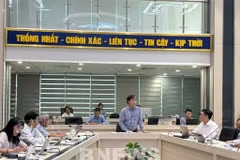
The Department of Agriculture and Environment is currently advising on a plan to strengthen air-pollution control and response measures, with a report expected this month./.
VNA