ASEAN shapes legal framework for climate change response

Law should provide the foundation for translating climate goals into concrete, implementable, monitorable and assessable actions, said Dr. Le Truong Son, Rector of the Ho Chi Minh City University of Law (ULAW).

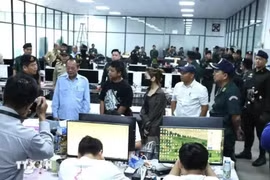
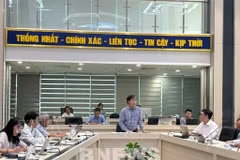
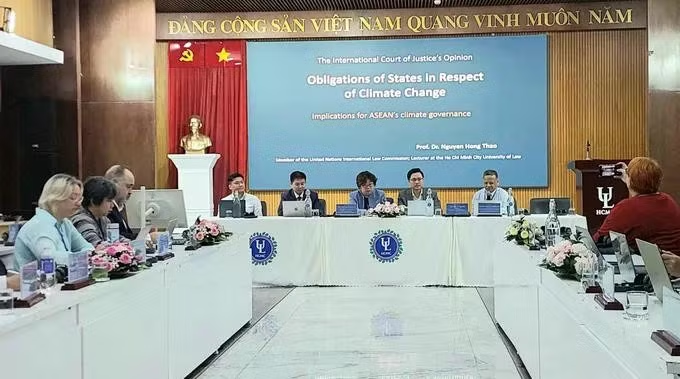
The fifth annual ASEAN conference on climate change (ACCC5 2026) takes place in Ho Chi Minh City on October 30. (Photo: sggp.org.vn/)

Ho Chi Minh City (VNA) – The Association of Southeast Asian Nations (ASEAN) needs stronger international legal frameworks and regional cooperation to translate climate commitments into practical action while ensuring a fair green transition, experts said at the fifth annual ASEAN conference on climate change (ACCC5 2026) in Ho Chi Minh City on October 30.

The conference, themed “Shaping the climate regime in Southeast Asia through international law,” was jointly organised by the Ho Chi Minh City University of Law (ULAW) and the Centre for International Law at the National University of Singapore (CIL-NUS).

It brought together experts, scientists, researchers, universities and representatives of domestic and international management agencies to discuss emerging legal issues in climate change response and the links between climate commitments, trade, investment, energy transition and sustainable development in Southeast Asia.

In his remarks, Dr. Le Truong Son, Rector of ULAW, stressed that climate change is not merely an environmental challenge but also directly affects coastal livelihoods, business operations and the development prospects of future generations.

Law should provide the foundation for translating climate goals into concrete, implementable, monitorable and assessable actions, Son said, adding that the effectiveness of the green transition should be measured by emission reductions and by its ability to safeguard livelihoods and development opportunities, particularly for communities with limited adaptive resources.

With countries preparing for the 31st United Nations Climate Change Conference (COP31), scheduled for November 9–20, in Antalya, Türkiye, Assoc. Prof. Danielle Yeow of CIL-NUS highlighted the increasingly close links between climate change, ocean affairs, investment and trade. She called for multidisciplinary approaches, stronger dialogue and greater efforts to connect research findings with policymaking and governance by governments, businesses and civil society.

One of the key topics that attracted considerable attention from delegates was the obligations and responsibilities of States in addressing climate change, with reference to the advisory opinions issued by the International Court of Justice (ICJ) in 2025 and the International Tribunal for the Law of the Sea (ITLOS) in 2024. Discussions covered the right to a safe and healthy environment, the interests of future generations, the preservation of maritime baselines amid rising sea levels, and accountability.

Participants examined the impact of environmental standards and emission controls on trade, investment, production and business. As emissions reporting and transparency requirements increase, ASEAN businesses need to strengthen their capacity to meet green standards and maintain access to international markets, while adapting to the ongoing transformation of global supply chains.

Addressing fairness in the green transition, Assoc. Prof. Dr. Tran Thi Thuy Duong, Dean of ULAW’s Faculty of International Law, highlighted the need to balance costs and benefits for Vietnam’s traditional craft villages participating in green production chains. She stressed that environmental standards must take account of the adaptive capacity of traditional producers and businesses with limited financial and technological resources.

Participants also discussed corporate responsibilities and the role of judicial bodies in resolving climate disputes and investor-state disputes, highlighting the need for a transparent, stable and enforceable legal environment./.


VNA

See more

Professor Yucheng Lin, an Assistant Professor at City University of Hong Kong (CityUHK). (Photo: VNA)

Hong Kong expert offers solutions to help Vietnam tackle sea-level rise

In an interview with the Vietnam News Agency’s correspondents in Hong Kong (China), Lin, an expert specialising in sea-level change and climate risk assessment, said Vietnam shared global drivers of sea-level rise with China’s coastal regions, but local conditions could lead to significant differences in the overall risks.

Typhoon Yagi caused severe losses in many provinces in Vietnam in 2024. (Photo: VNA)

Vietnam could face super typhoon like Yagi every seven years

If global average temperatures rise by two degrees Celsius, Vietnam could experience such a super typhoon once every 13 years on average. The frequency would increase to once every nine years under the three-degree warming scenario and once every seven years if temperatures rise by four degrees.

Six of the newly recorded species are of conservation significance, representing four orders and five families. (Photo published by VNA)

Dakrong Nature Reserve records 35 new bird species

Dakrong Nature Reserve in the central province of Quang Tri has recorded 35 bird species not previously documented, including several endangered and rare species listed on the International Union for Conservation of Nature (IUCN) Red List.

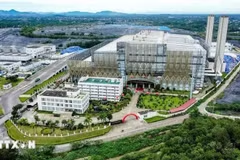
An overview of Soc Son waste-to-energy plant in the Nam Son Waste Treatment Complex, in Hanoi (Photo: VNA)

Hanoi targets collection and treatment of all industrial solid waste

Hanoi aims to ensure that all industrial solid waste from its hi-tech parks, industrial parks and industrial clusters is collected and treated in line with regulations under a new plan to strengthen waste management and tighten control on scrap collection, storage and recycling facilities across the capital.

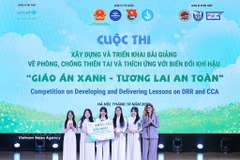
UNICEF Representative in Vietnam Silvia Danailov (first, right) honours first winners of the teaching materials competition. (Photo: VNA)

Deputy minister urges early action on disaster risks

Rapidly shifting climate conditions and increasingly overlapping hazards mean disaster risk reduction can no longer stand alone; it must sit at the heart of sustainable development, tightly integrated with climate response, water security, social welfare and economic growth.

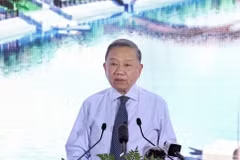
General Secretary of the Communist Party of Vietnam Central Committee and President To Lam speaks at the groundbreaking ceremony for a project to upgrade the Bac Hung Hai irrigation system. (Photo: VNA)

Hung Yen: Project to modernise Bac Hung Hai irrigation system launched

General Secretary of the Communist Party of Vietnam Central Committee and President To Lam stressed that the development of Bac Hung Hai must be integrated into broader efforts to ensure water security, protect the environment and promote sustainable development in the Red River Delta.

Illustrative image (Source: VNA)

Northern region to experience cold spell

The cold air is forecast to reach northeastern Vietnam from the evening and night of October 4 before spreading to other parts of the north and the area from Thanh Hoa to Hue. Winds will shift to the northeast at levels 2-3 inland and levels 3-4 along coastal areas.

Deputy Minister of Industry and Trade Truong Thanh Hoai and CEO of GWEC Ben Backwell chairs a offshore wind development workshop in Hamburg on September 24, 2026. (Photo: VNA)

Vietnam, Germany promote cooperation in offshore wind development, supply chains

At the discussion session, representatives of the ministry, offshore wind developers, equipment manufacturers and international financial institutions, including CIP, Siemens and KfW, discussed Vietnam’s offshore wind investment potential and the Vietnamese Government’s plans to achieve an offshore wind capacity target of 17GW by 2035, including measures to attract international investment to the country.

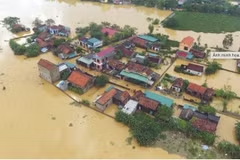
In Kim Tan commune, Thanh Hoa province, flood has submerged more than half of the ground floors of two- and three-storey houses. (Photo: VNA)

Floods affect over 16,000 homes, nearly 25,000ha of crops

The floods submerged and damaged 22,499ha of rice, crops and vegetables, along with 2,172ha of other crops. A further 1,175.62ha of aquaculture areas were affected. Some 1,999 metres of irrigation canals were eroded or damaged, while 15 schools were flooded.