Hanoi (VNA) – Vietnam and China have agreed to strengthen hydrological data sharing during the flood season and exchanges of advanced forecasting technologies.
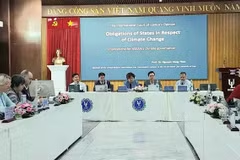
The Vietnam Meteorological and Hydrological Administration (VNMHA) under the Ministry of Agriculture and Environment had a working session in Hanoi on November 16 with a high-level delegation from China’s Ministry of Water Resources, led by Vice Minister Liu Dongshun.
At the event, the two sides signed the Minutes of Meeting on an emergency information-sharing mechanism for transboundary rivers. The document formalised key technical agreements reached by experts from the two countries, notably the conditions for activating emergency information provision at two critical locations in the river basins. At Lao Cai station in Vietnam, the activation threshold is a flow rate of 4,000 cu.m per second, while at Ping'er station in China, it is 2,500 cu.m per second. Once activated, information will be exchanged hourly.
Speaking at the working session, Hoang Duc Cuong, VNMHA Deputy Director stressed that Vietnam and China are neighbouring countries linked by the basins of major transboundary rivers, including the Red River (Yuan River) and the Bang Giang-Ky Cung River (Zuo River).
Amid the increasingly severe impacts of climate change, maintaining timely hydrological information sharing under the Memorandum of Understanding (MoU) signed in December 2023, together with close coordination during major floods in recent years, has provided clear evidence of mutual support. This cooperation has directly helped protect lives and property in border areas of both countries.
In response, Liu affirmed that hydrological information sharing is the longest-standing area of cooperation and has delivered some of the most practical results between the water resources and hydrological management agencies of the two countries.
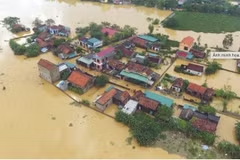
He expressed particular thanks to his Vietnamese counterparts for their timely support in flood prevention and control in recent years. A notable example occurred in late August, during floods triggered by Typhoon Narra. When major flooding hit the Zuo River basin, Vietnam immediately activated its emergency response mechanism following a request from China and doubled the frequency of upstream hydrological monitoring data provision, from four to eight times a day. This swift coordination gave Chinese authorities more time to forecast flooding along the Zuo River and make accurate and safe decisions on flood management.
During the annual flood season from May 15 to October 31, the two sides have consistently exchanged data four times a day at designated stations, increasing the frequency to eight times a day during exceptionally severe floods, such as those in October 2025 and August 2026. In addition to using FTP servers to exchange data in CSV format and applying strict data verification procedures, they have made flexible use of rapid communication channels such as WeChat and Zalo to verify figures in real time when unusual weather conditions occur.
Regarding technological development, Hoang Van Dai, Deputy Director of the National Centre for Hydro-Meteorological Forecasting, said Vietnam has automated most of its rainfall and water-level monitoring equipment, with data transmitted via satellites and mobile telecommunications. The country is also implementing its 2021-2030 network development plan, which aims to build 37 new hydrological stations in transboundary river basins, increasing the total from 109 to 146.
In forecasting, Vietnam has integrated advanced hydrological mathematical models with Geographic Information System (GIS) technology, enabling it to provide warnings of major floods an average of two to three days in advance, with bulletins issued every six hours during flood emergencies./.
See more
Heavy rain causes widespread damage across central Vietnam
According to the Vietnam Disaster and Dyke Management Authority under the Ministry of Agriculture and Environment, as of 5pm on November 11, the downpours injured two people in Hue city, and damaged or unroofed 38 houses in Quang Tri, Hue, Quang Ngai and Dak Lak.
Vietnam, RoK youth promote environmental education, cultural exchange
The exchanges between the 20 Korean youth ambassadors and students from Cuc Phuong Secondary School amid the primeval forest created a practical learning environment while promoting the spirit of international solidarity among young people in protecting the planet.
Coastal biosphere reserves network adopts action plan for sustainable development
A highlight of the declaration is the commitment to contribute to the Hangzhou Strategic Action Plan, particularly Action Target 18, under which the network will develop guidelines by 2028 to address challenges specific to coastal and marine biosphere reserves, supporting their nomination, management and monitoring.
Ninh Binh establishes world's largest Delacour's langur sanctuary
The establishment of the Kim Bang Delacour's Langur Species and Habitat Conservation Area in Ninh Binh province provides a solid legal and scientific foundation for completing the dossier to seek UNESCO recognition of the Van Long–Kim Bang–Tam Chuc Cultural and Ecological Landscape Complex as a World Heritage Site.
Vietnam, Indonesia boost green energy cooperation
Vietnam has considerable experience in solar power development that Indonesia could draw on as it implements its 100-GW solar power programme.
Urban trees capable of reducing fine dust to be planted
The Forestry and Forest Protection Department (FFPD) will lead the component on identifying crop and planting structures that help reduce air pollution, while also participating in the design of urban public-space landscapes.
Biodiversity conservation underpins Da Nang’s ambition to become ecological coastal city
The city’s master plan prioritises development that respects natural ecosystems, preserves ecological corridors, protects flood-storage areas and limits urban expansion in environmentally sensitive and disaster-prone zones.
ASEAN shapes legal framework for climate change response
Law should provide the foundation for translating climate goals into concrete, implementable, monitorable and assessable actions, said Dr. Le Truong Son, Rector of the Ho Chi Minh City University of Law (ULAW).
Bac Ninh engages communities in forest protection
Instead of relying mainly on authorities, residents have taken a more active role in patrolling forests, monitoring changes and reporting violations.
Phu Quoc joins forces to keep beaches clean during monsoon season ahead of APEC 2027
An Giang province is implementing a green-transition plan for the Phu Quoc special zone for the 2026–2035 period, with a vision to 2050, including an emphasis on plastic-free tourism and cleaner beaches.
CCS/CCUS essential for Vietnam to achieve net-zero emissions by 2050
ietnam has introduced various policies and guidelines on climate change response, energy security and marine economic development, identifying CCS/CCUS as a solution for reducing greenhouse gas emissions.
Hong Kong expert offers solutions to help Vietnam tackle sea-level rise
In an interview with the Vietnam News Agency’s correspondents in Hong Kong (China), Lin, an expert specialising in sea-level change and climate risk assessment, said Vietnam shared global drivers of sea-level rise with China’s coastal regions, but local conditions could lead to significant differences in the overall risks.
Vietnam could face super typhoon like Yagi every seven years
If global average temperatures rise by two degrees Celsius, Vietnam could experience such a super typhoon once every 13 years on average. The frequency would increase to once every nine years under the three-degree warming scenario and once every seven years if temperatures rise by four degrees.
Dakrong Nature Reserve records 35 new bird species
Dakrong Nature Reserve in the central province of Quang Tri has recorded 35 bird species not previously documented, including several endangered and rare species listed on the International Union for Conservation of Nature (IUCN) Red List.
Lam Dong establishes 8,408-hectare Ta Kou Nature Reserve
The reserve, covering 8,408 hectares, aims to protect and maintain the area and quality of natural forests, conserve biodiversity, endangered and rare species, and natural habitats typical of the region.
Hanoi targets collection and treatment of all industrial solid waste
Hanoi aims to ensure that all industrial solid waste from its hi-tech parks, industrial parks and industrial clusters is collected and treated in line with regulations under a new plan to strengthen waste management and tighten control on scrap collection, storage and recycling facilities across the capital.
Deputy minister urges early action on disaster risks
Rapidly shifting climate conditions and increasingly overlapping hazards mean disaster risk reduction can no longer stand alone; it must sit at the heart of sustainable development, tightly integrated with climate response, water security, social welfare and economic growth.
Hanoi tightens control over three emission sources as pollution season looms
Monitoring results from the first nine months of this year show that Hanoi’s air quality has improved significantly compared with the same period last year.
Hung Yen: Project to modernise Bac Hung Hai irrigation system launched
General Secretary of the Communist Party of Vietnam Central Committee and President To Lam stressed that the development of Bac Hung Hai must be integrated into broader efforts to ensure water security, protect the environment and promote sustainable development in the Red River Delta.
Seventeen wild animals released into natural habitat in Quang Tri
Previously rescued and cared for by the park’s Centre for Rescue, Conservation and Development of Organisms, all the animals underwent health checks and assessments of their ability to adapt to the wild before the reintroduction.