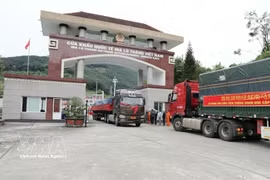
Hanoi (VNA) – Trade has become the standout engine of Vietnam-China relations since their diplomatic ties were established, with two-way goods flows rising steadily.
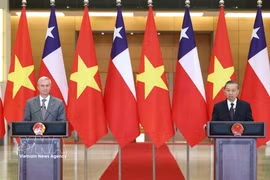
General Secretary of the Communist Party of Vietnam Central Committee and President To Lam’s trip to China for the 33rd APEC Economic Leaders’ Week and bilateral engagements is expected to add new momentum, including deeper economic connectivity, broader trade, investment and supply chain links, and a more balanced, substantive economic relationship that matches both sides’ potential.
Trustworthy partners
China is now one of the world’s top technology innovation economies, exporting a wide range of consumer goods, including electronics, smart appliances, robots, drones, unmanned vehicles, and digital solutions, into Vietnam at competitive prices. That presence creates opportunities in distribution, technical support, manufacturing and supply chain participation.
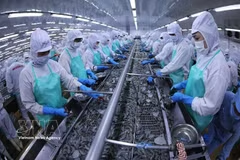
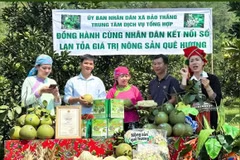
Vietnamese goods are gaining ground in China in return. The export mix is shifting toward processed, high added-value products, and trade promotion is reaching deeper into Chinese market. Vietnamese agricultural, aquatic, processed food and herbal products are increasingly visible in Chinese distribution and retail channels.
Quality remains the trust anchor. Business promotion and official market opening and trade promotion policies matter just as much. Free trade agreements reduce tariff barriers, while proximity lowers logistics costs and eases access to China.
Two-way trade hit 256.4 billion USD in 2025, up 24.8%. Vietnam exported 70.4 billion USD to China, up 14.8%, while imports hit 186 billion USD, up 29%. This resulted in a trade deficit of 115.6 billion USD, up 39.6% from the same period in 2024.
In the first 10 months of 2026, trade stood at 290 billion USD, up 39.3%. Vietnam’s exports to China rose 36.2% to 77.5 billion USD. Imports from China climbed 40.5% to 212.5 billion USD, pushing the deficit up 43.2% to 134.9 billion USD.
The numbers show deepening economic integration and a clear challenge for Vietnam to lift growth quality and extract more export value.
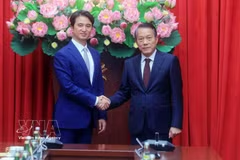
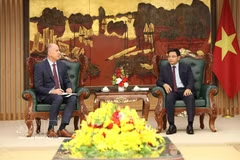
At a recent working session with Deputy Director of the Research Office of the State Council of China Fan Bi, Deputy Minister of Industry and Trade Luong Hoang Thai said Vietnam-China economic and trade ties have kept expanding despite global volatility and have delivered positive results.
Thai pointed to geography and the comprehensive strategic cooperative partnership as a big chance for cooperation beyond trade. Vietnam wants Chinese investment and technology transfer in transport infrastructure, electric vehicles and lithium batteries, renewable energy, smart manufacturing and supporting industries.
More room to grow
Bui Quang Hung, Deputy Director of the Vietnam Trade Promotion Agency hailed China as Vietnam’s largest trade partner and largest source of goods while Vietnam is China’s largest ASEAN trade partner and fourth largest globally.
Cooperation between Vietnamese localities and Hainan is now entering a stronger phase. Proximity, transport links and complementary goods structures have made Hainan an important partner. Vietnamese agro-forestry-fisheries, processed food and light industrial goods remain key exports to the province.
The Hainan Free Trade Port’s island-wide special customs regime, launched at the end of 2025 with tariff incentives, gateway opening and trade facilitation, creates a much larger cooperation space. Vietnamese firms can deepen access to Hainan, widen distribution, optimise logistics and plug more firmly into regional supply chains.
The Vietnamese Ministry of Industry and Trade has opened a Trade Promotion Office in Haikou to provide information and business matching, aiming to turn that potential into sustainable Vietnam-Hainan trade.
Fu Wenfeng, President of the Hainan Digital Trade Association, said Chinese companies are already approaching the office for information, project links and cooperation opportunities. The association and the office are acting as a bridge for market access and stronger business ties.
Fu said food and agricultural trade remains a priority, with clear complementarity and ample market room. Vietnam has strong farming and specialty production foundations and a relatively complete food processing industry. Well-known local brands have built market positions and shown strength in distinctive flavours and local branding.
China brings scale, diverse consumer segments and experience in specialised food processing equipment, cold chain logistics, brand operation and cross-border distribution.
Both sides also see the wider ASEAN market as a joint target through product R&D, supply chain building and shared distribution. That points to a two-way model that co-creates value across the whole product chain.
To help Vietnamese firms capture China more effectively, the Vietnam Trade Office in China will work with the Vietnamese Embassy to intensify trade promotion and business matching. Priorities include fairs, exhibitions and trade exchanges, plus expansion into northern and western China, where Vietnamese goods still have limited access but can connect with distribution, retail and potential local partners.
The Trade Office will also sharpen market and sector insight so localities, associations and companies can track demand and consumption trends and design better entry plans. On investment, it will pitch Vietnam’s FDI policies and industrial parks to Chinese companies and investors.
It will also help Vietnamese firms hunt for investment and business opportunities in China through advisory work, information and links to agencies, localities and credible partners, part of a push to widen cooperation and lift bilateral trade and investment ties./.
VNA