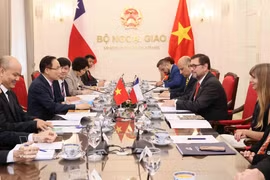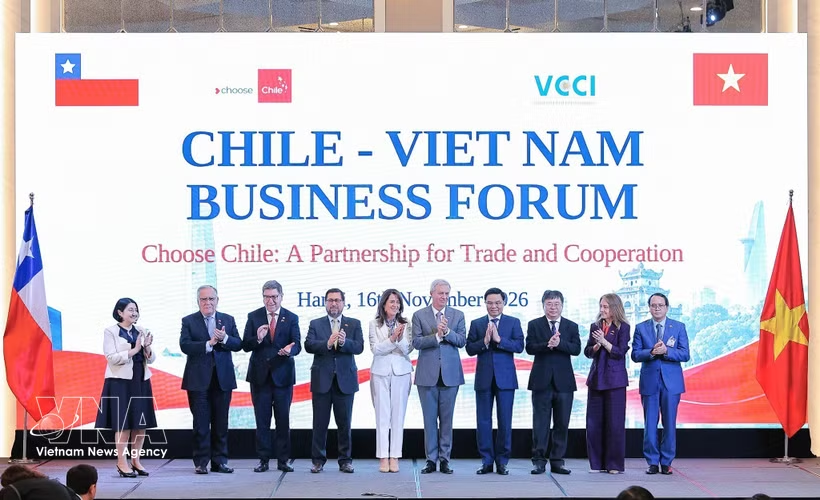
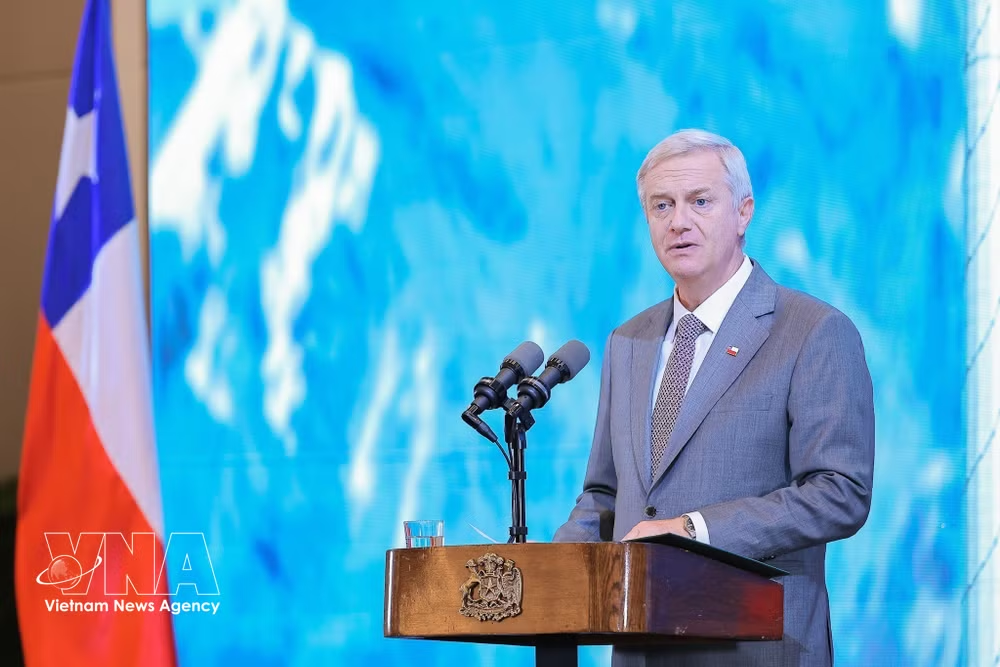
Hanoi (VNA) - Chilean President José Antonio Kast highlighted opportunities for Vietnam and Chile to expand economic ties by leveraging their complementary strengths and international integration, while addressing a forum in Hanoi on November 16.
The Chile-Vietnam Business Forum was jointly held by the Vietnam Chamber of Commerce and Industry (VCCI) and Chile’s Export Promotion Bureau (ProChile) as part of the official visit to Vietnam by the Chilean President.
The President pointed to potential for cooperation in agriculture and food, and called for stronger technical cooperation, better market access and closer links in innovation, technology, services and sustainable development.
The “Choose Chile” initiative was also introduced to promote the South American country's business and investment opportunities to international partners, including Vietnamese enterprises.
Speaking at the event, Vietnamese Minister of Industry and Trade Le Manh Hung said Vietnamese and Chilean businesses should fully tap incentives offered by free trade agreements (FTAs), strengthen links among industry associations, importers and distribution networks, and expand investment cooperation alongside technology transfer.
Hung stressed the need to turn existing cooperation frameworks and advantages into concrete results, noting that businesses from both countries should boost cooperation in developing human resources and adopting sustainable development standards.
The Ministry of Industry and Trade stands ready to work with relevant Chilean agencies to resolve difficulties, facilitate trade activities and advance cooperation initiatives, he affirmed.
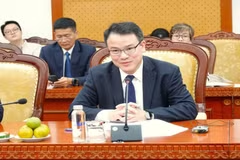
VCCI Deputy Secretary General Tran Ngoc Liem said businesses from both countries still have considerable scope to expand cooperation, particularly as Vietnam and Chile seek to diversify markets, enhance competitiveness, accelerate digital transformation and develop green economies.
He stressed that VCCI will continue to serve as a bridge between the two nations’ business communities and work with Chilean trade promotion organisations, including ProChile, to provide market information, identify potential partners, facilitate business connections and help address obstacles to cooperation.
Liem called for more targeted trade promotion activities and expanded investment cooperation in sectors where the two sides have complementary strengths. He also stressed that the effective use of FTAs, particularly the Vietnam–Chile Free Trade Agreement (VCFTA), and the Comprehensive and Progressive Agreement for Trans-Pacific Partnership (CPTPP), will help businesses gain market access, expand supply chains and boost bilateral trade.
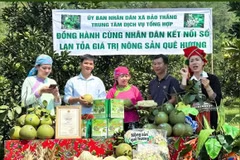
Participants explored cooperation in agriculture and food, including opportunities to export Chilean meat and fruits to Vietnam and expand Vietnamese businesses' presence in Chile. They also discussed logistics, transport costs, customs procedures, technical standards and quarantine requirements, highlighting issues requiring closer coordination to facilitate market access.
Chile's extensive FTA network and experience in international integration are expected to help Vietnamese businesses access South American markets, while Vietnam can serve as a gateway for Chilean enterprises to enter ASEAN and wider Asian markets. Capitalising on these advantages will support market diversification, strengthen supply chains and foster sustainable business ties.
Chile is one of the important partners of Vietnam in Latin America, while Vietnam is Chile’s largest trading partner in ASEAN. VCFTA, effective since 2014, and the two countries’ participation in CPTPP provide a strong framework for promoting trade, expanding markets and strengthening links between their business communities.
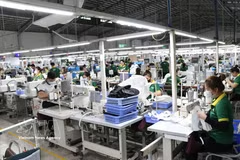
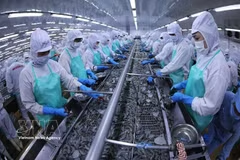
Trade between Vietnam and Chile exceeded 1.7 billion USD in 2025, with huge room for further growth. Vietnam has strengths in manufacturing, processing and exporting electronics, textiles and garments, footwear, wooden products, agricultural produce and seafood, while Chile has advantages in minerals, industrial materials, forestry, food, high-tech agriculture and renewable energy. These complementary strengths create opportunities for broader trade, investment and production links, as well as deeper participation in regional and global value chains./.