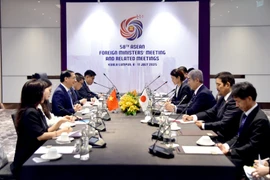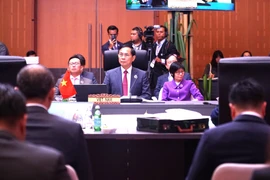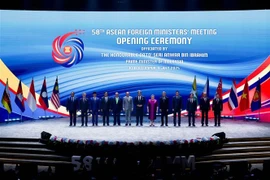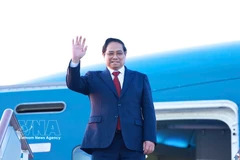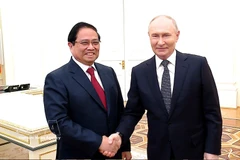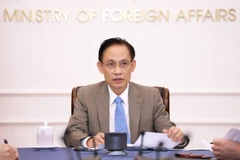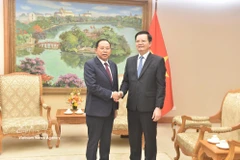
Kuala Lumpur (VNA) – As part of the ongoing 58th ASEAN Foreign Ministers’ Meeting (AMM-58) and related meetings, Vietnamese Deputy Prime Minister and Minister of Foreign Affairs Bui Thanh Son on July 10 attended ASEAN+1 foreign ministers’ meetings with Japan, Russia, the Republic of Korea (RoK), and the US, as well as the ASEAN+3 Foreign Ministers’ Meeting (with Japan, China, and the RoK).
During the meetings, ASEAN member states and their partners reaffirmed their commitment to advancing relations in a more substantive, effective, and comprehensive manner. In light of growing uncertainties in the regional and global landscape, all parties emphasised the need to enhance dialogue, cooperation, and coordinated actions to tackle common challenges. They stressed the importance of contributing actively to maintaining peace, security, and stability, thereby fostering an enabling environment for inclusive and sustainable growth.
The partners also reaffirmed their support for ASEAN’s centrality and pledged to assist the bloc in implementing the ASEAN Community Vision 2045. Particular priority will be given to cooperation in digital transformation, innovation, green transition, energy transition, artificial intelligence, and other emerging technologies.
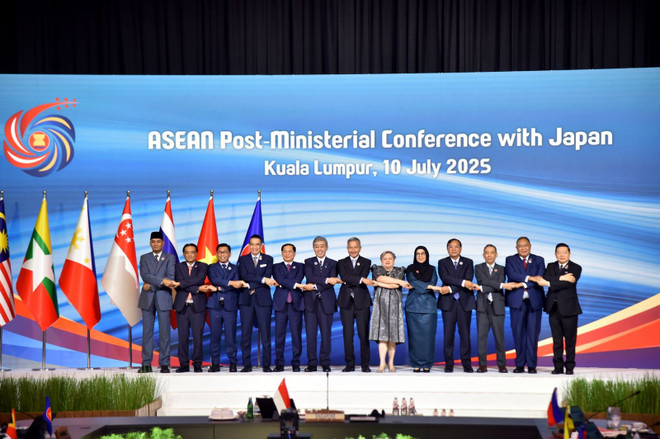
At the ASEAN-Japan foreign ministers’ meeting, Japanese Foreign Minister Takeshi Iwaya emphasised that over the past half-century, the ASEAN–Japan relationship has been nurtured on a solid foundation of friendship, cooperation, trust, and co-creation. He reaffirmed Japan’s commitment to deepening multi-layered cooperation with ASEAN, jointly addressing regional and global issues, and promoting global governance to build a shared future.
Countries highly appreciated the dynamic and substantive progress in the ASEAN–Japan Comprehensive Strategic Partnership. Notably, over 60% of the items listed in the partnership's action plan were implemented in the past year.
The ministers agreed on the need to expedite the upgrade of the ASEAN–Japan Comprehensive Economic Partnership Agreement to better respond to emerging areas of growth such as digital development, green growth, and resilient supply chains.
ASEAN also welcomed Japan’s support in improving the investment environment, developing small- and medium-sized enterprises (SMEs), promoting sustainable growth, narrowing development gaps, and advancing sub-regional development initiatives.
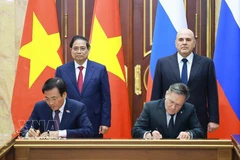
At the ASEAN–Russia ministerial meeting, Russian Foreign Minister Sergei Lavrov affirmed that ASEAN remains a trusted partner of Russia. He reiterated Russia’s commitment to promoting equal cooperation based on the principles of the United Nations Charter, and contributing actively to peace and stability in the Asia–Pacific.
The meeting noted that approximately 75% of the measures outlined in the ASEAN–Russia Action Plan for 2021–2025 have already been completed. Ministers welcomed the successful first ASEAN-Russia Digital Senior Officials’ Meeting earlier this year, which laid a strong foundation for further digital cooperation.
The ministers agreed to boost economic cooperation, particularly in key areas such as the digital economy, innovation, supply chain, sustainable tourism, clean energy, and the development of small- and medium-sized enterprises (SMEs). ASEAN also recognised the important role of the ASEAN–Eurasian Economic Union Business Forum and the ASEAN–Russia Business Council in enhancing connectivity between the business communities of both sides.
In the socio-cultural sphere, ASEAN welcomed Russia’s initiative to host the ASEAN–Russia Young Diplomats Summit and took note of the proposal to establish an ASEAN–Russia Senior Officials Meeting on Youth. Both sides agreed to continue working closely on developing the ASEAN–Russia Action Plan for 2026–2030 and to begin preparations for the celebration of the 30th anniversary of ASEAN–Russia relations in 2026.
At the meeting with the RoK, Korean Vice Minister of Foreign Affairs Park Yoonjoo reaffirmed the country's commitment to deepening and expanding its relationship with ASEAN based on mutual trust and respect, and shared benefit. He noted the alignment between ASEAN’s theme of “Inclusivity and Sustainability” and the RoK’s APEC 2025 theme “Creating a Sustainable Future” and expressed hope for closer coordination to maximise synergies between the two frameworks.
ASEAN member states shared the view that the ASEAN–RoK relationship is at its strongest, marked by the elevation to a Comprehensive Strategic Partnership in October 2024. Both sides highly appreciated the implementation of the 2021–2025 Action Plan, which has achieved an impressive 94.5% completion rate. They also agreed to adopt a new Action Plan for 2026–2030.
The ministers acknowledged ongoing efforts to prepare for negotiations to upgrade the ASEAN–RoK Free Trade Agreement (AKFTA), ensuring its relevance in the current global economic context. ASEAN welcomed the RoK’s forward-looking initiatives aimed at ensuring security and sustainability for the people of the region.
These include the 10 million USD high-performance computing infrastructure project, the ASEAN–RoK Startups Partnership, and the 20 million USD methane reduction project.
ASEAN also valued the RoK’s continued support through specialised cooperation channels, particularly in narrowing development gaps, enhancing sub-regional connectivity, and advancing the green transition.
Meanwhile, US Secretary of State Marco Rubio affirmed that the Indo-Pacific remains a central focus of the US foreign policy. He underscored the US’ enduring commitment to ASEAN, emphasising that ASEAN serves as the key mechanism for the US to strengthen its regional engagement.
The US expressed its wish to further explore concrete areas of cooperation under the ASEAN–US Comprehensive Strategic Partnership. ASEAN member states welcomed the full implementation of the 2021–2025 Action Plan, which achieved a 100% completion rate with progress across all priority areas.
The US is currently ASEAN’s second-largest trading partner and its largest foreign investor, with total two-way trade surpassing 450 billion USD and US direct investment reaching 42 billion USD in 2024. ASEAN noted its desire for a constructive dialogue with the US to maintain a stable, fair, sustainable, and mutually beneficial trade relationship.
The ministers agreed to intensify implementation of the ASEAN–US Digital Work Plan, focusing on key areas such as artificial intelligence, cloud computing, regional submarine cable systems, and combating online fraud.
Both sides also highlighted strong cooperation in clean energy and energy transition. The US has supported the development of the ASEAN power grid and has been working with the bloc to implement the ASEAN–US Energy Cooperation Work Plan for 2021–2025.
People-to-people and educational exchanges remain a key pillar of the partnership, with initiatives such as the Young Southeast Asian Leaders Initiative (YSEALI), the Fulbright Scholarship Programme, and the ASEAN-US Science and Technology Innovation Centre (STIC).
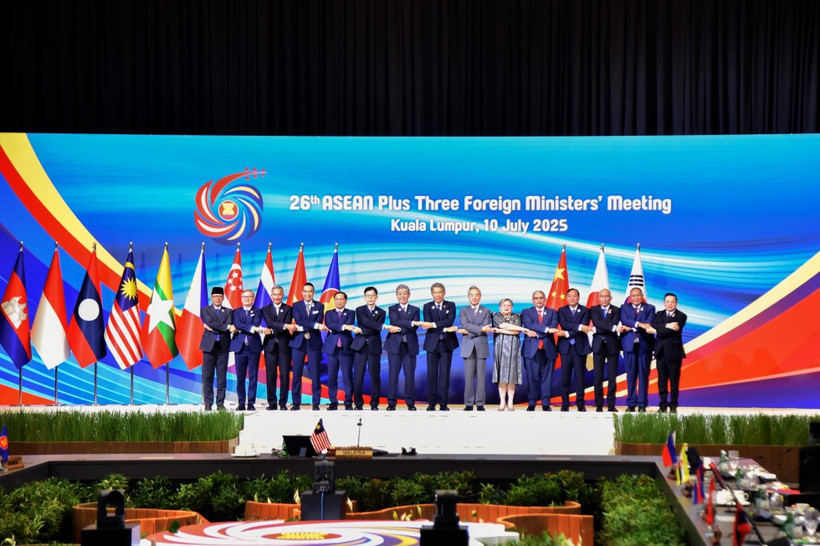
At the 26th ASEAN Plus Three (APT) Foreign Ministers’ Meeting, delegates from ASEAN, China, Japan, and the RoK emphasised the importance of leveraging the unique strengths of the ASEAN+3 cooperation framework to address the current volatile economic landscape. They expressed strong support for a fair, rules-based multilateral trading system and reaffirmed their commitment to inclusive and sustainable regional development.
The ministers pledged to continue the effective implementation of the ASEAN+3 Cooperation Work Plan (2023–2027), focusing on key priority areas such as the digital economy, digital finance, capacity building, support for small and medium-sized enterprises (SMEs), and the development of resilient, sustainable, and adaptive regional supply chains. They also highlighted the need for the development of sustainable, green, and smart infrastructure across the region.
To enhance regional financial resilience, the ministers committed to expanding the Asian Bond Markets Initiative (ABMI) and the Chiang Mai Initiative Multilateralisation (CMIM) mechanism to strengthen the safety of the financial network and improve the capacity to respond to financial risks.
The ministers agreed to enhance collaboration in energy and food security, smart agriculture, renewable energy, green transition, and sustainable growth.
Speaking at the meetings, Son underscored the importance of deepening comprehensive cooperation between ASEAN and its partners, in close alignment with the ASEAN Community Vision 2045.
In light of complex and unpredictable global and regional developments, he called on countries to promote dialogue, build trust, and shape an inclusive, transparent regional architecture based on international law, with ASEAN at its centre. He also highlighted the need for enhanced cooperation in addressing non-traditional security challenges such as cybersecurity, and energy and food security.
He emphasised ASEAN’s principled stance on key regional and international issues, including the East Sea and the Korean Peninsula. He called on partners to support ASEAN’s efforts in building the East Sea into a sea of peace, stability, cooperation, and sustainable development.
Regarding economic cooperation, the official proposed boosting regional supply chain connectivity, developing the digital economy, advancing the green transition, promoting sustainable trade, and supporting micro-, small-, and medium-sized enterprises (MSMEs).
He urged partners to work with ASEAN to accelerate the upgrading of existing free trade agreements, such as the ASEAN–Japan Comprehensive Economic Partnership and the ASEAN–RoK Free Trade Agreement.
He also called for increased support in implementing new initiatives such as the ASEAN Digital Economy Framework Agreement and the ASEAN Power Grid. Vietnam proposed giving priority to energy cooperation, including exploring the possibility of establishing a regional energy agreement to ensure long-term energy security and a just energy transition.
Son also further highlighted the critical role of people-to-people exchanges in fostering mutual trust and friendship. He appreciated youth, student, and expert exchange programmes between ASEAN and its partners, and encouraged greater facilitation for ASEAN citizens to study, work, and reside in partner countries./.