Energy – cornerstone of peace and development: Deputy PM

The Vietnamese official, who joined the ongoing 8th Russian Energy Week International Forum, underscored the crucial role of energy in safeguarding national energy security and promoting sustainable socio-economic development amid growing challenges from climate change and the depletion of natural resources.

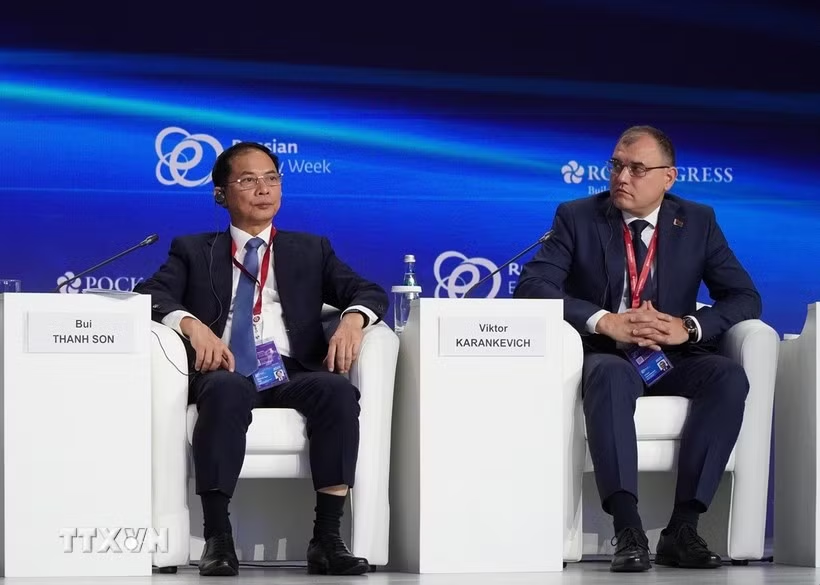
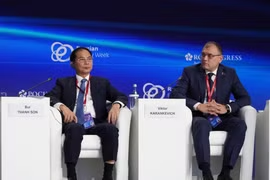
Deputy Prime Minister Bui Thanh Son (L) at the first plenary session of the 8th Russian Energy Week International Forum in Moscow. (Photo: VNA)

Moscow, (VNA) - Deputy Prime Minister Bui Thanh Son highlighted the fundamental role of energy in promoting peace and development, and equity in his remarks at the first plenary session of the 8th Russian Energy Week International Forum held in Moscow from October 15 to 17.

The Vietnamese official, who joined the event at the invitation of the Russian government, underscored the crucial role of energy in safeguarding national energy security and promoting sustainable socio-economic development amid growing challenges from climate change and the depletion of natural resources.

He stressed that the global energy sector must improve the efficiency of resource use, promote research and application of science and technology, reduce emissions in exploitation, processing, and use of traditional energy sources, and develop green, clean and high-efficiency energy sources.

Deputy PM Son thanked the Russian government for inviting Vietnam to this important and meaningful event, where leaders of countries and representatives from businesses around the world meet to discuss urgent trends in the global energy sector.

He revealed that Vietnam’s goal through 2030, with a vision toward 2045, is to ensure firm national energy security; provide sufficient, stable, and high-quality energy with low emissions to drive socio-economic development; safeguard national defence and security; improve living standards for people; and protect the ecological environment.

He addressed delegates’ questions regarding the Vietnamese Government’s plans to expand infrastructure and strengthen technical capacity for receiving liquefied natural gas (LNG), noting that the development and expansion of LNG terminal infrastructure have been carefully planned and aligned with the implementation schedule of gas-fired power projects.

Between 10 and 14 LNG terminal clusters will be developed to serve corresponding gas-fired power plants across all regions of Vietnam, Son said, adding that investors in LNG terminals and gas-to-power projects are actively implementing their plans, aiming to put the plants into commercial operation between 2028 and 2030.

Vietnam welcomes investors’ cooperation and experience sharing with Russian and other international companies to enhance their capacity in developing and operating LNG terminal infrastructure.

At the forum, delegates shared the view that the global energy sector is facing major challenges due to complex geopolitical tensions, which have disrupted supply chains and caused instability in both supply and demand markets. However, with the world’s population projected to reach 10 billion by 2050 and the global economy continuing to expand, energy demand is expected to keep rising.

They said that diversifying energy sources and markets, while ensuring a sustainable, stable, and competitively priced supply, is the most effective way to safeguard national interests and protect the global market from pressures of protectionism, trade restrictions, and tariff barriers.

Initiated in 2016, the Russian Energy Week International Forum serves as a platform to discuss key global fuel and energy trends, identify economic and technological solutions, and strengthen international cooperation to address challenges, mitigate risks, and promote efficient and sustainable energy development.

This year’s forum attracts nearly 5,000 delegates from 80 countries and territories, featuring more than 70 diverse events.

Deputy PM Son and the Vietnamese delegation are scheduled to engage in bilateral meetings on October 16 as part of their working trip to Russia./.
VNA

See more

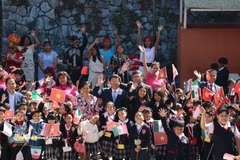
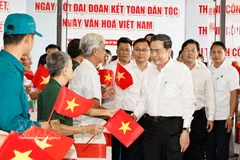
The Vietnamese delegation takes photo with students at the primary school named after the Socialist Republic of Vietnam (Photo: VNA)

CPV values traditional friendship with Mexican Labour Party

Deputy head of the CPV Central Committee’s Commission for Publicity Tran Thanh Lam proposed deeper theoretical exchanges and sharing of experience in Party building and national development; stronger cooperation in education, science, culture, external information, press, publishing and traditional medicine.

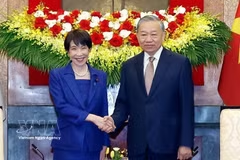
General Secretary of the Communist Party of Vietnam (CPV) Central Committee and President To Lam and Japanese Prime Minister Sanae Takaichi during her official visit to Vietnam in May, 2026. (Photo: VNA)

Top Vietnamese leader’s Japan visit to open up new space for bilateral cooperation

The visit is expected to further deepen ties through Party, State, parliamentary and people-to-people channels, while creating breakthroughs in economic, financial, scientific and technological cooperation, innovation, education and training, digital and green transformation, and supply chain diversification, thereby contributing to a peaceful and stable environment for development in both countries.

Politburo Member and Head of the Party Central Committee’s Commission for Publicity Trinh Van Quyet (R) meets with Jiri Mäntysalo, Vice Chairman of the Communist Party of Finland. (Photo: VNA)

Vietnam, Finland move to strengthen political trust, expand cooperation

Politburo Member and Head of the Party Central Committee’s Commission for Publicity Trinh Van suggested that Finland further promote its role as a bridge between Vietnam and the European Union (EU), while Vietnam could serve as a bridge between Finland and the Association of Southeast Asian Nations (ASEAN). He called for effective utilisation of the EU-Vietnam Free Trade Agreement (EVFTA) and urged Finland to encourage the remaining EU member states to ratify the EU-Vietnam Investment Protection Agreement (EVIPA) at an early date.

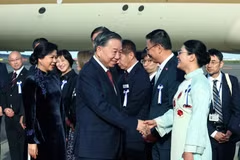
Representatives of the Japanese State and the Embassy of Vietnam in Japan welcome General Secretary of the Communist Party of Vietnam Central Committee and President To Lam and his spouse at Haneda International Airport in Tokyo. (Photo: VNA)

Top Vietnamese leader begins official visit to Japan

The visit is expected to further translate the potential and achievements of bilateral cooperation into concrete outcomes, strengthen the longstanding bonds between the two countries and ensure that the friendship nurtured across generations continues to deliver lasting benefits to both peoples.

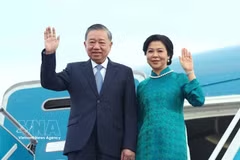
General Secretary of the Communist Party of Vietnam Central Committee and President To Lam, his spouse Ngo Phuong Ly and a high-ranking Vietnamese delegation leave Hanoi on November 8 for a four-day official visit to Japan at the invitation of the Japanese State. (Photo: VNA)

Top leader and spouse depart for official visit to Japan

General Secretary of the Communist Party of Vietnam Central Committee and President To Lam, his spouse Ngo Phuong Ly and a high-ranking Vietnamese delegation left Hanoi on November 8 for a four-day official visit to Japan at the invitation of the Japanese State.

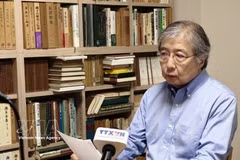
Toshiro Nishizawa, a Senior Fellow at Graduate School of Public Policy under the University of Tokyo in an interview with the Vietnam News Agency (VNA)'s correspondent in Japan (Photo: VNA)

Top leader’s visit to deepen Vietnam-Japan strategic cooperation: expert

The upcoming visit to Japan by General Secretary of the Communist Party of Vietnam Central Committee and President To Lam is expected to give fresh impetus to the Vietnam-Japan Comprehensive Strategic Partnership, reflecting the strategic priorities of both countries, according to a Japanese expert.

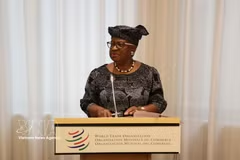
WTO Director-General Ngozi Okonjo-Iweala speaks at the event (Photo: VNA)

WTO hails Vietnam’s 20-year journey since accession

Joining the WTO was a strategic choice for Vietnam, closely associated with its Doi Moi (Renewal) process, opening-up policy and international economic integration. Over the past two decades, international economic integration has become a driving force for institutional reforms, trade expansion, foreign investment attraction and enhancement of the country's international standing.

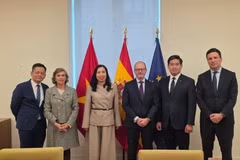
Vietnamese Deputy Minister of Foreign Affairs Le Thi Thu Hang (third, left) and other delegates at the political consultation (Photo: The Ministry of Foreign Affairs)

Vietnam, Spain seek to deepen Strategic Partnership

Vietnam asked Spain to continue voicing its support for and urging the European Commission (EC) to swiftly lift the IUU “yellow card” imposed on Vietnamese seafood, while actively encouraging EU member states to ratify the EU-Vietnam Investment Protection Agreement (EVIPA) at an early date.

Standing Deputy Minister of Foreign Affairs Nguyen Minh Vu (Photo: Ministry of Foreign Affairs)

Top leader's official visit to Japan carries three major strategic implications: Deputy FM

The visit, the first to Japan by the leader in his new capacity and the first visit to Japan by a General Secretary of the Communist Party of Vietnam in 11 years, will first set the overall strategic direction for bilateral relations in the new period, enabling leaders of the two countries to identify long-term cooperation orientations and priority areas that meet the development needs of both sides.