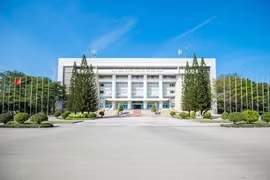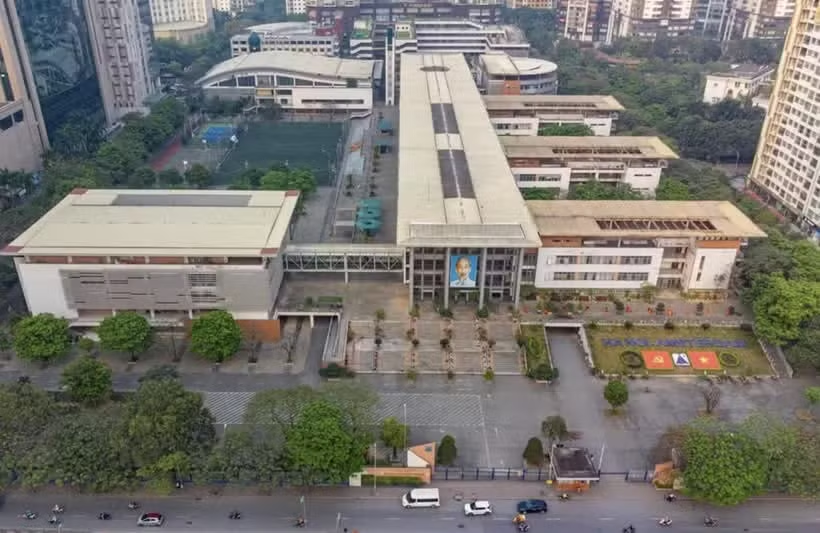
Hanoi (VNA) - The Hanoi People’s Committee has approved a plan to develop Chu Van An High School for the Gifted and Hanoi-Amsterdam High School for the Gifted into schools of international standards.
Under the plan, Chu Van An High School for the Gifted will be developed into an academic, research and innovation hub at the high school level, providing training for students with outstanding academic abilities, strong character, creativity and high capacity for international integration.
The school will build a modern governance system, a high-quality teaching workforce, synchronised facilities, a smart learning environment and a comprehensive quality assurance mechanism.
Its development will focus on internationalised learning outcomes, capacity to receive international students, international-standard governance, highly qualified teaching staff, and academic infrastructure.
Implementation will follow a phased roadmap. In the 2026–2027 academic year, the schools will pilot an in-depth academic programme for three to four classes, while introducing international standard programmes for the remaining classes. The plan also includes upgrading facilities and ensuring that 100% of teachers attain at least Level 4 foreign-language proficiency under Vietnam’s six-level language competency framework.
During 2031–2035, an enhanced integrated programme will be rolled out across the entire school, with 90% of teachers capable of bilingual or international-standard teaching. International and exchange students are expected to account for 1% of the student body.
In 2036–2045, all students are expected to obtain foreign-language, international academic and international information technology certificates, while international students will make up 2% of total enrolment. The schools are also expected to become centres for training high school teachers, and educational research, and rank among the top 100 schools for the gifted in Asia. They will also establish networks with leading specialised schools worldwide, and become an educational tourism destination in the capital.
For Hanoi-Amsterdam High School for the Gifted, the project aims to transform the school into a national talent-training centre with learning outcomes equivalent to internationally recognised degree and certification systems, nurturing future scientists and leaders in the knowledge economy. It also seeks to shift the educational philosophy from simply fostering academically gifted students to developing well-rounded talent, with a focus on systems thinking and interdisciplinary integration.
Through this approach, the school will not only equip students with a strong foundation of in-depth knowledge but also foster independent personal identities, the ability to conduct independent research, and the readiness to integrate into the global academic environment.
The model will be built around four criteria: academic and scientific research quality, the integration of STEM/STEAM education, foreign-language proficiency and academic integration, and a quality assurance and evidence system.
The implementation roadmap for Hanoi-Amsterdam High School for the Gifted consists of three phases.
The 2026–2027 period will focus on preparation, launch and piloting. The school will finalise its curriculum framework and pilot the programmes, while conducting ongoing evaluation and adjustments. Preparations will also be made in terms of facilities and teaching staff.
From 2027 to 2030, the programmes will be rolled out across all grades. The school will complete the necessary facilities and staffing, expand cooperation and take initial steps toward meeting international accreditation criteria.
The 2030–2035 period will focus on completing the model for implementing education programmes approaching international standards, with the aim of achieving learning outcomes equivalent to internationally recognised degree and certification systems. The school will also prepare for and carry out international educational quality accreditation in accordance with CIS standards.
According to the Hanoi Department of Education and Training, the plan is expected to improve the quality of elite education in the capital and create an educational model approaching international standards that can be replicated across the education sector.
The initiative is also in line with the goal set in the Politburo’s Resolution No. 71 on breakthroughs in education and training development, which aims for Vietnam to have a modern, equitable and high-quality national education system ranking among the world’s top 20 by 2045./.