Hanoi’s budget revenue surges in H1

The surge was largely driven by domestic revenue, which reached 373.9 trillion VND, meeting 77.5% of the yearly projection and rising 52.7% year-on-year.

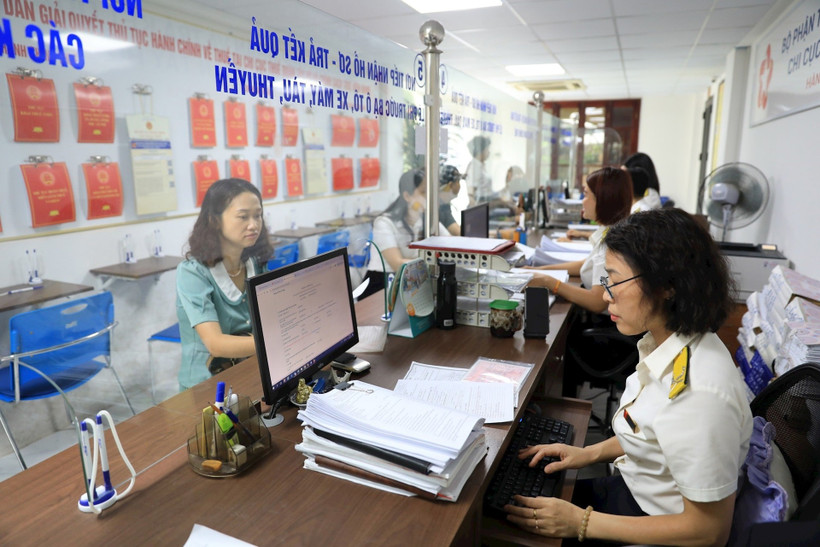
Civil servants and citizens at a taxation office in Hanoi. (Photo: VNA)

Hanoi (VNA) – Hanoi collected approximately 392.1 trillion VND (15.38 billion USD) in State budget revenue in the first six months of 2025, fulfilling 76.3% of the annual target, marking a 51.4% increase compared to the same period last year, according to the city’s Statistics Office.

The surge was largely driven by domestic revenue, which reached 373.9 trillion VND, meeting 77.5% of the yearly projection and rising 52.7% year-on-year.

Revenue from import and export activities contributed 16.4 trillion VND, equivalent to 60% of the target and up 36.2% from a year earlier. Meanwhile, earnings from crude oil amounted to 1.8 trillion VND, meeting 42.5% of the planned figure and equivalent to 89.4% of that recorded in the same period last year.

Hanoi saw strong contributions from the non-State business sector, which generated 77.3 trillion VND, representing a 44.2% increase from the same period in 2024. Meanwhile, foreign-invested enterprises contributed 18.7 trillion VND, a 13.7% increase, and State-owned firms made up 44.1 trillion VND, a slight year-on-year decrease of 0.8%.

Personal income tax revenue reached 33.7 trillion VND, up 26.2%, and land use fees soared to 72.5 trillion VND, nearly seven times higher than the same period in 2024. Revenue from fees and charges totalled 16.2 trillion VND, up 3.6%, with vehicle registration fees contributing 3.9 trillion VND.

On the expenditure side, local budget spending in the first half of the year was estimated at 69.5 trillion VND, achieving 37.9% of the year’s plan and representing a 56.2% year-on-year rise.

Development investment accounted for 30.5 trillion VND, while regular expenditures stood at 38.9 trillion VND, both showing similar growth rates of over 56%. Key spending areas included education and training, economic activities, state administrative operations, health care, social welfare, and environmental protection./.


VNA

See more

Deputy Governor of the State Bank of Vietnam Pham Thanh Ha speaks at a press conference on banking sector performance in 2025 and tasks for 2026, held in Hanoi on December 29. (Photo: VNA)

Credit growth nears 18% in 2025: central bank

At a press conference on banking sector performance in 2025 and tasks for 2026, held in Hanoi on December 29, SBV Deputy Governor Pham Thanh Ha said that as of December 24, 2025, total outstanding credit to the economy exceeded 18.4 quadrillion VND (about 670 billion USD), up 17.87% compared to the end of 2024.

Workers in the Du Long Industrial Park, Khanh Hoa province. (Photo: VNA)

Key economic policies taking effect in January 2026

A wide range of new economic policies and legal provisions will come into force in January 2026, covering taxation, advertising, land use, minimum wages, public finance, railways, technology transfer and statistics, among others.

From 4 billion USD in 2015, the size of the e-commerce market increases eightfold to reach 32 billion USD last year. (Photo: VNA)

Hanoi leads 2025 Vietnam eBusiness Index

​The average score of the rankings is 9.3 points. The gap in e-commerce development between the two major economic centres–Hanoi and HCM City–and the remaining provinces and cities is very large.

An aircraft of Vietnam Airlines - Illustrative image (Photo: VNA)

Vietnam Airlines adds 270 flights to during 2026 New Year holiday

Vietnam Airlines said the swift deployment of additional flights during the New Year holiday demonstrates the carrier’s proactive approach and readiness in mobilising resources to serve passengers during peak travel periods at the end of 2025 and the beginning of 2026.

Prime Minister Pham Minh Chinh (second from right) conducts an aerial inspection of the Ca Mau–Dat Mui expressway, the road leading to Hon Khoai, and the dual-use Hon Khoai port from a helicopter. (Photo: VNA)

PM urges faster progress on key infrastructure projects in Dat Mui, Ca Mau

During an aerial survey of Dat Mui commune, home to the five islands of Hon Khoai, Hon Sao, Hon Go, Hon Doi Moi and Hon Da Le, the Prime Minister underscored the area’s strategic importance for national defence, economic development and connectivity across the province, the Mekong Delta and the wider southern region.

Dao Ngoc Tien, Vice Rector of Foreign Trade University, speaks at the event. (Photo: doanhnghiepvn.vn)

High standards key for businesses to unlock VEFTA benefits

The EFTA bloc, comprising Switzerland, Norway, Iceland, and Liechtenstein, has a relatively small population but a combined GDP of about 1.3 trillion EUR (1.5 trillion USD), high living standards, and strong demand for high-quality products.

Workers make products for the Lunar New Year (Tet) in Hanoi's Bat Trang commune. (Photo: hanoimoi.vn)

Hanoi craft villages bustle as Lunar New Year approaches

Hanoi is home to the largest number of craft villages nationwide, with about 1,350 villages and craft-based communities, accounting for roughly 56% of rural villages in the capital. Of these, 318 are officially recognised as traditional craft villages.

Four seaports and four inland waterway ports are currently in operation within the Cai Mep Ha free trade zone. (Photo: VNA)

​ HCM City seeks new growth drivers as megacity takes shape

As traditional growth engines show signs of reaching their limits, HCM City is recalibrating its long-term development strategy in search of new drivers capable of sustaining momentum and reinforcing its role as the economic nucleus of the southern region.

Garment production for export at Hoa Tho Garment JS Corporation. (Photo: nhandan.vn)

Textile, garment industry secures role in global supply chain

By diversifying markets, products and customers, the sector has mitigated risks and responded proactively to market fluctuations, despite numerous challenges such as disrupted supply chains, rising shipping costs, and rapidly changing purchasing policies in many markets.