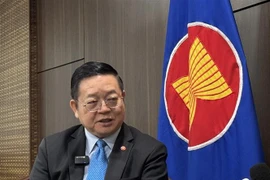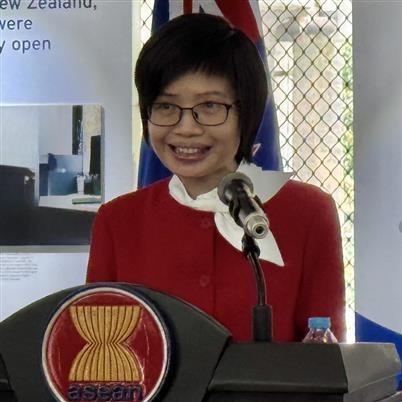
Jakarta (VNA) - Permanent Representative of Vietnam to ASEAN Ambassador Ton Thi Ngoc Huong has highlighted the significance of ASEAN 2025’s theme “Inclusivity and sustainability” in an interview granted to the Vietnam News Agency ahead of the 46th ASEAN Summit and related meetings to be held in Kuala Lumpur, Malaysia, from May 26-27.
Under the theme, Malaysia — ASEAN Chair in 2025 — has emphasised key priorities: upholding ASEAN’s centrality; strengthening the commitment to boost intra-bloc trade and investment; effectively leveraging advancements in science, technology, innovation, digital transformation, and emerging industries; and ensuring inclusiveness and sustainability in ASEAN community-building efforts, accelerating the narrowing of development gaps, improving living standards, and minimising the impacts of climate change.
The ambassador said amid rapidly evolving and unpredictable global political and economic dynamics, along with intensifying competition between powers that directly affects the region and ASEAN, the 46th ASEAN Summit, the bloc’s first high-level meeting in 2025, offers an opportunity for member states to reaffirm their commitment to strengthening solidarity, deepening cooperation, upholding ASEAN’s centrality, and enhancing its resilience.
The Summit is expected to adopt the “Kuala Lumpur Declaration on ASEAN 2045: Our Shared Future” and the “ASEAN Community Vision 2045”, reflecting the highest political commitment of ASEAN leaders to jointly build a strong, resilient, innovative, and dynamic ASEAN Community that is people-centred and future-ready.
ASEAN leaders are expected to reach consensus on key cooperation directions for 2025 and the new phase through 2045. They will also exchange views and reaffirm ASEAN’s common stance on emerging geopolitical and geo-economic issues.
On this occasion, ASEAN leaders will meet with the leaders of China and the Gulf Cooperation Council (GCC) member states to explore opportunities for promoting cooperation aimed at stability, development, and prosperity both regionally and globally, Huong said.
Challenges present opportunities
Regarding the opportunities and challenges of ASEAN’s new development roadmap and the atmosphere within ASEAN amid the evolving context, the ambassador highlighted the ASEAN Community Vision 2045 as a crucial document that sets a long-term cooperation direction for the next 20 years. It builds on previous vision documents, which typically covered only 10-year periods.
The idea to develop a post-2025 vision for ASEAN was conceived in 2020 during Vietnam’s ASEAN Chairmanship and officially launched in 2022. It is scheduled for completion in 2025, coinciding with the 10th anniversary of the establishment of the ASEAN Community.
According to Ambassador Huong, countries expect a stronger, more resilient, and more mature ASEAN after 10 years as a Community and 58 years since its founding.
They hope this community can help member states overcome challenges and uncertainties, seize opportunities arising from rapid advancements in science and technology, and accelerate their progress.
There is also an expectation that the 670 million people in the region will continue to live in peace and stability, enjoy prosperous and secure lives, and benefit from a green, clean, and sustainable environment. Additionally, ASEAN’s role, image, and standing in the region and the world are expected to become more proactive and dynamic.
The ambassador believed that ASEAN’s opportunities over the next 20 years lie in the global development trends of science-technology, and innovation.
She noted that ASEAN has the advantage of being one of the most dynamic economic regions in the world, with growing demand for cooperation both within the bloc and with countries inside and outside the region.
However, there are also inherent and emerging challenges: maintaining unity and solidarity within ASEAN while balancing diverse interests; addressing significant development gaps; managing pressures from great-power strategic competition; optimising opportunities from advances in science, technology, digital transformation, and green transition; as well as enhancing the capacity to respond to emerging issues.
ASEAN leaders are fully aware of both the opportunities and challenges facing the bloc, she said, citing Vietnamese Party General Secretary To Lam during the 30th anniversary celebration of Vietnam’s ASEAN membership on his official visit to the ASEAN Secretariat on March 9. He emphasised that difficulties and challenges are a driving force for innovation and development, and that it is precisely within these challenges that opportunities emerge for ASEAN to rise and assert a new standing. What matters is that member states’ commitment to ASEAN and the importance they place on the bloc remains consistent and continues to be reinforced, the diplomat said.
The roadmap for translating the goals of the ASEAN Community Vision 2045 into action is reflected in the strategic plans that drive cooperation across key pillars and sectors.
From vision to implementation, ASEAN countries will need to invest resources, demonstrate political will, and adopt a flexible, responsive approach to effectively deliver on the agreed objectives as scheduled, she suggested.
The growing appeal of ASEAN
According to Ambassador Huong, 55 countries both within and beyond the region have acceded to the ASEAN-initiated Treaty of Amity and Cooperation in Southeast Asia (TAC), demonstrating their respect for and commitment to the principles guiding inter-state relations in the region. Currently, 94 countries have appointed ambassadors to ASEAN, including 10 that have established dedicated permanent missions to ASEAN.
There is a steadily growing number of countries seeking to become dialogue partners, sectoral partners, or development partners of ASEAN, requesting summit-level meetings with the bloc, or expressing a desire to participate in ASEAN-led mechanisms and the TAC.
Moreover, when an issue emerges and threatens peace and stability in the region, ASEAN consistently takes proactive positions, and its voice is closely heeded by international partners, including major powers. Over time, the bloc has successfully developed a common set of principles and norms for regional conduct, taken the lead in initiating and chairing various dialogue and cooperation mechanisms, and built a vast network of relationships with partners – including all the five permanent members of the United Nations Security Council, many major global powers, and leading regional and international organisations.
Through these efforts, ASEAN has promoted a culture of dialogue, enhanced trust-building, prevented conflict, fostered economic linkages, and mobilised collaborative efforts to tackle common challenges. Its role and contributions to regional and global peace, stability, and cooperation have continued to be promoted, Huong said.
Vietnam’s active contributions to the “shared ASEAN home”
The ambassador noted that 2025 marks the 30th anniversary of Vietnam’s accession to ASEAN.
According to her, Party General Secretary To Lam once affirmed that the bloc is the foremost and most directly relevant multilateral cooperation mechanism for Vietnam. Standing at a new historical juncture, Vietnam and ASEAN are jointly advancing toward ambitious goals. In this next stage of the regional bloc’s development, Vietnam is more aware of its responsibility for actively participating in and contributing meaningfully to ASEAN’s collective work, helping unlock potential and address emerging challenges, while continuing to implement ASEAN’s historical mission and amplify its success stories.
The diplomat said a strong and cohesive ASEAN Community brings significant benefits to all member states. Therefore, each nation bears both responsibility and interest in contributing to the bloc’s growth and development.
She remarked that at this historic moment for both ASEAN and Vietnam, the above-said commitment articulated by General Secretary Lam will be concretely realised through Vietnam’s active and practical contributions to various mechanisms, forums, and cooperation frameworks of ASEAN and those between the bloc and its partners. This is all in service of building a stable, sustainable ASEAN home, which remains a place of prosperity and peace for its nearly 700 million citizens, including the people of Vietnam./.
VNA