India, ASEAN step up talks to upgrade trade in goods agreement

India and ASEAN signed AITIGA in 2009 to promote trade liberalisation and expand economic ties. However, changes in trade patterns, supply chains and the global economic environment have created a need to update the agreement to reflect current conditions.

New Delhi (VNA) – India and the Association of Southeast Asian Nations (ASEAN) will hold the next round of talks on reviewing the ASEAN-India Trade in Goods Agreement (AITIGA) in India in January 2027, as both sides seek to resolve outstanding issues and accelerate negotiations to modernise the trade pact.

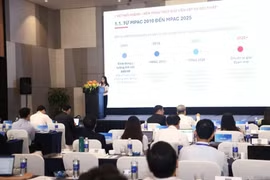
According to a statement released by India’s Ministry of Commerce and Industry on October 9, the decision followed the 15th meeting of the AITIGA Joint Committee, held at the ASEAN Secretariat in Jakarta, Indonesia, from October 6 to 9. The meeting reviewed progress in negotiations and discussed ways to advance the agreement’s review to better reflect changes in regional and global trade.

It was co-chaired by Nitin Kumar Yadav, Additional Secretary in India’s Department of Commerce under the Ministry of Commerce and Industry, and Mastura Ahmad Mustafa, Deputy Secretary-General (Trade) at Malaysia’s Ministry of Investment, Trade and Industry. Delegates from ASEAN member states, including Vietnam, attended the meeting.

Three of the eight sub-committees under the joint committee also held meetings in a hybrid format alongside the main session. They covered legal and institutional issues, national treatment and market access, and rules of origin. These areas are important to modernising the agreement, improving market access and facilitating trade between the two sides.

The joint committee directed all sub-committees to speed up work on outstanding chapters under the AITIGA review, set firm deadlines and strengthen coordination to ensure measurable progress.

India and ASEAN reaffirmed their commitment to resolving outstanding policy issues and developing a balanced, forward-looking agreement that benefits both sides and strengthens trade ties, according to the statement.

The next Joint Committee meeting, scheduled for January 2027 in India, will review the sub-committees’ progress and provide further guidance to help conclude negotiations in a timely manner.

India and ASEAN signed AITIGA in 2009 to promote trade liberalisation and expand economic ties. However, changes in trade patterns, supply chains and the global economic environment have created a need to update the agreement to reflect current conditions.

ASEAN is one of India’s major trading partners, accounting for around 11% of the country’s total international trade.

Upgrading AITIGA is expected to improve market access, address trade barriers and strengthen economic integration. It could also help diversify supply chains and unlock further cooperation between India and Southeast Asian economies./.

​

VNA

See more

Cambodia seeks to improve healthcare quality, support people

Cambodia seeks to improve healthcare quality, support people

Speaking at a ceremony on October 7 marking the 80th anniversary of the University of Health Sciences in Phnom Penh, PM Hun Manet said more than 2.25 million women had benefited from government cash support from pregnancy until their children turn two in the first half of 2026.

Bangkok named world's best city for 2026

Bangkok named world's best city for 2026

Bangkok scored 97.68 points, surpassing Paris of France with 97.14 points and Istanbul of Türkiye with 96.67 points, which ranked second and third, respectively, according to the magazine's latest poll.

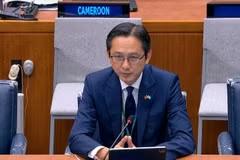
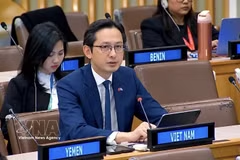
Ambassador Do Hung Viet, Permanent Representative of Vietnam to the UN, speaks at the general debate of the Third Committee of the 81st session of the UN General Assembly in New York on October 6, 2026. (Photo: VNA)

Vietnam, ASEAN highlight inclusive social development at UN

ASEAN will continue to work closely with the UN under the ASEAN–UN Plan of Action for 2026–2030, helping translate commitments to social development into concrete and sustainable outcomes and bring tangible improvements to people's lives, particularly those of vulnerable groups, Ambassador Do Hung Viet affirmed.

Indonesia expand carbon market incentives

Indonesia expand carbon market incentives

Coordinating Minister for Food Zulkifli Hasan outlined three primary sectors open to green investment, including sustainable agriculture through low-emission rice cultivation, waste-to-energy processing, and marine conservation through blue carbon development.

A shop in Jakarta, Indonesia (Photo: VNA)

Indonesia, Timor-Leste uphold new economic potential

Addressing the Bali–Timor-Leste Business Forum in Denpasar, Bali, last weekend, Bali Governor Wayan Koster said the two sides are well-placed to develop sectors where their respective strengths can complement each other.

Malaysia calls on ASEAN to jointly tackle haze

Malaysia calls on ASEAN to jointly tackle haze

Malaysian Minister of Natural Resources and Environmental Sustainability Arthur Joseph Kurup said on October 6 as host of the 28th Sub-Regional Ministerial Steering Committee (MSC) Meeting in 2027, Malaysia would use its chairmanship to translate the ASEAN Agreement on Transboundary Haze Pollution (AATHP) into concrete action by enhancing data sharing, improving law enforcement and cross-border cooperation.

Singapore proposes boosting the ASEAN power grid. (Illustrative photo: VNA)

Singapore outlines priorities for 2027 ASEAN Chairmanship

Singapore’s Minister for Sustainability and the Environment Grace Fu said at the recent launch of the Southeast Asia Climate Outlook Survey 2026 that ASEAN should focus on building up its regional power grid, boosting climate finance and increasing its resilience against climate change impacts.

Thailand, Laos push for single inspection plan at border

Thailand, Laos push for single inspection plan at border

Under the proposed model, customs authorities and other relevant agencies from Thailand and Laos, and potentially China, would coordinate inspections at a single location. Goods would undergo customs and other procedures only once instead of separate procedures by each side, significantly reducing the time and costs for businesses.