Singapore (VNA) – ASEAN should focus on building up its regional power grid, boosting climate finance and increasing its resilience against climate change impacts, said Singapore’s Minister for Sustainability and the Environment Grace Fu has said.
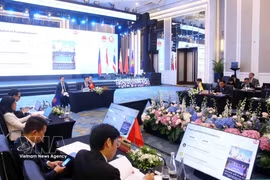
She said these will be areas in which Singapore seeks to promote practical cooperation during its 2027 ASEAN Chairmanship while speaking at the recent launch of the Southeast Asia Climate Outlook Survey 2026.
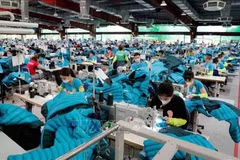
According to the Singaporean minister, volatility in global energy markets is directly affecting Southeast Asia, a region heavily dependent on imported energy. Rising fuel prices are increasing production costs, putting pressure on jobs and livelihoods, raising household electricity bills, and affecting transport, logistics and food supplies.
Against this backdrop, she said the energy crisis underscored the need to accelerate, rather than delay, the transition to renewable energy.
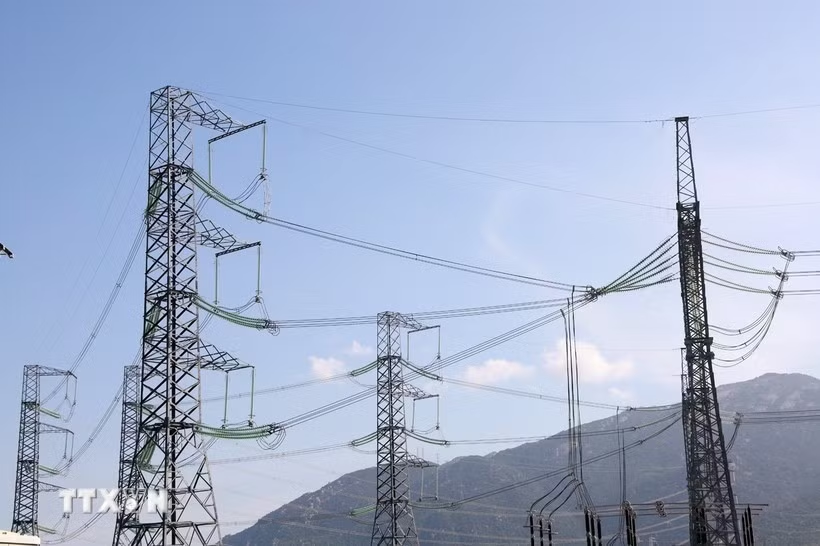
One key priority is the development of the ASEAN Power Grid (APG), which will enable ASEAN countries to make better use of the region's abundant energy resources and reduce dependence on any single source of supply.
Fu cited the Laos-Thailand-Malaysia-Singapore Power Integration Project as an example demonstrating the feasibility of multilateral cross-border electricity trading within ASEAN. The next steps should include clearer rules for cross-border electricity trade and practical standards for subsea power cables, she said.
The second priority is climate finance. Singapore is developing new financial instruments to mobilise capital for green projects in the region, including the Financing Asia's Transition Partnership (FAST-P) blended finance initiative and carbon markets.
FAST-P has so far mobilised about 1.14 billion USD for green energy projects in the region, including battery storage, solar power and grid upgrades, helping facilitate the gradual replacement of coal-fired power with cleaner energy sources.
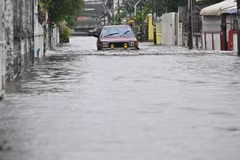
The third priority is strengthening climate resilience through investment in infrastructure and solutions to protect economies, communities and long-term development from increasingly extreme weather events, Fu said.
The survey, conducted by the ISEAS-Yusof Ishak Institute and the Lee Kuan Yew Centre for Innovative Cities at the Singapore University of Technology and Design, attracted 3,706 respondents from all 11 ASEAN countries, including Timor-Leste for the first time.
The survey found that 55.3% of respondents considered unemployment and economic recession major concerns, while 53.6% were concerned about climate change and extreme weather events. In Vietnam and the Philippines, climate change ranked as the top concern, reflecting frequent exposure to storms, floods and other natural disasters. Meanwhile, respondents in Singapore and Brunei were particularly concerned about extreme heat.
The survey also showed that the energy transition continues to face significant challenges. About 44.6% of respondents were concerned about rising energy prices and living costs, while 26.1% worried about energy shortages, up from 20.3% in the 2024 survey./.