Khanh Hoa grows smart farming to modernise agriculture

To create breakthroughs in agriculture, Khanh Hoa will continue to develop signature crops and livestock, including grapes, aloe vera, green asparagus, onions, garlic, goats, sheep, bird’s nests, mangoes, purple sugarcane, durians, and high-quality rice varieties. The province is also encouraging businesses, cooperatives, and organisations to invest in building closed agricultural value chains, applying digital technology to increase the added value of local farm products.

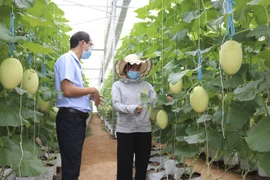
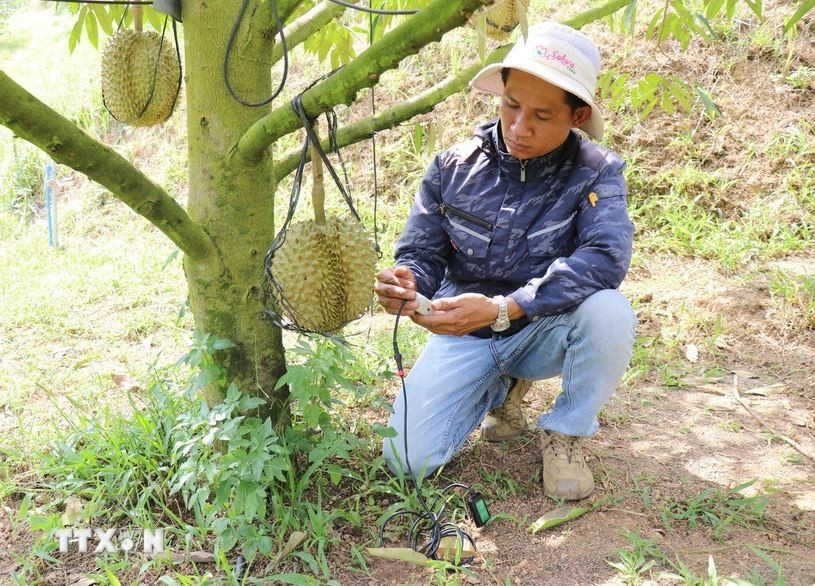
A technician at Sakura Farm (Dong Khanh Son commune, Khanh Hoa province) uses equipment to test, analyse, and diagnose the “health” of durian-growing soil, providing accurate indicators and timely treatment recommendations. (Photo: VNA)

Khanh Hoa (VNA) – The south-central province of Khanh Hoa is stepping up efforts to modernise agriculture through science, technology, and digital transformation, in line with the Politburo's Resolution No. 57 on breakthroughs in science, technology, innovation, and national digital transformation.

The province has recognised the use of advanced technology and intelligent solutions as a crucial factor in enhancing productivity, improving product quality, and developing a modern agricultural ecosystem.

Sustainable farming practices on the rise

Many local cooperatives and farms are adopting circular economic models and advanced cultivation standards such as VietGAP and organic farming. At Sakura Farm in Dong Khanh Son commune, high-tech durian cultivation spans 45 ha, with Musang King and Ri6 varieties already in harvest. The farm stands out for its comprehensive use of automated irrigation, fertilisation, and AI-powered soil analysis, complemented by drone monitoring for crop management.

Farm owner Nguyen Pham Minh Man said these applications have strengthened sustainability, ensuring ecological balance while producing high-quality, chemical-free durians.

Research and technology transfer are also expanding. The Nha Ho Research Institute for Cotton and Agriculture Development has pioneered biotechnology and genetic techniques to develop high-yield, climate-adapted varieties of grapes, apples, asparagus, aloe vera, rice, mangoes, longans, and jackfruit. By 2030, the institute plans to prioritise pest- and climate-resilient crops, microbial and nano-technology for soil improvement, IoT-based cultivation systems, and AI-powered pest management.
2-1.jpg
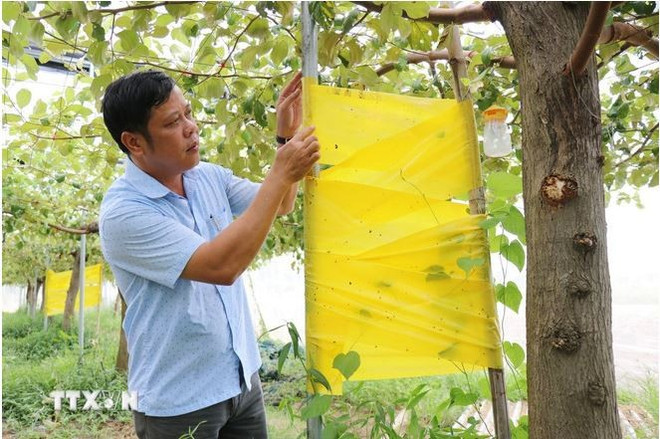
Dr. Phan Cong Kien, Deputy Director of the Nha Ho Research Institute for Cotton and Agriculture Development inspects a net-house apple cultivation model equipped with a biological trapping system to eliminate insects. (Photo: VNA)

Towards high-tech agriculture

According to the provincial Department of Agriculture and Environment, Khanh Hoa now has over 1,003 ha under high-tech farming and more than 5,599 ha certified under USDA-NOP (US), JAS (Japan), and EU organic standards. The province has issued 163 planting area codes covering over 5,171 ha, along with three packaging facility codes for mango and durian exports to the EU and China.

Key crops such as durian, mango, pomelo, asparagus, and aloe vera have penetrated export markets, while grapes and apples have a high profit margin. High-tech grape cultivation can generate 600 million VND per hectare per crop, with two crops annually.

To create breakthroughs in agriculture, Khanh Hoa will continue to develop signature crops and livestock, including grapes, aloe vera, green asparagus, onions, garlic, goats, sheep, bird’s nests, mangoes, purple sugarcane, durians, and high-quality rice varieties. The province is also encouraging businesses, cooperatives, and organisations to invest in building closed agricultural value chains, applying digital technology to increase the added value of local farm products.

The province is conducting reviews and planning production zones scientifically, based on natural conditions and local potential. It focuses on fruit-growing areas, essential oil crops, high-tech farming, and agro-ecotourism models. Efforts are being made to standardise production processes, improve seed quality, build agricultural brands, and apply digital technology in market monitoring and product consumption.

Khanh Hoa will mobilise resources from programmes and projects to invest in research on crop and livestock varieties, transfer farming and processing technologies to diversify products, develop digital human resources, and foster partnerships among businesses, scientists, and farmers within sustainable production chains. The implementation of Resolution 57 is expected not only to renew the province’s growth model but also to modernise agriculture, improve livelihoods, and promote rural economic development in the new period./.

VNA

See more

Phin Ho Tra – a national five-star OCOP product. (Illustrative photo: VNA)

Hanoi to host Vietnam OCOP Festival 2025

The festival is seen a practical activity celebrating the achievements made by the capital and the country in 2025, affirming OCOP’s role in rural economic development, contributing to realising Vietnam’s aspiration for strong economic growth in the context of deep integration.

The expanded Hoa Binh Hydropower Plant (Photo baochinhphu.vn)

EVN launches major power projects

Among the flagship projects inaugurated was the expanded Hoa Binh Hydropower Plant with a total installed capacity of 480MW per year and average annual output of about 488 million kWh.

An ultra-intensive shrimp farming model linked with environmental protection in Ca Mau province. (Photo: VNA)

Fisheries take the lead in the Mekong Delta’s green transition

Across the Mekong Delta, leading aquaculture producers, processors and exporters, along with suppliers of inputs, are transitioning to circular, high-tech and clean production models that cut greenhouse gas emissions and comply with international certification standards.

A perspective view of the Red River Landscape Boulevard project in Hanoi (Photo: VNA)

Works starts on Hanoi’s Red River Landscape Boulevard Axis project

The project is among the 234 key works and projects being launched, inaugurated or technically opened simultaneously across 34 cities and provinces nationwide to mark the 14th National Party Congress. Its launch contributes to implementing the country’s strategic development orientations while concretising Hanoi’s development goals in the new period.

The ground-breaking ceremony of the Yen Bai 1 biomass power plant in Lao Cai province on December 19. (Photo: VNA)

Work starts on 114-million-USD biomass power plant in Lao Cai

The project, developed by Erex Yen Bai Biomass Power Co. Ltd. is located in Dong Cuong commune, Lao Cai province. It is backed by Japan’s Erex Group and falls under the Joint Crediting Mechanism, a bilateral initiative between Vietnam and Japan to reduce greenhouse gas emissions.

At the inauguration ceremony (Photo: VNA)

Vietnam Railways Corporation unveils upgraded coaches, digital tools

These moves reflect the VNR's commitment to fulfilling six priority tasks set by the Prime Minister, including leading in innovation and digital transformation, applying sci-tech in line with the Politburo’s Resolution No. 57-NQ/TW, and spearheading advances in digital, green and circular economy.

Producing MDF panels for export at Hai Duong MDF Construction and Manufacturing Co., Ltd., in Ho Chi Minh City (Photo: VNA)

HCM City targets 15 billion USD in wood exports by 2035

The merger of HCM City with Binh Duong and Ba Ria – Vung Tau is expected to give the local wood industry a strong boost into a phase of high-quality growth driven by linkages, innovation, sustainability, and deeper integration into global value chains.

Delegates cut a ribbon to inaugurate the expanded Terminal T2 at Noi Bai International Airport in Hanoi on December 19, 2025. (Photo: VNA)

Expanded Terminal T2 at Noi Bai International Airport makes debut

The project expands the terminal’s floor area to over 200,000 sq.m, increases passenger capacity from 10 million to 15 million, even up to 18 million per year, and boosts operational capacity with boarding gates rising from 17 to 30 and jet bridges from 14 to 27, meeting strong growth in international travel demand.

A section of Can Tho - Ca Mau Expressway (Photo: VNA)

Can Tho – Ca Mau travel time halves from December 19

Stretching more than 110 km with a total investment of over 27.5 trillion VND (1.04 billion USD), the project not only resolves long-standing traffic bottlenecks in the Mekong Delta, but also opens up new development opportunities for the entire region - especially Ca Mau, the last locality in the country to be directly connected to the eastern North–South expressway axis.