Malaysia moves to protect farmland from industrial expansion

Indonesia has already set aside about 25,000 hectares through the Permanent Food Production Zones programme, which will help protect land from encroachment by industries.

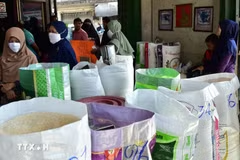
Hanoi (VNA) – Malaysia is working with state governments to safeguard agricultural land from the rapid expansion of industrial projects, real estate developments, data centres and semiconductor manufacturing, as concerns over food security grow.

The country has already set aside about 25,000 hectares through the Permanent Food Production Zones programme, which will help protect land from encroachment by industries, according to Indonesian Deputy Agriculture and Food Security Minister Datuk Chan Foong Hin. That’s nearly 5% of Malaysia’s farmland, excluding palm oil and rubber plantations.

Chan said Malaysia must preserve a minimum proportion of farmland and strengthen protection for existing food production areas. The Ministry of Agriculture and Food Security also plans to propose expanding the protected agricultural land.

The move comes as Malaysia has attracted billions of USD in data centre investments in recent years. According to HSBC Holdings, investment in the sector is equivalent to nearly 18% of the country’s gross domestic product (GDP).

Malaysia has also emerged as a major manufacturing hub for artificial intelligence (AI) hardware and is among the world’s four largest net exporters. Rapid industrial growth has prompted some palm oil companies to convert parts of their land for data centres and solar farms.

There is growing competition between industry and agricultural activities, Chan said, adding that the governments of some localities see data centres as more profitable or more advanced than agriculture.

Land use is administered by local authorities and the federal government plans to align policies across states to strengthen food security, while remaining attractive to industry, Chan said.

Urbanisation is adding to the pressure on agricultural production. The sector’s share of Malaysia’s economy and employment has steadily declined over the past two decades, World Bank data shows, sparking concerns about food security. Frequent global supply chain disruptions and climate change impacts have only heightened those worries./.
VNA

See more

Thai rice exports decline nearly 19% in first half of 2026

Thai rice exports decline nearly 19% in first half of 2026

DFT Director-General Arada Fuangthong attributed the decline to abundant global rice supplies, which have intensified price competition. In addition, conflicts in the Middle East disrupted Thai rice exports to Iraq – one of its key markets – from March.

Buildings in Kuala Lumpur, Malaysia (Illustrative photo: AFP/VNA)

Malaysia businesses thrive on AI boom

Nineteen Malaysian companies enter Forbes Asia’s 2026 list of the 200 best companies with annual revenues of less than 1 billion USD, more than double the number from the previous year.

An electric vehicle on display at an auto exhibition in Kuala Lumpur, Malaysia, in June 2026. (Photo: VNA)

Malaysia considers levy on EV sales to fund public charging infrastructure

Speaking during a question-and-answer session in the Senate on August 5, Minister of Investment, Trade and Industry Johari Abdul Ghani said the proposal followed the government's loss of 3.3 billion MYR (825 million USD) in tax revenue through incentives for imported EVs, while investment in public charging infrastructure had fallen short of expectations.

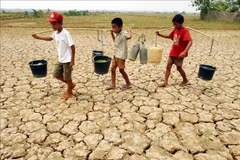
Drought-hit farmland in Cibarusa, Bekasi, Indonesia. (Photo: AFP/VNA)

Indonesia takes drastic measures to respond to strong El Niño

Under its response plan for agriculture and forestry, Indonesia is stepping up forest and peatland fire prevention and firefighting, deploying weather modification technology, improving irrigation systems, putting boreholes into operation, distributing drought-resistant crop varieties, and expanding agricultural insurance. These measures aim to mitigate the impact of drought on rice, palm oil and coffee production.

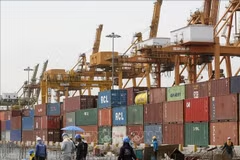
Goods are loaded at a port in Bangkok, Thailand. (Photo: AFP/VNA)

Thailand's exports to US, Europe surge in fiscal 2026

Data from the Thailand Customs Department show that the country's total international trade reached approximately 21.4 trillion THB (660 billion USD) during the period, approaching the 22 trillion THB recorded for the whole of the previous fiscal year.

Malaysia, Thailand step up efforts to restore seafood trade

Malaysia, Thailand step up efforts to restore seafood trade

The inspections focus on biosecurity measures at farms, production systems, and related documentation, including laboratory analyses of chemical residues and the use of prohibited substances. Authorities are also assessing farms, hatcheries, laboratories and border inspection facilities in both countries.

Indonesia steps up response to forest fires

Indonesia steps up response to forest fires

Indonesia's National Disaster Mitigation Agency (BNPB) is preparing to deploy two water-bombing helicopters to accelerate firefighting efforts in the Mount Bromo area. Ground crews are continuing to battle the flames, although many fire hotspots remain in steep, hard-to-reach locations.

ASEAN urged to place children at centre of policymaking

ASEAN urged to place children at centre of policymaking

Citing data from the United Nations Children’s Fund (UNICEF), she said the Asia-Pacific is home to around 1.12 billion children, the largest in the world. ASEAN alone records around 200 million people aged below 18, or nearly 30% of its population.

A corner of Bangkok, Thailand (Illustrative photo: VNA)

Thailand steps up business cooperation with Indonesia

Thailand and Indonesia should connect the “mainland and archipelago” by using Thailand as a manufacturing hub and Indonesia as a large market and maritime economic gateway, said Thai Prime Minister Anutin Charnvirakul.

Thai Prime Minister Anutin Charnvirakul delivers the policy speech at the ASEAN Secretariat in Jakarta on August 4. (Photo: VNA)

Thai PM outlines three priorities for ASEAN’s future

To strengthen resilience, ASEAN should deepen integration, build reliable supply chains, bolster energy security, advance digital connectivity and enhance technological capacity, said Thai Prime Minister Anutin Charnvirakul.