Milestones in organ donation, transplants mark Vietnam’s steady progress

Vietnam’s organ donation and transplantation sector is entering a new phase of development, underscored by rising public awareness, stronger institutional coordination, and notable medical achievements.

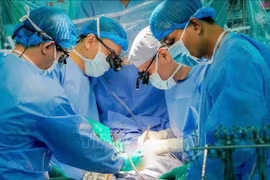
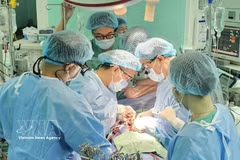
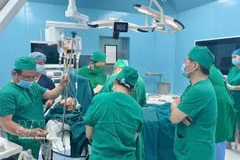
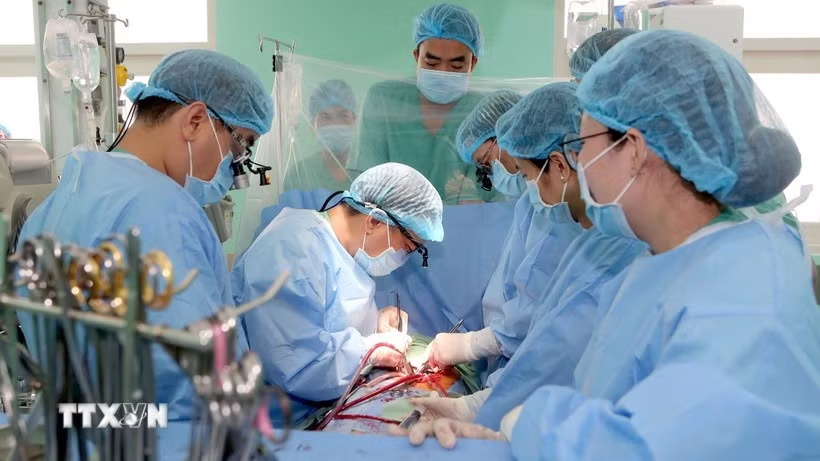
A medical team from the Hue Central Hospital performs a heart transplant for a patient. (Photo: VNA)

Hanoi (VNA) – Vietnam’s organ donation and transplantation sector is entering a new phase of development, underscored by rising public awareness, stronger institutional coordination, and notable medical achievements.

According to Associate Professor Dong Van He, Director of the Vietnam National Coordinating Centre for Human Organ Transplantation, 2025 marked an historic turning point, with 66 cases of organ donation recorded nationwide – the highest figure to date.

Encouragingly, in the early months of 2026, nearly 10 additional cases of tissue and organ donation have been reported, signalling continued momentum across the national network.

26-year-old woman’s final gift of light

On March 6, in Hai Tien commune, Ninh Binh province, 26-year-old Pham Thi Huong passed away after a prolonged battle with end-stage cancer. At the prime of her youth, she chose to conclude her life journey with a profound act of generosity: donating her corneas to restore sight to others.

Upon receiving notification from her family, a retrieval team from the Tissue Bank at Hanoi Eye Hospital 2 immediately set out. They worked within the critical six- to eight-hour window required for cornea recovery.

Phan Duc Tam, a staff member of the Tissue Bank who had personally assisted Huong in registering as a donor during her lifetime, recalled her remarkable resilience. Even in the most painful stages of her illness, she remained optimistic and directly contacted the Tissue Bank to express her wish to donate.

Her motivation, though simple, carried strong resonance: “Giving is also a way of receiving. I give light to someone. When others know, they may follow. Perhaps, in some way, that light will return to my parents and to those around me.”

Despite their immense grief, Huong’s family honoured her final wish, supporting the medical team in carrying out the donation. The case marked the first cornea donation in Hai Tien commune following recent administrative restructuring, representing a meaningful shift in local perceptions of organ donation.

Huong’s passing is not an end, but a continuation - her corneas will soon bring light to patients who have long waited in darkness.
donation2.png
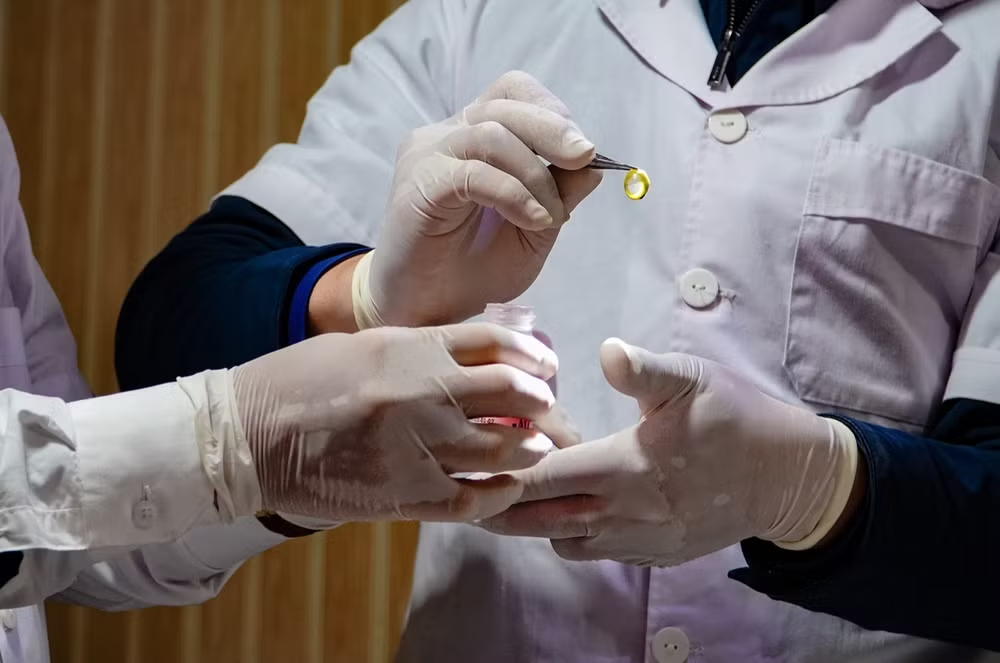
Medical personnel retrieve the corneas of Pham Thi Huong for transplantation to patients who have long awaited a chance to regain their sight. (Photo: VietnamPlus)

More than 30 hospitals have successfully provided counselling for tissue and organ donation cases.

Associate Professor Duong Duc Hung, Director of Viet Duc University Hospital, noted that since the beginning of 2026, the hospital has successfully mobilised five cases of organ donation.

In 2025 alone, the hospital performed 284 transplant procedures, nearly half of which involved organs from brain-dead donors. These included complex interventions such as pediatric and geriatric heart transplants, simultaneous liver-kidney transplants completed within six hours, and combined heart-liver transplants.

At the national level, the 66 organ donations recorded in 2025 accounted for more than 25% of all such donations over the past 15 years. From 2010 to 2025, Vietnam documented a total of 262 cases, highlighting the steady upward trajectory of the system.

The country’s transplant achievements have also reached new technical heights, including performing two lung transplants in a single day and conducting combined heart-lung transplantation on a single patient.

Currently, 109 hospitals nationwide participate in the organ donation and transplantation network. To date, more than 30 hospitals have successfully counselled families on organ and tissue donation. Intensive care teams are becoming increasingly proactive, while diagnostic and coordination procedures have been standardised and systematised. These developments point to long-term, structural progress rather than short-term campaigns.

Notably, amendments to the Law on Donation, Removal and Transplantation of Human Tissues and Organs are expected to bring Vietnam closer to international practices, and ensure greater equity and humanity in implementation.

Since the country’s first transplant in 1992, Vietnam has performed more than 9,500 organ transplants. Over 102,000 individuals have registered as donors nationwide, with participation rising rapidly in recent years. However, organ donations remain limited, even as demand continues to grow. While Vietnam records the highest number of transplants annually in Southeast Asia, exceeding 1,000 procedures per year, its rate of post-mortem donation remains among the lowest globally./.
VNA

See more

Da Nang will roll out a citywide health screening and periodic health check-up programme for all residents on July 1. (Illustrative photo: VNA)

Da Nang to launch citywide health screening programme on July 1

Director of the municipal Department of Health Tran Thanh Thuy said the city has developed a comprehensive plan for conducting free periodic health examinations and screening services throughout 2026, and prepared the necessary human resources, facilities and digital infrastructure to ensure effective implementation.

Students play football during a break atthe Hai Xuan Secondary School in Ninh Binh province . (Photo: VNA)

Vietnam targets annual health screening for all students by 2030

By 2030, all educational institutions are expected to have separate medical rooms equipped with essential medicines and healthcare equipment, adequate access to safe drinking water and sanitation facilities, and school meal services that comply with food safety regulations.

Staff from the Ho Chi Minh City First Aid Centre demonstrate first aid skills. (Photo: VNA)

Vietnam, France cooperate to build community first-aid network

The agreement focuses on establishing hundreds of first-aid stations across Long Chau’s pharmacy and vaccination network, standardising first-aid training for medical and pharmaceutical students, and expanding community health education activities nationwide.

In Hanoi, the temperature recorded in Lang Ha at 1 pm on May 26 reached 40 degrees Celsius. (Photo: VNA)

Proactive response needed to cope with extreme weather: Experts

Health experts warned that prolonged heat exposure could cause heatstroke, heat exhaustion and other serious health conditions. High-risk groups include the elderly, children, pregnant women, people working or exercising outdoors for long periods, and those suffering from chronic illnesses such as hypertension, chronic obstructive pulmonary disease, asthma and diabetes.

Ho Chi Minh City plans over 95 million USD for universal health screenings in 2026. (Illustrative photo: VNA)

Ho Chi Minh City earmarks over 95 million USD for universal health screenings in 2026

Ho Chi Minh City's free health examination programme, set to begin on May 25, is carried out at qualified healthcare facilities, mobile clinics at schools, factories and businesses, community-based screening sites arranged by local authorities, as well as through home visits to elderly residents, people living alone and those with limited mobility.

Healthcare workers are employed in an isolation and treatment area for patients infected with the Ebola virus in Entebbe, Uganda. (Photo: Xinhua/VNA)

Health Ministry calls for stronger preparedness against Ebola

Medical facilities were instructed to strengthen surveillance, especially for individuals who have travelled to or returned from outbreak-hit countries or areas within the previous 21 days. They were also asked to strictly enforce infection control measures, including protective procedures, screening, triage and isolation protocols for suspected or confirmed Ebola cases.

Party General Secretary and State President To Lam speaks at a working session Party Committee of the Ministry of Health on Vietnamese traditional medicine in Hanoi on May 20 (Photo: VNA)

Top leader calls for historic transformation of traditional medicine

Highlighting strategic orientations for the sector, Party General Secretary and State President To Lam requested that traditional medicine be incorporated into the country’s overall development strategy in the new era. He called for the building of a national traditional medicine ecosystem linked to the development of the health economy and national soft power.

Deputy Prime Minister Pham Thi Thanh Tra speaks at the programme “Organ and Tissue Donation Day May 20 – Giving is Forever”. (Photo: VNA)

Deputy PM calls for stronger organ donation movement to save more lives

Vietnam has gradually mastered some of the world’s most complex transplant techniques since the country’s first successful kidney transplant in 1992. As of 2025, Vietnam had conducted 10,878 organ transplants, with 34 licensed hospitals now capable of performing transplant procedures.

The meeting between the delegation from Military Hospital 175 and Mayor of Leipzig Burkhard Jung at Leipzig City Hall (Photo: VNA)

Healthcare cooperation shines in Vietnam – Germany ties

The partnership between Military Hospital 175 and medical institutions in Leipzig has been recognised as a highlight of Vietnam – Germany healthcare cooperation, as well as of the sister-city relationship between Ho Chi Minh City and Leipzig.

Dr Truong Thanh Tinh, head of the Department of Neurosurgery under the University Medical Centre Ho Chi Minh City, gives a post-surgery check-up on the 12-year-old patient. (Photo: VNA)

Vietnam performs first awake brain surgery on child patient

The hospital announced on May 19 that the patient, a 12-year-old boy, recovered well after surgery, remained fully conscious and showed no new focal neurological deficits. Post-operative imaging indicated that the tumour had been almost completely removed. Doctors are continuing close monitoring and preparing further treatment plans to support the child’s full recovery.

Ho Chi Minh City steps up surveillance to prevent Ebola risk

Ho Chi Minh City steps up surveillance to prevent Ebola risk

Under the directive, the Ho Chi Minh City Centre for Disease Control has been instructed to tighten surveillance at border gates by monitoring incoming travellers for unusual health symptoms, carefully reviewing epidemiological factors, travel histories and accommodation records, and coordinating closely with aviation, maritime and international health quarantine authorities to promptly detect suspected cases.