Party chief’s gold market directive timely, well-grounded: Lawmakers

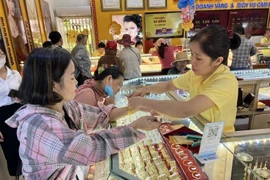
Legislators said adjustments to the gold bullion market policy should be implemented years ago, rather than delayed until now, in order to narrow the gap between domestic and global gold prices and to better control gold bullion smuggling across borders, which remains challenging.

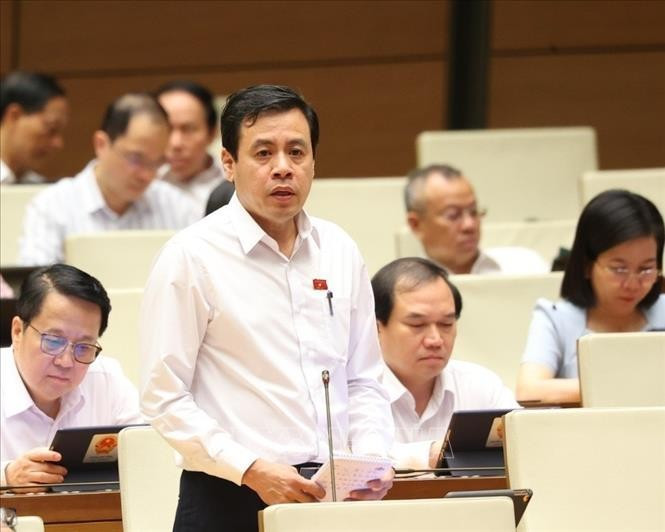
NA deputy Tran Anh Tuan of HCM City says that shifting to a market-based management approach, allowing qualified enterprises to join the production, trading, and distribution of gold as a regular commodity, would help narrow the price gap. (Photo: VNA)

Hanoi (VNA) - Lawmakers have expressed their support for Party General Secretary To Lam's directive on gold market management, agreeing that ending the State's monopoly on gold bullion will help address price disparities between gold brands.

At a May 28 working session with the Party Central Committee's Commission for Policies and Strategies, the Party chief requested that the State's monopoly on gold bullion branding should be dismantled in a controlled way, with the principle that the government retains oversight of bullion production. However, licences can be granted to qualified enterprises to participate in gold bar manufacturing, thereby fostering a level playing field, diversifying supply sources, and contributing to price stability in the market.

The General Secretary pointed to the need to focus on researching and proposing a set of suitable, phased solutions for early implementation. These may include learning from international experiences to recommend the establishment of a national gold exchange, permitting gold trading on the commodities exchange, or setting up a dedicated gold trading platform within Vietnam’s planned international financial centre, among other options.

On the sidelines of the 9th session of the 15th National Assembly on May 29 morning, legislators said adjustments to the gold bullion market policy should be implemented years ago, rather than delayed until now, in order to narrow the gap between domestic and global gold prices and to better control gold bullion smuggling across borders, which remains challenging.

Tran Anh Tuan from Ho Chi Minh City said shifting to a market-based management approach, allowing qualified enterprises to join the production, trading, and distribution of gold as a regular commodity, would help narrow the price gap.

It is necessary to open the door wider for capable enterprises, he stressed, noting that as supply increases, the market will have more options, domestic prices will gradually align with global prices, thereby helping to stabilise the market and curb cross-border gold smuggling.

In addition, barriers to domestic gold bar production should be gradually removed, and the mechanism should be expanded to allow all qualified businesses to join under the State control through common regulations and a tightly monitoring technological system, he added.

Sharing Tuan’s opinions, Trinh Xuan An from Dong Nai province affirmed that the Party leader’s directives on gold market management is essential and well-founded in both realities and legal frameworks.

The revision of Decree No. 24/2012/ND-CP on management of gold trading activities, which becomes outdated and no longer aligns with current market conditions, must be thoroughly and prudently studied, he said, noting that enterprises with proven capacity should be permitted to import, exploit, process, and trade gold bullion.

Allowing the gold market to operate underground and lack transparency may lead to financial risks and threats to economic security, he went on.

According to An, the management work should be based on supply–demand principles, without specific interventions such as determining who is allowed to buy or sell gold. Assigning credit institutions to sell gold runs counter to market economy principles.

An also agreed with the solution proposed by the Party chief regarding the establishment of a national gold exchange, however, he noted that such an exchange must be professionally and transparently managed—not an impromptu trading floor as in the past, nor a hub for virtual gold speculation.

All products introduced to the market must have clear origins to prevent the exchange from becoming a tool for money laundering or a haven for illicit activities, he went on./.

VNA
See more

Visitors shop at Glorious Spring Fair 2026 (Photo: VNA)

Spring Fair 2026 opens broader prospects for Vietnam–UAE trade cooperation

For Vietnam, the UAE serves not only as a consumer market but also as a gateway to the Middle East and North Africa. Vietnamese agricultural products such as cashew nuts, pepper, cinnamon and rice have steadily gained market share, while aquatic products, including tra fish and tuna, are increasingly present in the UAE’s hospitality sector.

Bao Viet Bank's employee counts Vietnamese banknotes at a transaction counter in Hanoi. (Photo: VNA)

Credit quota reform, tighter capital rules may widen gap among banks

Yuanta Vietnam Securities estimates that to achieve GDP growth above 10%, credit growth would need to exceed 16%. This suggests bank credit is no longer expected to be the main growth driver, with greater reliance on fiscal policy, public investment and capital markets.

Commercial Counsellor Do Viet Phuong, Head of the Vietnam Trade Office in Cambodia. (Photo: VNA)

Spring Fair 2026 offers ample room to deepen Vietnam–Cambodia trade ties

Cambodia holds substantial potential for cooperation in agro-processing and exports, especially in key products such as rice, cashew nuts and rubber. In recent years, the country’s cultivation area and agricultural output have grown steadily, providing a stable raw material base for processing industries.

Vietnam is projected to have approximately 2.4 million SMEs, accounting for over 98% of the country’s total enterprises. (Photo: cafef.vn)

Banks offer diverse solutions to support SMEs

With an increasingly significant role in the economy, the small and medium-sized enterprise (SME) sector is becoming a key segment in the credit growth strategies of many banks and the banks have been taking diverse solutions to support the enterprises.

Workers process coconuts for export at Vina T&T Group. (Photo: nhandan.vn)

Agricultural exports reliant on securing raw material supply

According to Secretary General of the Vietnam Pepper and Spice Association Le Viet Anh, pepper remained Vietnam’s leading spice export in 2025, with shipments exceeding 247,000 tonnes, accounting for 59.3% of total spice export volume. Export revenue reached 1.66 billion USD, out of total spice exports of 2.1 billion USD.

Prime Minister Pham Minh Chinh speaks at the meeting between standing Government members and representatives of ministries, agencies and Phu Tho province (Photo: VNA)

PM orders new Lo river bridge to meet emerging development needs

Stressing both immediate and long-term imperatives, Prime Minister Pham Minh Chinh directed that authorities pursue a dual-track approach: repairing the existing bridge to ensure safety while simultaneously investing in a new structure capable of opening up new socio-economic development space and safeguarding national defence and security.

Online event promotes Vietnamese products in Canada (Photo: VNA)

Online programme promotes Vietnamese products in Canada

Vietnam’s exports to Canada have doubled over the past five years to more than 13 billion USD, reflecting strong cooperation potential, especially as the Comprehensive and Progressive Agreement for Trans-Pacific Partnership (CPTPP) continues to take effect.

Vehicles transporting import and export goods at Mong Cai international border gate. (Photo: VNA)

Mong Cai smart border gate to open new era for cross-border trade

The smart border gate will be based on Industry 4.0 technologies, with cross-border data connectivity serving as its core. Beyond modernising a single customs checkpoint, the project aims to create a regional-scale “digital gateway” facilitating more efficient trade flows.

Vietnam’s Trade Counsellor in Italy Duong Phuong Thao. (Photo: VNA)

Spring Fair 2026: Trade fairs boost Vietnam–Italy trade connectivity

Vietnam’s Trade Counsellor in Italy Duong Phuong Thao said the bilateral relations are developing positively, providing a solid foundation for economic and trade ties. The Italian Government, financial institutions and business community regard Vietnam as a key market in Southeast Asia.