Politburo, Secretariat issue conclusion on political, two-tier local government system

The Politburo and Secretariat urged strict adherence to the Politburo’s personnel regulations, stronger accountability from leaders, and effective evaluation and deployment of officials. The grassroots level was directed to shift from a passive to a proactive and enabling governance model, enhancing socio-economic management and responding promptly to public and business needs.

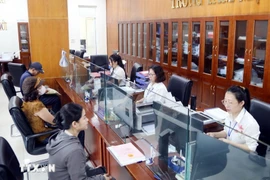
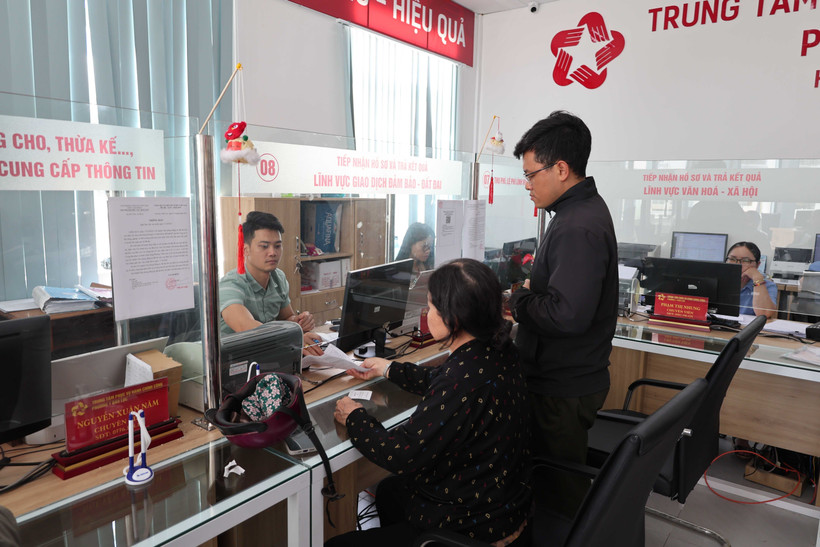
Processing administrative requests at Bao Loc ward's Public Service Centre, Lam Dong province (Photo: VNA)

Hanoi (VNA) - The Party Central Committee's Politburo and Secretariat have urged efforts to further refine and enhance the efficiency of the political system and the two-tier local government model, according to Conclusion No. 202-KL/TW signed by Politburo member and Permanent Member of the Secretariat Tran Cam Tu on October 31.

The conclusion came following the report of the Party Central Committee’s Organisation Commission on the performance of the political and two-tier local government system.

The Politburo and Secretariat agreed with the key contents and recommendations in the report, acknowledging the proactive and effective performance of all-level Party committees and organisations, the Government and National Assembly Party Committees, and the Party Central Committee’s Organisation Commission in addressing challenges and ensuring smooth operation of the political system and the two-tier local administration model.

The Politburo and Secretariat requested Party Committees at all levels and relevant central agencies to promptly implement assigned tasks under previous conclusions, especially Conclusion No. 195-KL/TW dated September 26, 2025 on the two-tier administrative model.

They urged strict adherence to the Politburo’s personnel regulations, stronger accountability from leaders, and effective evaluation and deployment of officials. The grassroots level was directed to shift from a passive to a proactive and enabling governance model, enhancing socio-economic management and responding promptly to public and business needs.

The Government and National Assembly Party Committees were assigned to refine institutional frameworks related to decentralisation, delegation of power, and administrative procedures, particularly in finance, planning, land, and public assets.

Matters under the Government and the Prime Minister’s authority should be addressed immediately, while those under the National Assembly’s jurisdiction should be included in the upcoming 10th session of the 15th legislature. All related tasks should be completed by December 15, 2025.

The Government Party Committee was directed to review and revise all sectoral legal documents to ensure coherence and feasibility under the two-tier model; restructure and improve personnel capacity; ensure funding for digitalisation, equipment upgrades, and infrastructure, prioritising remote and disadvantaged areas; integrate shared national databases and upgrade digital infrastructure at the commune level; and propose commendations for outstanding collectives and individuals in implementing Resolution No. 18-NQ/TW. These tasks must be completed by December 15.

Party Committees of the Government, the Vietnam Fatherland Front, and central-level mass organisations were assigned to accelerate the restructuring of public service units, state-owned enterprises, and press agencies under their jurisdiction, completing these tasks within 2025.

At the same time, the Politburo and Secretariat approved the immediate updating of land use, construction, and specialised plans—including national defence and security land—to reflect the repurposing of public facilities for administrative, educational, healthcare, cultural, and socio-economic uses in line with local planning laws. Provincial and municipal Party Committees were tasked with guiding the process, resolving emerging issues, and reporting results to higher authorities.

They also authorised the Standing Boards of provincial-level Party Committees to adjust working regulations of the Party Committees affected by structural changes to ensure unified leadership.

In the conclusion, the Politburo and Secretariat also gave directions related to the confirmation of residence evaluation for Party members, as well as the review and management of public assets, support for disadvantaged areas, and the strengthening of inspection of the allocation and use of public offices and facilities./.

VNA
See more

Prime Minister Le Minh Hung (centre) holds high-level phone talks with his Dutch counterpart Rob Jetten on August 11. (Photo: VNA)

Vietnam, Netherlands to deepen cooperation, elevate Comprehensive Partnership

Congratulating the Netherlands on its achievements in socio-economic development and foreign affairs, PM Hung thanked the country for considering Vietnam as one of its leading strategic partners in the region under its new foreign policy. He affirmed that Vietnam attaches importance to and wants to further deepen its multifaceted cooperation with the Netherlands.

Deputy Minister of National Defence Sen. Lt. Gen. Nguyen Van Gau (right) and US Assistant Secretary of State for East Asian and Pacific Affairs Michael George DeSombre at their meeting on August 10 (Photo published by VNA)

Vietnam, US step up cooperation in search for missing Vietnamese soldiers

A Vietnamese official proposed that the US continue increasing resources for dioxin remediation at Bien Hoa and Phu Cat airbases, expand projects supporting people with disabilities, enhance the sharing of historical data, provide DNA technology assistance and continue close coordination in the search for missing US service members and Vietnamese soldiers.

Trinh Van Quyet (left), member of the Political Bureau of the Communist Party of Vietnam (CPV) Central Committee, Secretary of the CPV Central Committee and Chairman of its Commission for Publicity, and Australian Assistant Minister for Foreign Affairs and Trade Matt Thistlethwaite at their meeting in Canberra on August 11, 2026 (Photo: VNA)

Vietnam, Australia seek to forge stronger bonds

The two sides highlighted the progress in the Vietnam–Australia Comprehensive Strategic Partnership and discussed measures to boost cooperation in areas with considerable potential, including communications, digital trade, cybersecurity, education and people-to-people exchanges.

The executive board of the Vietnam–Spain Friendship Association for the 2026–2031 term makes debut at the congress. (Photo: VNA)

Vietnam–Spain Friendship Association looks to strengthen people-to-people ties

Nguyen Duc Loi, President of the Vietnam–Spain Friendship Association for the 2021–2026 term, said Vietnam–Spain relations have continued to develop positively across various fields, with political ties increasingly strengthened and cooperation in trade, education, culture, tourism, and people-to-people exchanges.

At a ceremony marking the 50th anniversary of Vietnam - New Zealand diplomatic ties in Ho Chi Minh City in 2025 (Photo: VNA)

Lifting Vietnam-New Zealand Comprehensive Strategic Partnership to new level

The trip comes as bilateral ties are growing on a foundation of strong political trust and mounting strategic confidence. It carries historic significance as the first state visit to New Zealand by a top Vietnamese Party and State leader, a signal of Vietnam’s high regard and priority for New Zealand - a vital and effective Comprehensive Strategic Partner in the region, and an affirmation of Vietnam’s growing interest in the South Pacific.

General Secretary of the Communist Party of Vietnam Central Committee and President To Lam (L) shakes hands with Australian Prime Minister Anthony Albanese (Photo: VNA)

Party General Secretary and President To Lam, Australian Prime Minister meet the press

Vietnam and Australia will step up cooperation in artificial intelligence (AI), semiconductors, digital technology, cybersecurity, green technology and emerging technologies, while supporting each other in enhancing capacity to participate more deeply in regional and global supply chains. The two sides will also strengthen cooperation in education and training and people-to-people exchanges.

Australian Prime Minister Anthony Albanese (R) welcomes General Secretary of the CPV Central Committee and President To Lam in Canberra on August 11, 2026. (Photo: VNA)

Top Vietnamese leader holds talks with Australian PM

PM Albanese welcomed General Secretary and President Lam and the high-ranking Vietnamese delegation on their state visit to Australia, stressing its signficance amid the rapidly growing ties, particularly since the two countries elevated their ties to a Comprehensive Strategic Partnership in March 2024.

General Secretary of the Communist Party of Vietnam Central Committee and President of Vietnam To Lam meets with President of the Australian Senate Sue Lines and Speaker of the House of Representatives Milton Dick in Canberra on August 11, 2026. (Photo: VNA)

Top leader meets with Australian Senate President, House Speaker

Welcoming General Secretary and President To Lam and the Vietnamese high-ranking delegation, the Australian parliamentary leaders spoke highly of Vietnam’s development achievements and expressed their admiration for the dynamism and creativity of the country and its people, particularly young Vietnamese.

Prof. Emeritus Roberto Rabel, a senior fellow at the Centre for Strategic Studies at Victoria University of Wellington (Photo: VNA)

Top leader’s state visit to give fresh impetus to Vietnam–New Zealand ties: expert

The upcoming state visit by General Secretary of the Communist Party of Vietnam Central Committee and President of Vietnam To Lam to New Zealand is expected to provide fresh momentum for strengthening official cooperation and expanding links among businesses, organisations and communities, said Prof. Emeritus Roberto Rabel, a senior fellow at the Centre for Strategic Studies at Victoria University of Wellington.