Secretary of State Marco Rubio praises "remarkable journey" in US – Vietnam relations

Thirty years ago, in the night of July 11, 1995 (US time), US President Bill Clinton officially announced the normalisation of diplomatic relations with Vietnam. In the early morning of July 12, 1995 (Vietnam time), Prime Minister Vo Van Kiet officially announced the normalisation of diplomatic relations with the US.

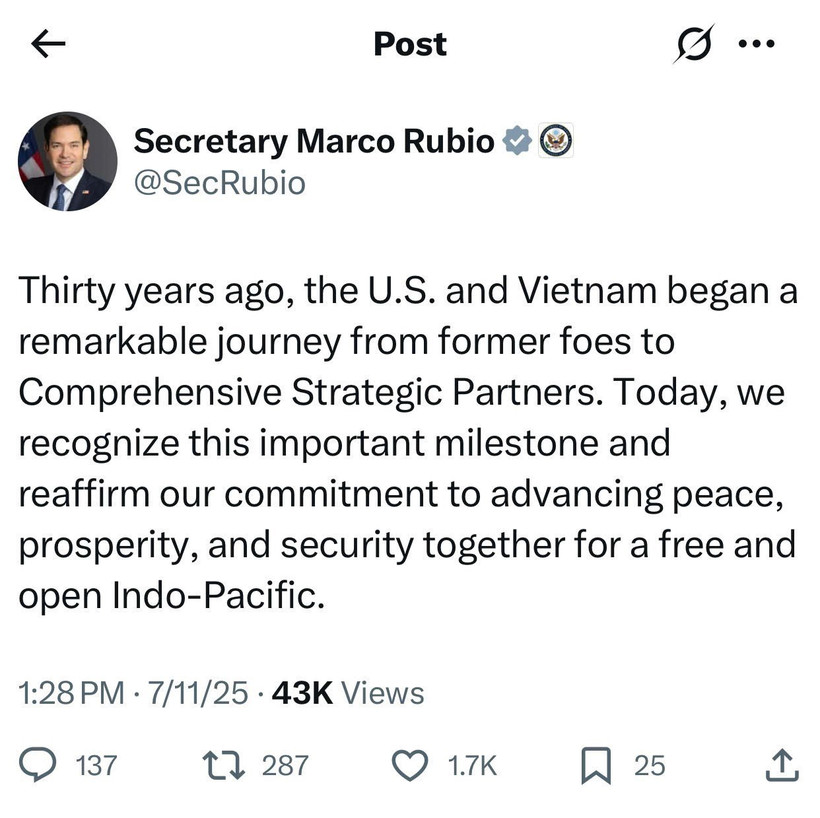
US Secretary of State Marco Rubio's post on X social network. (Photo: VNA)

Washington (VNA) - On the occasion of the 30th anniversary of the normalisation of diplomatic relations between the US and Vietnam (1995-2025), US Secretary of State Marco Rubio on July 11 wrote a post on X social network to acknowledge this important milestone.

“Thirty years ago, the U.S. and Vietnam began a remarkable journey from former foes to Comprehensive Strategic Partners. Today, we recognize this important milestone and reaffirm our commitment to advancing peace, prosperity, and security together for a free and open Indo-Pacific,” he wrote.

Thirty years ago, in the night of July 11, 1995 (US time), US President Bill Clinton officially announced the normalisation of diplomatic relations with Vietnam. In the early morning of July 12, 1995 (Vietnam time), Prime Minister Vo Van Kiet officially announced the normalisation of diplomatic relations with the US.

Since then, the bilateral relations have been continuously upgraded. On July 25, 2013, the two countries established a Comprehensive Partnership. The next important turning point took place in September 2023, when US President Joe Biden paid a state visit to Vietnam. In Hanoi, the two countries issued a statement upgrading their relationship to a Comprehensive Strategic Partnership for Peace, Cooperation and Sustainable Development./.
See more

Party General Secretary To Lam (R) and outgoing Cambodian Ambassador Chea Kimtha (Photo: VNA)

Party chief hosts outgoing Cambodian ambassador

General Secretary Lam stressed that their relationship is rooted in a shared history of solidarity, close bonds and mutual sacrifice in pursuit of each country’s peace, stability and development and ASEAN’s common interests.

Prime Minister Pham Minh Chinh (standing) on January 14 chairs the sixth meeting of the National Steering Committee for the implementation of Vietnam’s commitments at the 26th United Nations Climate Change Conference of the Parties (COP26). (Photo: VNA)

Achieving net-zero emissions by 2050 is a political mission of Vietnam: PM

Bringing Vietnam to net-zero emissions by 2050 is not merely a promise but a commitment to action - a political mission of the nation and a responsibility of the entire political system, the business community, and every citizen. Therefore, all ministries, sectors, localities, businesses, and people must focus on fulfilling this mission effectively.

Ambassador Do Hung Viet (second from right( (Photo: VNA)

Communist Party USA shows confidence in Vietnam’s new development path

The documents of the upcoming 14th National Party Congress continue to reaffirm the guideline of building and defending the Fatherland under a socialist orientation amid rapid and complex international and regional developments, with particular emphasis on closely combining development with national defence, and domestic affairs with foreign affairs.

☕ Afternoon briefing on January 14

☕ Afternoon briefing on January 14

The sixth meeting of the National Steering Committee for the implementation of Vietnam’s commitments at COP26, the final review of organisational arrangements for the 14th National Party Congress, and the inauguration of the congress's press centre are among news highlights on January 14.

The press centre for the 14th National Party Congress is equpped with modern facilities, high-speed internet connectivity, more than 150 computers and a full range of technical equipment. (Photo: VNA)

Press centre for 14th National Party Congress inaugurated

So far, 597 journalists and technicians from 113 domestic media outlets, along with 79 journalists and media assistants from 43 foreign news agencies, overseas Vietnamese media, and political party publications, have registered to cover the congress, marking a significant increase compared to the 13th National Party Congress.

Politburo member and Permanent member of the Party Central Committee’s Secretariat Tran Cam Tu (front, centre) and other officials examine organisational arrangements for 14th National Party Congress on January 14. (Photo: VNA)

Final review of preparations for 14th National Party Congress

After on-site inspections and reports from relevant units on the implementation of the assigned tasks following the preliminary review on January 13 morning, Politburo member and Permanent member of the Party Central Committee’s Secretariat Tran Cam Tu commended agencies and units for their strong sense of responsibility, close coordination, and timely completion of tasks.

A delegation of the Central Military Commission pays tribute to General Le Van Dung. (Photo: VNA)

State-level funeral held for General Le Van Dung

A delegation of the Party Central Committee led by Politburo member and Standing Vice Chairman of the National Assembly Do Van Chien paid respects to General Dung and conveyed condolences to his family.

Prime Minister Pham Minh Chinh chairs meeting of National Steering Committee for International Integration. (Photo: VNA)

PM urges shift towards deeper, more effective international integration

PM Pham Minh Chinh emphasised integration serves three key goals: enhancing Vietnam’s stature, capacity, position and credibility on the global stage; strengthening strategic proactiveness in international relations; and improving the material and spiritual well-being of the people.

Ho Chi Minh City’s downtown area and the Thu Thiem Peninsula, where the International Financial Centre is being developed in Ho Chi Minh City. (Photo: VNA)

Permanent NA Vice Chairman urges renewing mindset in lawmaking

Therefore, renewing thinking in lawmaking and institutional development, he stressed, is an objective and long-term strategic requirement. This means a decisive shift from the mindset of “making laws to manage” toward “legislation that creates development,” with the focus on establishing a transparent and stable legal framework that enables effective governance, encourages innovation, liberates productive forces, and mobilises all social resources.