Seminar highlights capital mobilisation for double-digit growth

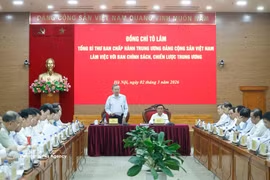
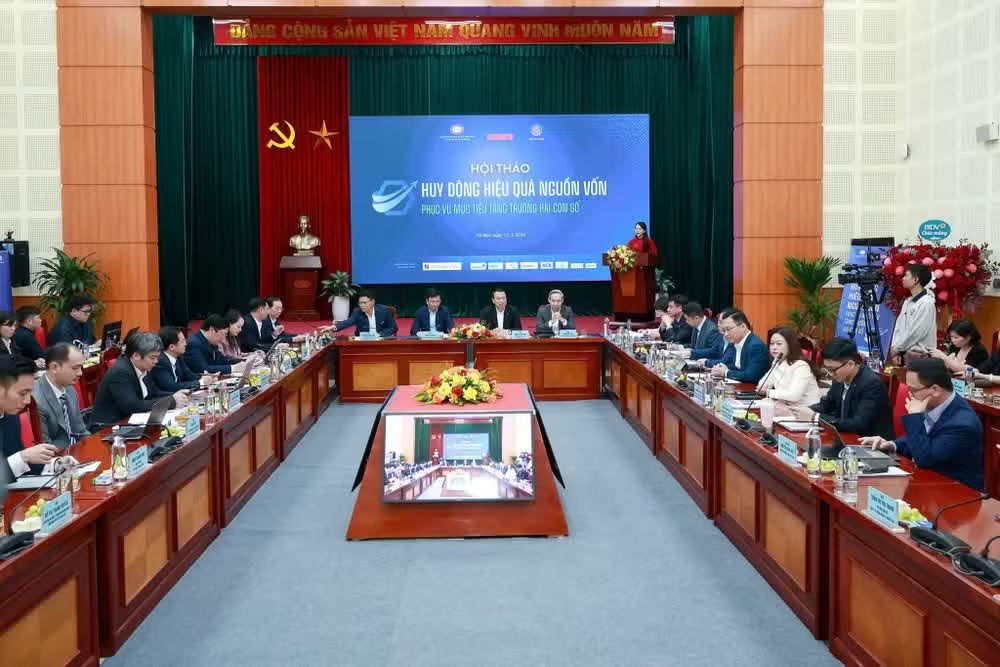
Workshop on “Effective capital mobilisation for double-digit growth”, held on March 12, 2026. (Photo: VietnamPlus)

Hanoi (VNA) – Efficient mobilisation, allocation and use of financial resources, alongside a well-calibrated mix of monetary and fiscal policies, are critical to Vietnam’s ambition of achieving double-digit growth in 2026–2030, experts said at a March 12 seminar.

Participants, including policymakers, economists and financial leaders, stressed the urgency of building a multi-tiered financial ecosystem. Delivering on the 10%+ annual GDP growth target set by the 13th National Party Congress will require deep reforms, shifting away from a bank credit-heavy model towards more diversified and sustainable capital channels.

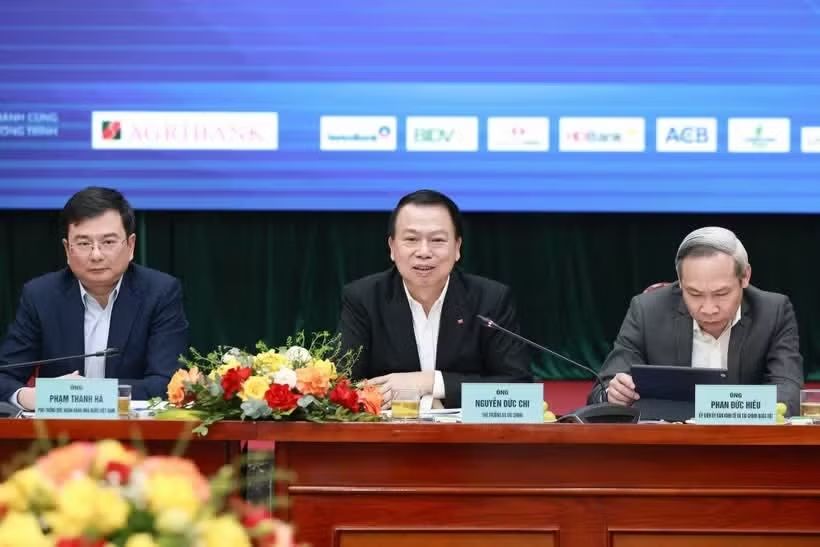
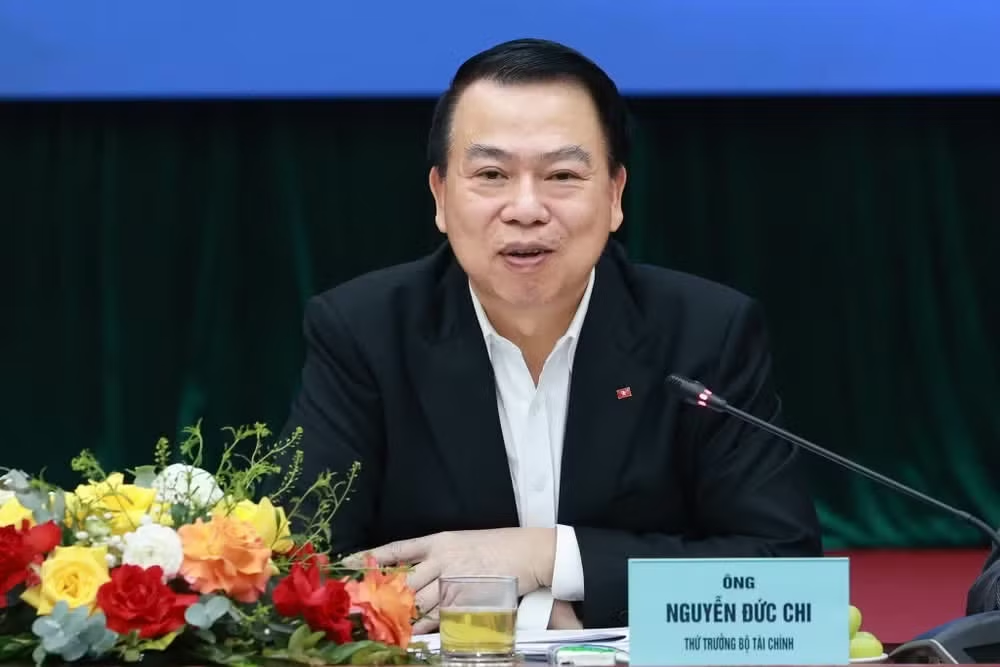
Deputy Finance Minister Nguyen Duc Chi said mobilising total social investment at around 40% of GDP in the coming period is ambitious but achievable if idle resources are unlocked, noting that the key constraint now lies in capital absorption rather than availability.

Vietnam posted solid macroeconomic performance in 2025, with GDP expanding 8.02% and total capital mobilisation reaching a record 1.15 quadrillion VND (about 43.7 billion USD). However, demand for funding remains high for strategic infrastructure, especially North–South and interregional links, while businesses continue to seek capital to expand production. Meanwhile, the domestic capital market remains underdeveloped, and institutional investors such as pension and investment funds have yet to play a full role.
z7613231983314-395cc6ed0ed6e000b692b643afacb0b0.jpg
Deputy Minister Nguyen Duc Chi stresses that the biggest challenge is no longer a “lack of capital scale,” but rather the economy’s “capacity to absorb capital.” (Photo: VietnamPlus)

Pham Thi Thanh Tam, Deputy Director General at the Department of Financial Institutions, said sustaining high growth will require lowering the ICOR from 6.3 to 4.8 to improve capital efficiency, with the State budget acting as “seed capital” for high-impact projects.

On the monetary front, State Bank of Vietnam Deputy Governor Pham Thanh Ha said policy is being managed flexibly to ensure sufficient liquidity at competitive rates, prioritising new growth drivers including the digital, green and circular economies. Credit growth exceeded 19% in 2025, providing a strong base for further expansion this year.

The banking sector is also reforming credit allocation. Nguyen Le Nam, Deputy Director General of the Monetary Policy Department, said rigid credit growth caps are being gradually phased out in favour of directing capital towards production and priority sectors.

Digital transformation across the banking system, particularly among leading lenders such as Agribank and BIDV, has streamlined procedures and significantly shortened access to financing. Greater transparency in interest rates and the expansion of electronic payments are also helping cut compliance costs for businesses and improve access to credit for individuals, while channelling funds into key technology and infrastructure projects.

A major breakthrough highlighted at the workshop is the need to upgrade the stock market into a primary channel for medium- and long-term capital mobilisation. Vietnam’s expected upgrade to “secondary emerging market” status from September 2026 is seen as a milestone, potentially unlocking up to 25 billion USD in foreign inflows by 2030.

Pham Thi Thuy Linh, head of the Market Development Department at the State Securities Commission, said the legal framework has largely aligned with international standards, with six key solution groups to be rolled out. These include improving the business environment and launching a central counterparty (CCP) mechanism by 2027, diversifying green bonds and derivatives, promoting IPOs, restructuring the investor base, advancing digital transformation with big data and AI, and strengthening inter-agency coordination to curb fraud.

Experts said the upgrade would bolster investor confidence and enable the stock market to take on a larger role in long-term capital provision, easing pressure on the banking system.
z7613233331587-2cd89c42bbda1e040ae7669216336215.jpg
Looking ahead, experts agree that achieving double-digit growth is not merely a numerical target but a test of governance capacity and the ability to seize opportunities in the digital era. (Photo: VietnamPlus)

According to Duong Thanh Tung, a specialist at Deloitte Vietnam, a proposed International Financial Centre (VIFC) should function not just as a financial hub but as an “operating system” for capital markets, integrating institutions, transparent dispute resolution mechanisms and global investor protection standards. If effectively implemented, it could help manage exchange rate risks, attract long-term capital and enhance the global competitiveness of Vietnamese enterprises.

With coordinated fiscal policy, a transparent capital market and a modern banking system forming a “three-pillar” foundation, Vietnam is well-positioned to unlock resources and move closer to its goal of becoming a high-income economy by 2045./.
VNA

See more

Villas left unoccupied for years. (Photo: diendandoanhnghiep.vn)

Taxes proposed on vacant land, speculative deals

A key proposal is to introduce a mechanism to regulate windfall gains from differences in land values, while imposing high taxes on vacant land and property transactions conducted within a short period.

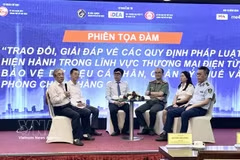
Panellists at the conference (Photo: VNA)

Ho Chi Minh City promotes safe, transparent e-commerce ecosystem

Ho Chi Minh City is stepping up efforts to build a safer and more transparent e-commerce ecosystem as authorities accelerate implementation of the new E-commerce Law, which aims to strengthen consumer protection, enhance platform accountability and support the sustainable growth of Vietnam's digital economy.

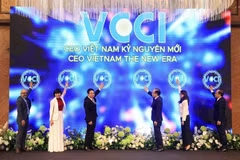
Minister of Foreign Affairs Le Hoai Trung (third, right), VCCI Chairman Ho Sy Hung (third, left), and representatives of government agencies and educational institutions attend the launch ceremony of the programme. (Photo courtesy of VCCI)

Vietnam launches programme to develop globally competitive CEOs

The Vietnam Chamber of Commerce and Industry (VCCI) on July 25 launched a Vietnam business leadership development programme 2026-2030 (CEO Vietnam The New Era), to build a new generation of internationally competitive chief executive officers (CEOs) in Vietnam.

Spokeswoman of the Ministry of Foreign Affairs Pham Thu Hang (Photo: MoFA)

Vietnam strictly prohibits all forms of forced labour: Foreign Ministry

Vietnam will continue working with the US in a constructive and cooperative spirit, while urging the US side to fully take into account the measures Vietnam has adopted when adjusting tariffs on Vietnamese goods, consistent with the actual situation and Vietnam's ongoing legislative and enforcement push.

The fourth Vietnam International Logistics Exhibition (VILOG 2026) will take place in Ho Chi Minh City from July 30 to August 1, 2026. (Illustrative photo: vilog.vn)

Vietnam's flagship logistics exhibition returns with smart, sustainable focus

The exhibition comes as Vietnam cements its position as one of Asia's fastest-growing manufacturing and logistics hubs, with demand increasing for more integrated, technology-driven supply chain solutions. It also reflects the sector's ongoing push towards greater competitiveness and deeper participation in global value chains.

Lien Khuong International Airport is expected to provide a major boost to Lam Dong's tourism after August 19. (Photo published by VNA)

Lien Khuong International Airport set to reopen on August 19

Once operations stabilise, Lien Khuong International Airport in the Central Highlands province of Lam Dong is projected to serve approximately 6,800 passengers a day, nearly 1,000 more than before its temporary closure. Passenger throughput during the final four months of 2026 is forecast to reach around 816,000.

A corner of Buon Ma Thuot ward of Dak Lak province. (Photo: VNA)

Dak Lak focuses on promoting marine-based economy, logistics

With a coastline stretching nearly 189 kilometers, featuring a network of straits, bays, lagoons, and seaports with significant development potential, Dak Lak is well positioned to advance its marine economy, particularly through the harvesting, aquaculture, and processing of high-value seafood products.

At the working session between representatives of the Vietnam Trade Office in Argentina and CMA Paraguay. (Photo: Vietnamese Ministry of Industry and Trade)

Trade office connects South American firms with Vietnamese market

The trade office also highlighted Vietnam’s 100-million-strong consumer market, rising incomes and growing demand for processed, convenience and health-oriented food products. With its strategic location, Vietnam serves not only as a promising market but also as a gateway to Southeast Asia.

Dr Nguyen Thi Bich Nguyet, head of the Office of Environmental Geography and Sustainable Development under the Vietnam Academy of Social Sciences (Photo: VNA)

Integrated marine spatial governance serves sustainable development

When marine spatial governance is implemented through effective cross-sectoral coordination, strengthened by science and technology and supported by expanded international cooperation, the sea will become not only a resource to be exploited but also a long-term development space for the nation.

Experts discuss ways to connect Vietnam's logistics sector with global logistics networks at the forum held in Ho Chi Minh City on July 24. (Photo: VNA)

Global supply chain shift opens new opportunities for Vietnam's logistics

For Vietnam, the current transition presents an opportunity to capitalise on its geo-economic advantages, extensive network of free trade agreements (FTAs) and improving investment climate to attract new investment, expand manufacturing and boost exports, said Deputy Minister of Industry and Trade Phan Thi Thang.

Illustrative photo (Source: VNA)

Vietnam records 16.65 billion USD trade deficit in first half

A comprehensive package of measures is needed to maintain and gradually expand Vietnam's trade surplus. This will provide a solid foundation for the agricultural sector to further strengthen its role as a pillar of the economy and make a more substantial contribution to Vietnam's overall economic growth.