Smart port model helps boost Vietnam-China border trade

In recent years, cooperation between Vietnam and China in building “smart border gates” has become an important highlight, helping to remove bottlenecks in the flow of goods, especially agricultural products.

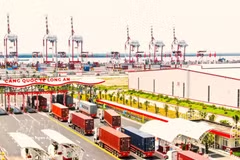
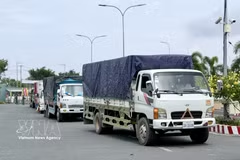
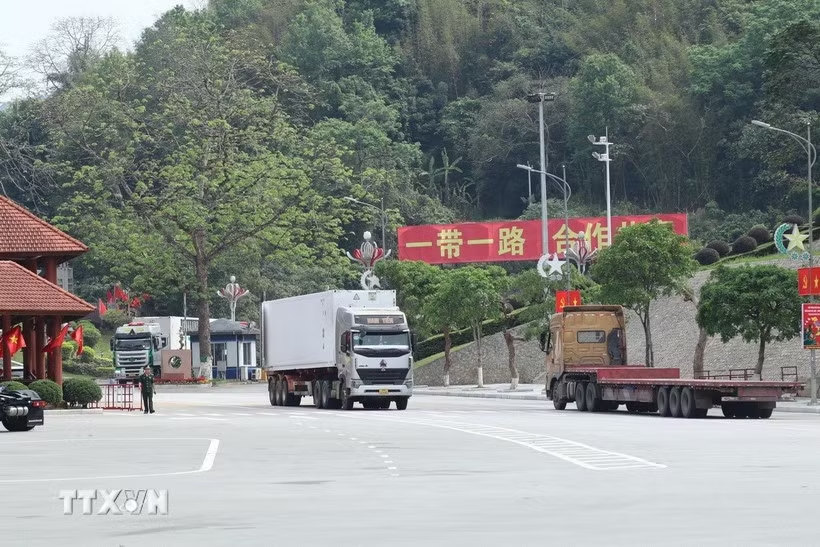
Vehicles carrying imports and exports at Huu Nghi International Border Gate in Lang Son province. (Photo: VNA)

Hanoi (VNA) – In recent years, cooperation between Vietnam and China in building “smart border gates” has become an important highlight, helping to remove bottlenecks in the flow of goods, especially agricultural products.

This is not only a practical step to promote bilateral trade but also demonstrates the determination of both countries to modernise border management, in line with the trend of comprehensive and extensive development.

Previously, it took 3–5 days for a truck to complete all procedures, but now the process only takes about 15 seconds. The synchronised application of QR code scanning, facial recognition, and fingerprint identification allows drivers to quickly finish entry procedures. In particular, fruits with short shelve lives, such as durian, a product highly popular in China, can now be transported cross the border without the risk of spoilage due to delays.

Since 2023, the Youyi Guan customs in Guangxi, China, has operated an intelligent quarantine system, enabling Vietnam and China to digitalise the entire coordination process. The average waiting time for each truck has been reduced by 3.5 hours, and the need for transshipment minimised. In 2024 alone, the number of trucks clearing customs at the Vietnam – China border gates reached a record of 3,300 per day, double the figure of 2019.

Another highlight is the application of advanced science and technology. Driverless trucks, smart cranes, 5G technology, and the Beidou navigation satellite system have been deployed, making border gate operations largely automated and moving toward 24/7 operation. This is China’s first cross-border smart border gate model, which has delivered tangible results and is continuing to expand.

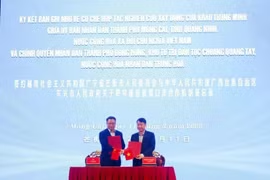
The joint efforts of the two countries to promote cooperation in reform and capacity building of border gate management not only shorten customs clearance times but also lay a solid foundation for stable and sustainable bilateral trade ties.

Zhu Houdong, deputy chief commander of the China–Vietnam Friendship cargo transport corridor-smart port project, told the Vietnam News Agency that the purpose of building the smart port model is to achieve the goal of rapid customs clearance, ensuring goods can be transported from Nanning to Hanoi and vice versa within 24 hours, thereby maximising the stability of supply and production chains between the two countries.

In the coming period, based on the existing infrastructure, the current customs clearance capacity will be doubled, Zhu added./.

VNA
See more

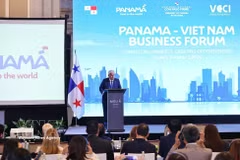
Panamanian President José Raúl Mulino speaks at the Panama-Vietnam Business Forum on October 7 in Hanoi. (Photo: VNA)

Vietnam, Panama seek to expand economic cooperation

In the presence of President Mulino, VCCI and the Chamber of Commerce, Industries and Agriculture of Panama signed a memorandum of understanding (MoU) to strengthen cooperation, enhance trade and investment promotion programmes, and support bilateral investment and trade.

Ministry updates on Vietnam-US reciprocal trade agreement talks

Ministry updates on Vietnam-US reciprocal trade agreement talks

The US is one of Vietnam’s major trading partners and holds paramount importance to the country’s exports. The conclusion of the bilateral trade agreement will help establish a stable and balanced trade framework toward sustainable development and open up greater opportunities for cooperation between the two countries.

MICE visitors enjoy services at Song Be Golf Resort in Ho Chi Minh City. (Photo: VNA)

Ho Chi Minh City shifts MICE tourism from venues to experiences

Ho Chi Minh City boasts significant advantages for MICE tourism, with the central area offering strengths in finance, trade and services; Binh Duong in industry, exhibitions and business connectivity; and Ba Ria-Vung Tau and Con Dao in marine tourism, resorts, ecology and distinctive experiences.

National Brand products are on display at the Vietnam National Brand International Forum. (Photo: VNA)

Vietnam's national brand value jumps 45% to over 462 bln USD

Deputy Minister of Industry and Trade Luong Hoang Thai outlined Vietnam's National Brand Programme 's achievements, the role of business community and plans for brand development in a press interview ahead of the 10th Vietnam National Brand Product recognition ceremony on October 16.

Khanh Hoa province possesses significant advantages for renewable energy projects and new energy sectors. (Photo: VNA)

New value chains from two industrial – renewable energy centres

To implement the revised Power Development Plan VIII, the Ministry of Industry and Trade has proposed establishing two inter-regional renewable energy industrial and service centres in the northern and southern regions to develop the renewable energy sector and a complete value chain.

WB Senior Environmental Specialist and Task Team Leader Stephen Ling speaks at the working session (Photo; VNA)

Ca Mau, WB cooperate in sustainable fisheries development

Scheduled to run from 2026 to 2029, the project aims to develop the local fisheries sector and deepen global integration, while adapting to climate change and protecting the environment through infrastructure upgrades, technological innovation, and better management and production capacity.

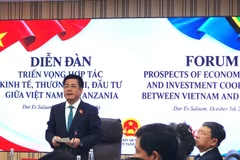
Vice President of the Vietnamese National Assembly Nguyen Hong Dien speaks at the forum. (Photo: Vietnam Trade Promotion Agency)

Tanzanian businesses seek greater cooperation, investment opportunities with Vietnam

Attending the forum during his working visit to Tanzania, Vice President of the National Assembly Nguyen Hong Dien said the two economies were highly complementary. Tanzania has strengths in natural resources, agriculture, energy, its domestic market and its strategic position in East Africa, while Vietnam has advantages in manufacturing and processing, high-tech agriculture, electronics, telecommunications and international trade.

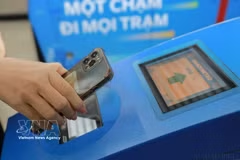
The automatic ticketing system that uses electronic identification, authentication, biometric recognition and cashless payment for passengers on the Cat Linh-Ha Dong railway line in Hanoi. (Photo: VNA)

Cashless payments open gateway to financial inclusion

Cashless payments continued to grow rapidly in the first eight months of 2026. The number and value of cashless transactions rose 34.56% and 13.26% year-on-year, respectively, while online transactions increased 46.57% in number and 21.77% in value.