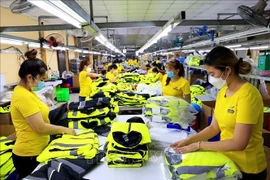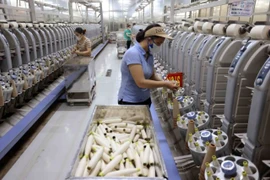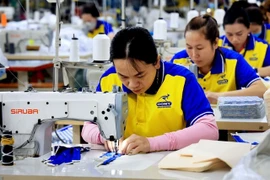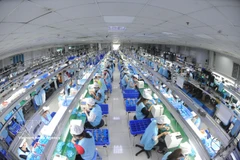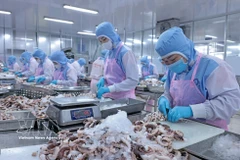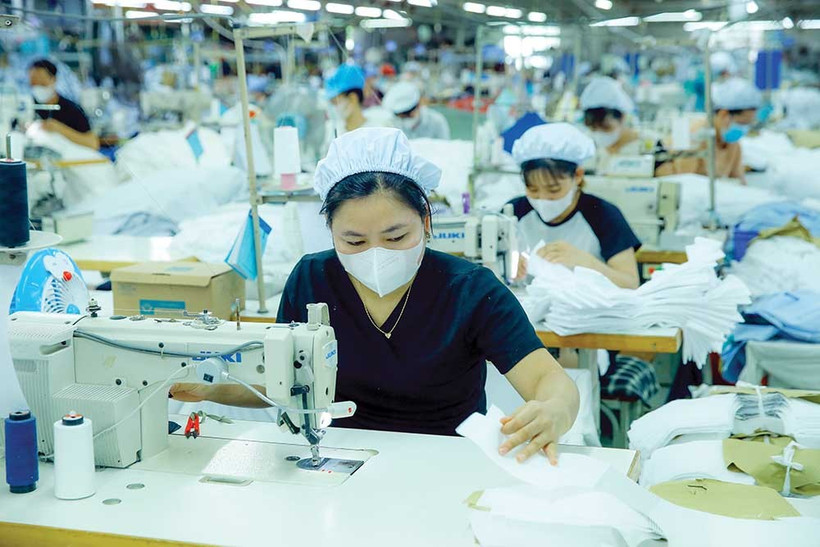
Hanoi (VNA) – The fluctuations in orders, markets, and tariffs from major trading partners force textile and garment enterprises to adapt quickly and flexibly to seize opportunities, and achieve their business goals for 2025.
Adapt flexibly, seize opportunities
It is estimated that by the end of May, the total textile and garment industry's exports reached nearly 16.8 billion USD, including nearly 15 billion USD from exports of textiles and garments. Exports to key markets such as the US, Japan, and Europe all saw double-digit growth. However, it’s hard to predict market moves.
Hoang Manh Cam, Deputy Chief of the Office of the Vietnam National Textile and Garment Group (Vinatex), said that the International Monetary Fund (IMF) has recently lowered its forecast for world economic growth in 2025 to 2.8% (down 0.5 points compared to the forecast released in January), and in 2026 to 3%. Along with that, major economies in the world have also adjusted their growth forecasts for 2025 such as the US down from 2.8% to 1.8%; Europe down to 0.8% (0.2% lower than the forecast in January). Germany zero; China down to 4% (0.6% lower than the previous forecast); Japan up 0.6% (0.5% lower compared to the previous forecast).
Cam said textile and garment enterprises are still trying to accelerate exports, especially when the US-China trade relationship tends to cool down with some agreements reached; freight rates are decreasing, the VND/USD exchange rate is developing more positively; actual inventories in the US, according to Sourcing Journal, are at a very low level, many brands are only enough for the next six to eight weeks.
The number of orders and export sales after the first 5 months of the year continue to strengthen the motivation for the business community. It is estimated that by the end of May, the total textile and garment exports reached nearly 16.8 billion USD.
Meanwhile, some countries competing with Vietnam in textiles and garments such as Pakistan or Bangladesh seem to have no signs of promoting negotiations with the US on reciprocal tariffs.
Nguyen Hung Quy, General Director of the Vinatex Southern Corporation (VSC), said that it has received enough orders until the end of August. In response to developments related to export tariffs to the US, VSC has proactively developed the EU and UK markets. The proportion of orders from these markets has increased significantly compared to the beginning of the year.
Speeding up delivery progress
Understanding the psychology of customers wanting to goods to be delivered quickly within the 90-day period of temporary suspension of US tariffs, Vietnamese businesses have improved their ability to respond and coordinate production to deliver goods early.
Hung Yen Garment Corporation said that from now until the end of July, its buyers require on-time delivery, not accepting delays like previous years. This request from the buyers has forced the entire production system to concentrate highly to complete the orders.
Meanwhile, for May10 Corporation, orders are full until the end of July, some types such as jackets until the end of August, and some others until the end of the year.
Commenting on the market, Vinatex leaders said that the garment industry still has many opportunities for orders until the end of the third quarter of 2025.
Therefore, businesses need to be proactive and flexible to make the most of market opportunities, completing at least two thirds of the annual profit plan to have reserves for production organisation, avoiding risks when the market reverses.
|It is forecast that from now until July 10, the US will have a temporary reciprocal tariff policy for Vietnam. On the positive side, US inventories are low, so orders in the third quarter of 2025 are expected to remain good, but in the fourth quarter of 2025 they may decrease by about 10% due to reduced US consumer demand.
In addition to advantages, the textile and garment industry also faces challenges as the negotiation results between Vietnam and the US have not been finalised. The US tariff policy is still uncertain; consumption in the Republic of Korea (RoK) and China is still weak, and demand cannot recover immediately. Increased electricity prices also affect production costs for businesses.
At this time, businesses are trying to take advantage of free trade agreements (FTAs) that have come into effect to get tariff incentives and diversify markets./.
See more
Hai Phong city targets 4.3 billion USD in FDI in 2026
Hai Phong’s investment appeal is underpinned by a rapidly expanding development space, including the Southern Coastal Economic Zone covering more than 20,000 hectares, a planned free trade zone, deep-water ports at Lach Huyen, and 12 industrial parks newly established in 2025.
Vietjet shifts domestic check-in at Tan Son Nhat from January 13
During the recent New Year 2026 holiday peak, Vietjet added 380 flights, equivalent to nearly 78,000 additional seats, on many key domestic routes linking Hanoi and Ho Chi Minh City with destinations such as Vinh, Thanh Hoa, Hai Phong, Da Nang, Phu Quoc, Nha Trang and Da Lat.
Capital sources expanded for sustainable growth
According to the State Bank of Vietnam (SBV), by the end of November 2025, outstanding green credit was estimated at around 750 trillion VND (28.55 billion USD), with an average growth rate exceeding that of overall credit in the economy.
Traceability emerges as protective shield for Vietnam’s exports
Traceability data are evolving into a critical layer of protection, helping exporters reduce tariff risks, shorten inspection times and strengthen proof of origin, thereby avoiding exclusion from formal distribution networks.
Retail market expands sharply, sustainability challenges persist
According to a report on recently released by the Ministry of Industry and Trade’s Agency for Domestic Market Surveillance and Development, the size of the market reached more than 7 quadrillion VND (about 266 billion USD) in 2025, up around 10% compared with 2024.
Vietnam eyes Israel as promising rice market under free trade deal
The Vietnam - Israel Free Trade Agreement (VIFTA), which took effect in late 2024, is poised to provide a fresh boost to agricultural exports, with rice at the forefront.
Resolution 79: State economy to lead growth
Resolution 79 is described as a “clear action declaration” by the Politburo, saying the state economy is not only responsible for maintaining macroeconomic stability, but must also become the force leading a new growth model that is green and sustainable.
Leveraging export advantages within RCEP region
In 2025, seafood exports to China alone exceeded 2.2 billion USD, up about 33% compared to 2024. Shipments to Japan fetched nearly 1.7 billion USD, a year-on-year increase of 14.6%, while those to the Republic of Korea and Australia grew by 9.6% and 3.2%, respectively.
Da Nang continues targeted investment promotion approaches
According to Chairman of the Da Nang People’s Committee Pham Duc An, the city prioritises building sustainable economic ecosystems and focuses on key breakthrough sectors with strong spillover effects, including high technology and digital transformation, logistics, urban infrastructure, finance, processing and manufacturing industries, high-tech agriculture, and the pharmaceutical and medicinal herb industry.
📝OP-ED: Resolution 79 – Launchpad for national aspirations
Resolution 79 is not only about SOEs. At a deeper level, it is about how Vietnam reorganises its development drivers in a world that is changing at breakneck speed.
UOB raises Vietnam’s 2026 GDP growth forecast to 7.5%
In 2025, Vietnam’s GDP grew by 8%, beating UOB’s forecast of 7.7% but still falling short of the Government’s target of 8.3–8.5%, which would have needed an extraordinary boost in the final quarter.
Reference exchange rate up 4 VND on January 10
With the current trading band of +/- 5%, the ceiling rate applicable for commercial banks during the day is 26,388 VND/USD, and the floor rate 23,874 VND/USD.
Infrastructure key to unlocking tourism’s role in double-digit growth target
With transport links running smoothly, urban infrastructure upgraded and digital platforms built out in a more systematic way, tourism would move beyond a purely consumption-driven sector to become a deeper, more durable engine of growth.
Hyundai sales in Vietnam rise almost 23% in December
In 2025, sales reached 53,229 vehicles across the market, a result considered a testament to the efforts by TC Group, Hyundai Thanh Cong, and the entire Hyundai dealership network nationwide amidst a volatile market.
Da Nang approves plan key infrastructure developers at FTZ
The Da Nang FTZ is expected to contribute 17.9% to the city’s gross regional domestic product and create 127,000 jobs by 2040, with total investment needs estimated at 40 trillion VND (1.6 billion USD).
HCM City accelerates shift toward ecological urban agriculture
The city’s agricultural sector is undergoing a strong transformation, restructuring toward higher value-added and sustainable development. In recent years, the sector has maintained steady growth, with agricultural, forestry and fisheries output rising by an estimated 2.5% annually.
Vietnam records biggest trade surplus with Netherlands among European partners
Vietnam’s exports to the Netherlands totalled 13.5 billion USD last year, up 3.7% compared to 2024, while imports stood at 825 million USD, rising 5.2%.
Footwear-leather industry seeks new drivers to sustain growth
Vietnam currently ranks third globally in footwear production, with around 1.4 billion pairs manufactured annually, behind China and India, and second in exports with approximately 1.3 billion pairs a year.
Sunpro - Ben Tre wind power plant becomes operational in Vinh Long
The plant features seven turbines and has a total investment of about 1.6 trillion VND (60.9 million USD), expected to generate 89.5 GWh per year, enough to supply electricity for about 27,000 households.
Dong Nai to launch major projects ahead of 14th National Party Congress
The launch of work on these projects represents an important political event for the province as they demonstrate the strong commitment of the entire political system to developing a comprehensive and modern infrastructure network, enhancing inter-regional connectivity, and addressing social welfare needs.