Thailand's vehicle output drops nearly 18% in May

Thailand's vehicle production fell 17.94% year-on-year to 114,214 units in May 2026, according to the Federation of Thai Industries (FTI), as exports declined amid tensions in the Middle East and weakening demand in several major markets.

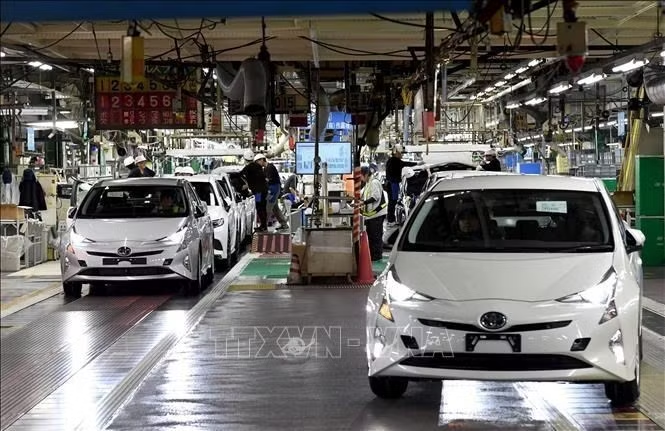
Toyota vehicles are assembled at a manufacturing plant in Thailand. (Photo: AFP/VNA)

Bangkok (VNA) - Thailand's vehicle production fell 17.94% year-on-year to 114,214 units in May 2026, according to the Federation of Thai Industries (FTI), as exports declined amid tensions in the Middle East and weakening demand in several major markets.

Surapong Paisitpattanapong, adviser to the chairperson of the FTI’s Automotive Industry Club, said the export production dropped 36.20% in May. The decline dragged overall production in the first five months of 2026 down slightly by 1.13% to 587,759 units.

Exports of completely built-up vehicles totalled 59,434 units in May, down 26.69% from the same month last year.

The FTI pointed to two major negative factors behind the decline. The first was the Middle East market, where exports fell 66.14% because of the conflict between the US and Iran. The second was Australia and Oceania, where exports dropped 37.18% as the market was affected by stricter carbon control regulations and aggressive expansion by electric vehicles from China.

As a result, the value of completely built-up vehicle exports in May fell 24.36% year-on-year to 41.72 billion THB (1.28 billion USD).

Domestic vehicle sales moved in the opposite direction, reaching 57,765 units last month, up 10.6% year on year.

The key support came from the popularity of battery electric vehicles, or BEVs. Sales of electric passenger cars rose 61.19% to 18,034 units, as consumers sought to reduce the burden of higher fuel prices.

Investment of more than 150 billion THB in the first five months of the year, together with the government’s economic stimulus measures, also helped strengthen confidence.

However, the pickup truck market, a core segment of Thailand’s automotive industry, expanded by only 0.21%.

Thailand’s electric vehicle industry continued to show positive signs despite mixed production figures. New registrations of BEVs in May reached 21,619 units, up 55.14%.

This brought the cumulative number of registered BEVs nationwide to 468,757 units as of May 31, 2026.

Motorcycle production also expanded in May, reaching 230,691 units, up 9.67% year on year./.

VNA

See more

Malaysia unveils action plan to become regional AI leader

Malaysia unveils action plan to become regional AI leader

The Malaysia Digital 2030 (MD2030) strategy is built around seven strategic pillars, namely government, economy, infrastructure, talent, society, trust and security, and innovation, with each led by the relevant ministry under a whole-of-government approach.

Illustrative image (Photo: VNA)

Thai national carrier joins probe into heroin smuggling case

A Thai air hostes swas arrested after a kilogramme of heroin was found hidden in her luggage after she arrived at Melbourne airport on June 25. She was carrying 12 tote bags, and the heroine was in the lining. The amount has a street value of about 500,000 AUD (345,000 USD).

Thailand pushes carbon data use for net-zero emissions

Thailand pushes carbon data use for net-zero emissions

Director of the Thailand Greenhouse Gas Management Organisation (TGO) Nakorn Trakwiraphat said integrating climate science, big data and artificial intelligence (AI) would enable climate and emissions data to be transformed into actionable insights for forecasting, policymaking and the building of effective greenhouse gas mitigation solutions.

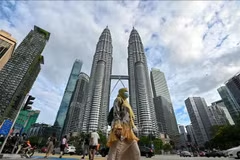
A corner of Kuala Lumpur, Malaysia. (Photo: Xinhua/VNA)

Malaysia, EU move closer to free trade agreement

Malaysian Investment, Trade and Industry Deputy Minister Sim Tze Tzin said the fourth round of negotiations, held in Kuala Lumpur from June 8-12, saw the conclusion of three chapters, namely Customs and Trade Facilitation, Trade Remedies and Good Regulatory Practices. The next round of negotiations will be held on September 21-25 in Brussels, Belgium.

Malaysia expands tourism market outreach

Malaysia expands tourism market outreach

Deputy Tourism, Arts and Culture Minister Chiew Choon Man said Tourism Malaysia is focusing on high-performing and stable markets, including China, Indonesia, Japan and India, while expanding its presence in long-haul markets such as Russia, Germany and Australia to diversify the country's visitor base.

Visitors at a tourist site in Bangkok, Thailand. (Photo: Xinhua/VNA)

Thailand expands cross-border QR payment system

The programme allows visitors from China, Singapore, Malaysia, Indonesia, Vietnam, the Republic of Korea, Laos and Cambodia, as well as Hong Kong (China), to use their domestic mobile banking applications or e-wallets to make direct payments to Thai merchants through QR codes without the need to exchange cash.

VinFast VF7 is showcased at the GAIKINDO Indonesia International Auto Show (GIIAS) 2025 in Indonesia. (Illustrative photo: VNA)

Indonesia promotes circular economy in EV battery industry

Battery recycling can bolster Indonesia's position within the EV battery production supply chain, enabling the country to become fully integrated in battery production, from raw material preparation to end-product manufacturing, according to Ahmad Faisal Suralaga, Director of Downstreaming Strategy and Governance at Indonesia’s Ministry of Investment and Downstreaming.

Malaysia looks to become apparel hub

Malaysia looks to become apparel hub

According to the Malaysia External Trade Development Corporation (Matrade), its total trade in apparel and clothing accessories exceeded 4.5 billion USD in 2025, marking an 8.3% annual hike.

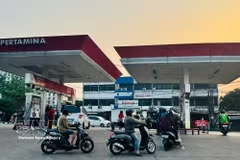
Indonesia strengthens energy security with B50 biodiesel rollout

Indonesia strengthens energy security with B50 biodiesel rollout

The B50 biofuel mandate would significantly reduce Indonesia's reliance on imported petroleum products. The country currently consumes around 39 million kilolitres of diesel annually, and increasing the biodiesel blend to 50% is expected to meet a substantial share of domestic demand.