Top leader calls for clearer rules on Party members engaged in private business

The new regulations should retain principles that remain valid while addressing new issues related to ownership, production organisation, distribution and the responsibilities of Party members in a socialist-oriented market economy.

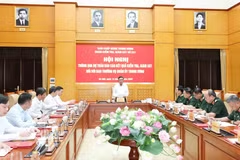
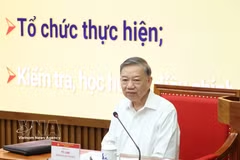
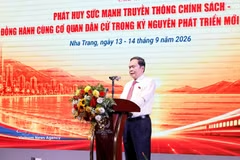
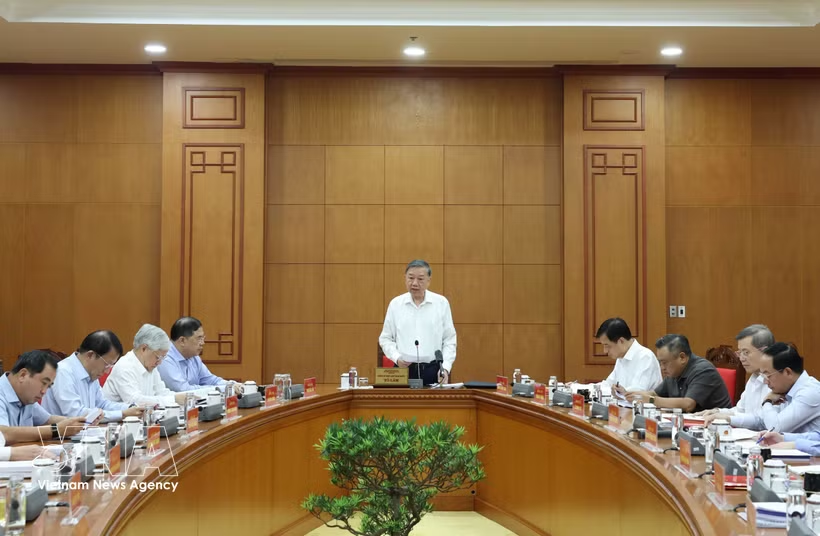
General Secretary of the Communist Party of Vietnam (CPV) Central Committee and President To Lam chairs the working session with the Party Central Committee's Commission for Policy and Strategy in Hanoi on September 14 to discuss a draft project on new regulations concerning Party members engaged in the private sector. (Photo: VNA)

Hanoi (VNA) – General Secretary of the Communist Party of Vietnam (CPV) Central Committee and President To Lam has called for clearer rules governing Party members engaged in private business, saying the new regulations should encourage lawful economic activity and help mobilise resources for national development.

The top leader made the request while chairing a working session with the Party Central Committee's Commission for Policy and Strategy in Hanoi on September 14 to discuss a draft project on new regulations concerning Party members engaged in the private sector.

After hearing a report on the project and opinions from participants, the leader said the policy allowing Party members to engage in private economic activity reflects the Party’s process of renewing its thinking, reviewing practical experience and developing its theory.

The new regulations should retain principles that remain valid while addressing new issues related to ownership, production organisation, distribution and the responsibilities of Party members in a socialist-oriented market economy, he said.

He stressed that Party members’ right to engage in lawful economic activities must be clearly recognised together with their legal status, responsibilities and obligations. The status of Party membership should mean higher standards of responsibility and exemplary conduct, not business privileges.

Support policies must be based on transparent and equal criteria, he said, stressing that businesses must not face discrimination based on whether their owners are Party members.

The working-class nature and the Party's goal of serving the people should be reflected in the practical activities of Party members, the top leader said. The new rules should take into account the origin of assets, business practices, treatment of workers and the use of business results.

Financial contributions cannot substitute for compliance with the law and Party discipline, he said, adding Party members with strong capabilities should be encouraged to take the lead in technological innovation, productivity improvement, development of Vietnamese brands and sustainable business.

General Secretary and President Lam asked the drafting body to clearly assess the current situation and define the scope of the new regulations. The regulations should be concise and clearly set out principles, regulated groups, limits, responsibilities and authority. Matters determining what Party members may and may not do must be specified.

He also called for clear distinctions among different groups, including Party members outside the public sector, incumbent officials and civil servants, public employees, members of the armed forces, leaders of State-owned enterprises and representatives of State capital, as well as former officials and retirees.

Effective measures are also needed to prevent conflicts of interest while protecting lawful business activities, he said.

The new regulations should be linked with Directive No. 12-CT/TW, issued by the Party Central Committee's Secretariat on August 19, 2026, on renewing and improving Party building in the private sector.

The leader called for efforts to recruit outstanding entrepreneurs into the Party while also paying attention to skilled workers, engineers, scientists and other outstanding employees. Recruitment should focus on political motivation, qualities, reputation and the process of personal development, rather than numbers or financial contributions.

He said Party organisations in private enterprises must effectively perform their political, educational and supervisory roles and contribute to building progressive labour relations. Coordination rules should clearly define the responsibilities of Party organisations, business owners and management, without one body taking over the functions of another.

The performance of Party members engaged in business should be assessed based on productivity, innovation, tax compliance, wages, social insurance, occupational safety and environmental protection, the leader said.

Social responsibility must begin with proper treatment of workers who create value together with the business, he added, stressing that donations and charity cannot compensate for violations of workers’ rights and obligations.

The leader assigned the Commission for Policy and Strategy to lead efforts to finalise the project, working with relevant Party bodies to clarify the management of different groups of Party members and mechanisms for supervision and accountability.

The Government Party Committee was asked to review relevant laws and propose a roadmap for institutionalising the new regulations, while coordinating with the National Assembly Party Committee on matters under the legislature’s authority.

The top leader said the new regulations should enable Party members to contribute and conduct business lawfully, strengthen effective Party management, and build public and business confidence in a fair and integrity-based system.

They should also help mobilise resources for development while making the Party cleaner, stronger and closer to the people, he said./.
VNA

See more

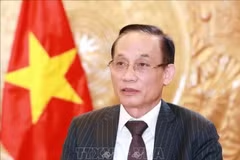
Politburo member and Minister of Foreign Affairs Le Hoai Trung (File Photo: VNA)

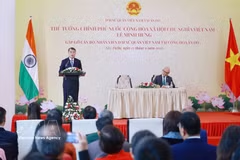
Vietnam, India seek stronger Party-to-Party ties

Vietnam and India enjoy a special relationship based on traditional friendship, solidarity, mutual support and high political trust. The elevation of bilateral ties to an Enhanced Comprehensive Strategic Partnership during General Secretary of the Communist Party of Vietnam Central Committee and President To Lam’s visit to India in May 2026 was an important milestone.

King of Thailand Maha Vajiralongkorn Phra Vajiraklaochaoyuhua and Queen Suthida Bajrasudhabimalalakshana arrive in Hanoi on September 14. (Photo: VNA)

Thai King, Queen arrive in Hanoi for State visit to Vietnam

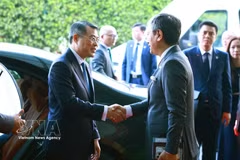
The State visit to Vietnam by King of Thailand Maha Vajiralongkorn Phra Vajiraklaochaoyuhua and Queen Suthida Bajrasudhabimalalakshana holds not only political significance but also serves as a continuation of the friendship and close ties between the Thai Royal Family, Government and people and the Vietnamese Government and people.

☕ Afternoon briefing on September 14

☕ Afternoon briefing on September 14

PM Le Minh Hung's meetings with foreign leaders on the sidelines of the 18th BRICS Summit, Vietnam and the US signing a five-year MoU on health cooperation, and the 32nd meeting of the ASEAN Senior Level Committee on Financial Integration are among news highlights on September 14.

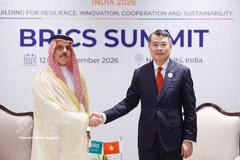
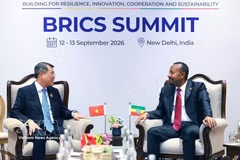
Prime Minister Le Minh Hung (R) receives Saudi Arabian Minister Foreign Affairs Prince Faisal bin Farhan Al Saud on September 13 on the sidelines of the 18th BRICS Summit in New Delhi, India. (Photo: VNA)

Vietnam seeks effective, substantive ties with Saudi Arabia

Affirming that Saudi Arabia is one of Vietnam’s most important partners in the Middle East, PM Hung expressed his pleasure at the positive development of bilateral relations in recent years, and voiced his wish to work with Saudi Arabia to further develop the bilateral relationship in a more effective and substantive manner, for the benefit of the two countries' people.

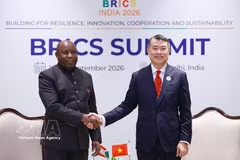
Prime Minister Le Minh Hưng and Burundi President Évariste Ndayishimiye at their meeting on September 13 (Photo: VNA)

Vietnam attaches importance to promoting friendly relations, cooperation with Burundi: PM

Thanking President Ndayishimiye and the Burundi Government for supporting the effective operation of Lumitel, the telecommunications joint venture of Vietnam’s Viettel Group in Burundi, Prime Minister Le Minh Hung proposed that Burundi continue facilitating Lumitel’s participation in e-government and digital transformation projects, while enabling it to expand investment and business activities, making it a symbol of bilateral cooperation.

☀️ Morning digest on September 14

☀️ Morning digest on September 14

PM Le Minh Hung's participation in the 18th BRICS Summit, his bilateral activities on the sidelines of the summit, and NA President Tran Thanh Man's working visit to Submarine Brigade 189 are among news highlights last weekend.

A senior Indian official sees off PM Le Minh Hung (left) as the Vietnamese leader concludes the working trip to attend the 18th BRICS Summit and conduct bilateral activities in India. (Photo: VNA)

PM Le Minh Hung wraps up working trip to India

​The working trip reaffirmed Vietnam's foreign policy of proactive and active integration into the world, and multilateralisation and diversification of external relations. It also helped to strengthen ties with partners, broaden avenues for cooperation, and enhance Vietnam's role and standing at regional and global multilateral mechanisms.

Prime Minister Le Minh Hung speaks at the meeting with staff of the Vietnamese Embassy and representative agencies as well as the Vietnamese community in New Delhi on September 13. (Photo: VNA)

Prime Minister meets with staff of Vietnamese representative agencies, community in India

At a meeting with staff of the Vietnamese Embassy and representative agencies in New Delhi on September 13, PM Hung said that officials and employees working overseas must firmly grasp the Party’s new mindset and policies on foreign affairs as well as overseas Vietnamese affairs, including the Politburo's Resolution No. 23-NQ/TW on overseas Vietnamese.

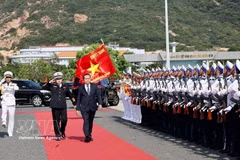
NA President Tran Thanh Man inspects the guard of honor of Submarine Brigade 189 at Cam Ranh Military Base, Naval Region 4. (Photo: VNA)

National Assembly President Tran Thanh Man visits and works with Vietnam People's Navy

NA President Man urged naval officers and personnel to thoroughly grasp and fully understand the Party’s guidelines and the State’s policies and laws regarding military and national defence affairs, with a particular focus on the "Strategy for Protecting the Fatherland in the New Situation" and the "Strategy for Sustainable Development of Vietnam’s Marine Economy to 2030, with a Vision to 2045."

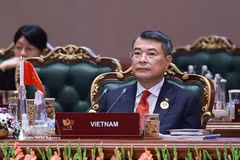
Prime Minister Le Minh Hung attends the 18th BRICS Summit. (Photo: VNA)

Vietnamese PM Le Minh Hung attends 18th BRICS Summit in New Delhi

Vietnam's own development model centres on people, institutional reform, modern governance and science and technology, while ensuring harmony among economic growth, social equity and environmental protection, PM Hung said, affirming that Vietnam stands ready to work with BRICS in a spirit of responsibility, goodwill and substantive cooperation to create a peaceful, prosperous, sustainable and inclusive future for all countries and people.

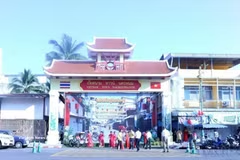
The gate of Vietnam Town in Thailand's Nakhon Phanom province (Photo: VNA)

Thai King and Queen’s Vietnam visit to deepen bilateral friendship: Official

The visit will provide strong momentum to translate leaders’ commitments into concrete outcomes. Vietnam and Thailand have agreed to step up cooperation and economic connectivity in a mutually complementary manner, with new breakthroughs and qualitative advances, striving to raise two-way trade to 25 billion USD from the current 22 billion USD in a balanced and sustainable direction.

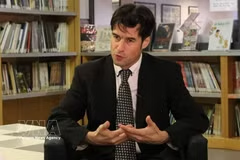
Professor Pierre Journoud (Photo published by VNA)

Vietnam - France ties enter “acceleration of history” period: French historian

The frequency of high-level visits does not tell the whole story, but at the very least it reflects clear trust at the highest leadership level, which can then spread to government agencies and other stakeholders in both countries. It also demonstrates unprecedented efforts to translate trust into concrete results, despite practical obstacles that remain, primarily in the cultural, economic and financial spheres.