Top leader demands shift from passive preservation to active shaping of national memory

General Secretary of the Communist Party of Vietnam Central Committee and President To Lam has demanded a shift from passive preservation to actively shaping national memory, with each generation responsible not only for inheriting the past but also creating and safeguarding values that may become heritage for centuries.

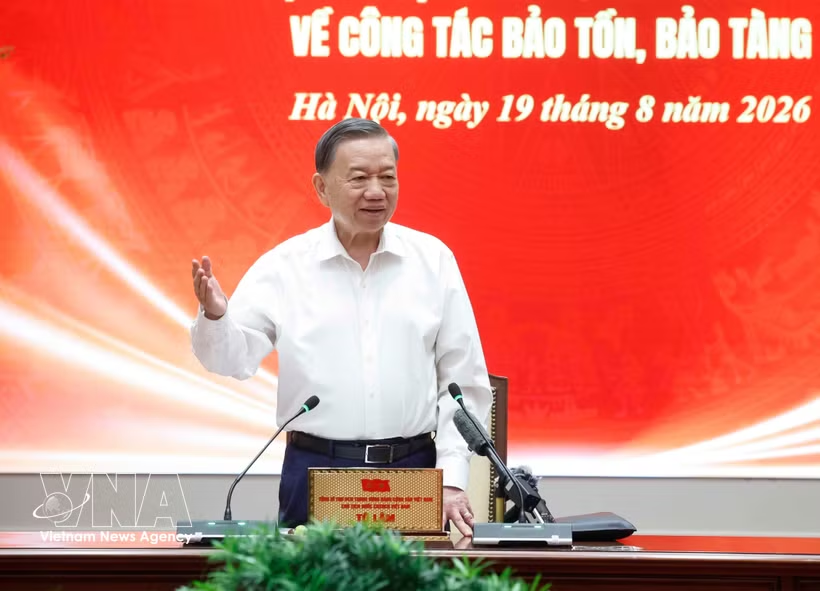
Party General Secretary and President To Lam speaks at the event. (Photo: VNA)

Hanoi (VNA) – General Secretary of the Communist Party of Vietnam Central Committee and President To Lam has demanded a shift from passive preservation to active shaping of national memory, with each generation responsible not only for inheriting the past but also creating and safeguarding values that may become heritage for centuries.

At a working session with the Ministry of Culture, Sports and Tourism (MoCST) in Hanoi on August 19, General Secretary and President Lam called for a serious reassessment of the capacity and structure of the preservation and museum system, swift action on shortcomings and long-delayed projects, and a gradual enrichment of national collections.

The MoCST, he said, must complete a preliminary review to identify urgent issues and prepare a comprehensive report clearly outlining priority areas and solutions for each group of problems. The review should cover the condition of heritage sites, deterioration of existing bodies and investment priorities, avoiding prolonged piecemeal repairs in which repeated investments ultimately fail to fix fundamental problems.

The top leader called for the settlement of gaps in the preservation of Vietnam’s history from independence to the present, particularly the history of reconstruction, development and social transformation. He stressed the need to build the capacity to identify and create future heritage as soon as such values begin to emerge.

He said historical and cultural data and heritage must be seen as a core component of the national cultural infrastructure, and called for a unified, interconnected, verifiable and sustainable national digital cultural data repository, along with special and breakthrough mechanisms to advance data and artificial intelligence (AI) in protecting heritage and transforming cultural values into economic value. The long-term digital preservation challenge must be tackled immediately, he noted.

According to the General Secretary and President, AI will play an increasingly important role in searching for, compiling, interpreting and disseminating knowledge. This is a matter of knowledge sovereignty and the right to tell the nation’s own story, rather than merely a digital transformation project for the cultural sector.
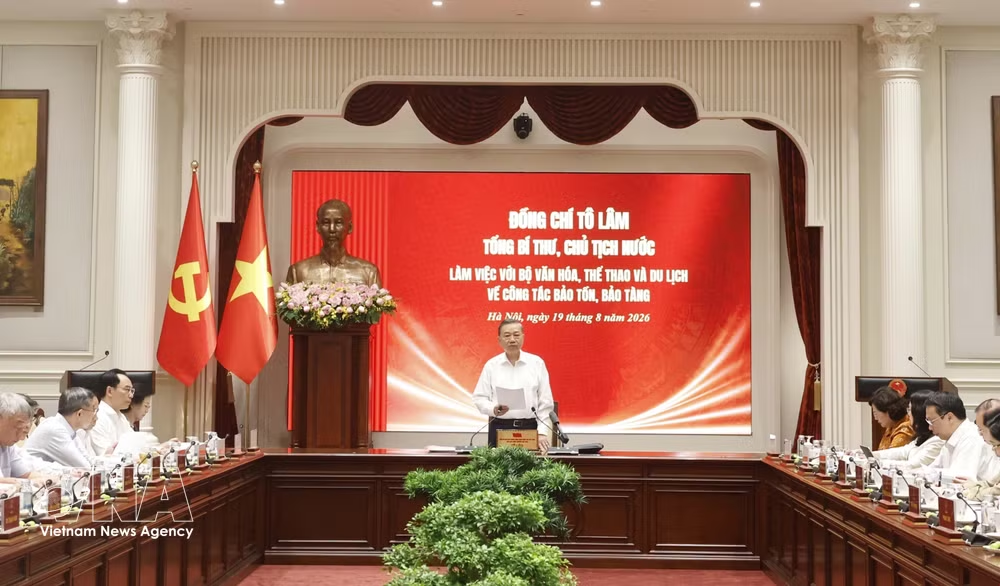
vnanet-l.jpg
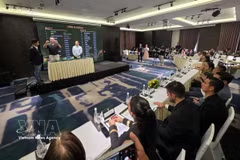
At the working session with the Ministry of Culture, Sports and Tourism. (Photo: VNA)

The MoCST was urged to renew how museum performance is evaluated, with measurable indicators covering visitor numbers and profiles, whether young people visit and return, the impact of educational activities, research contributions, data use and the social benefits generated from state investment.

The Ministry of Education and Training must coordinate to make museums regular learning spaces, as history and culture conveyed solely through textbooks are less likely to foster a deep connection than seeing authentic artifacts, experiencing real spaces and engaging with real stories, he said.

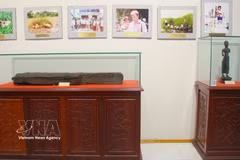
The MoCST reported that Vietnam now has more than 40,000 heritage sites and nearly 70,000 inventoried intangible cultural heritage elements. A total of 20,060 relics and antiquities have been registered under the Law on Cultural Heritage. The country has 177 museums housing more than 4 million documents and artifacts, including many rare and valuable collections, while 1,881 artisans have been awarded People’s Artisan or Meritorious Artisan titles./.

VNA

See more

National treasures on display at the Can Tho Museum feature QR codes that visitors can scan to access more information. (Photo: VNA)

Can Tho steps up digitalisation of cultural heritage

A digital portal on cultural heritage data of Can Tho will be built, supporting the city’s digital transformation targets in heritage management under Politburo Resolution No. 80-NQ/TW on developing Vietnamese culture.

An impressive Xoe Thai dance performance at the “Northwest Quintessence” street festival. (Photo: VNA)

Community-led approach strengthens ethnic cultural heritage preservation

Established in 2025, the Vietnam Pioneers Network provides a space for ethnic communities to share their heritage stories, helping reduce ethnic stereotypes and promote understanding of cultural diversity. Operating on a voluntary basis, the network connects community groups in localities across the country through core members.

Opportunities for Vietnamese cinema to break through

Opportunities for Vietnamese cinema to break through

Against the backdrop of globalisation and the explosion of digital technology, cinema is no longer merely an art form. It has become an important cultural industry making a direct contribution to economic growth and national soft power.

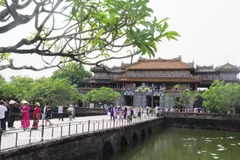
A large number of tourists visit Hue Imperial City. (Photo: VNA)

Hue rolls out vibrant events to boost National Day tourism

Vietnamese visitors will also receive free admission to attractions within the Complex of Hue Monuments on August 19 and September 2, giving domestic tourists greater opportunities to explore the historical and cultural heritage of the former imperial capital.

A performance showcases the rich heritage of Then at the event. (Photo: VNA)

Vietnam showcases Then ritual practices in Laos

The programme aims to promote the value of an intangible cultural heritage of humanity while strengthening the great friendship, special solidarity, comprehensive cooperation and strategic cohesion between Vietnam and Laos.

Delegates at the tournament’s group-stage draw ceremony. (Photo: VNA)

Pickleball World Cup 2026 gets underway in Da Nang

The tournament will feature leading players from the PPA and APP circuits alongside top Vietnamese and international competitors, including Ly Hoang Nam, Phuc Huynh, Truong Vinh Hien, Sophia Phuong Anh and Sophia Huynh Tran.

A match at KAVIJA CUP 2026. (Photo: VNA)

Vietnamese community in Japan’s Karate tournament held

The 2026 Karate tournament for Vietnamese people in Japan, KAVIJA CUP 2026 provided athletes with opportunities to exchange experience and improve their skills, and identifies promising talents for higher-level competitions in Japan and internationally.

Artist Ngo Duc Hoang gives a live painting demonstration on traditional Do paper at the exhibition in Vladivostok on August 15. (Photo: VNA)

Exhibition of Vietnamese Do paper paintings captivates Far Eastern audience

An exhibition of paintings on traditional Vietnamese Do paper by artist Ngo Duc Hoang in Vladivostok features the works, created between 2021 and 2026, exploring a wide range of themes related to Vietnam, from urban life to the mountainous northwestern region, and from natural landscapes to images of the lotus, Vietnam’s national flower.

Thua Thien Hue Innovation Startup Centre organises a programme to showcase and connect startup projects in Hue city. (Photo: VNA)

Hue makes use of heritage to drive startup growth

The central city of Hue is working to build an image as an innovation and startup hub by leveraging its strengths in education, cultural heritage, and quality of life to attract young talent.