Traditional Tet food offerings to ancestors

During the Lunar New Year (Tet) festival, each ethnic group in Vietnam has its own culinary specialties that reflect the culture of their people and are used as offerings to worship their ancestors.
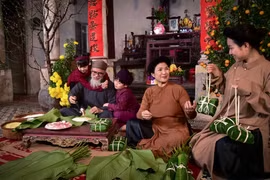
Traditional Tet food offerings to ancestors ảnh 1Banh chung (square sticky rice cake) is a signature dish of Tet. (Photo: VNA)
Hanoi (VNA) – During the Lunar New Year (Tet) festival, each ethnicgroup in Vietnam has its own culinary specialties that reflect the culture oftheir people and are used as offerings to worship their ancestors.

Most Kinh (Vietnamese ethnic majority) people start preparations a monthbefore the festival.

Many people usually cook nine dishes: banh chung (square sticky ricecake), dua hanh (pickled onions), gio nac (boiled lean porksausage) and gio thu (boiled pork head sausage), thitdong (frozen meat), nem ran (spring rolls), canhmang (bamboo shoot soup), canh bong tha (dried pig skin soup),boiled chicken, and che kho (sweet green bean paste).

These carefully cooked traditional dishes are put on the homealtar to worship their ancestors during Tet festival.

Of all the dishes, banh chung is the soul of Tet, reflecting thequintessence of heaven and earth through the skilled hands of humans. To makethe cake, the most fragrant and fibrous sticky rice are chosen and the cakes oftenhave pork, green beans, dried onions and pepper in the centre.

The cakes are often eaten with pickled onion because its sour and lightpeppery flavour helps digestion. Meanwhile, gio nac and giothu have remained on the offering food tray at Tet from the pastto the present.

Nem (spring rolls) is a popular dish in the north that always has a placeon a Tet food tray because it is so flavourful and healthy. It ismade out of minced pork, carrots, wood ear fungus, green-bean sprouts, beanglass noodles and other ingredients. The fried rolls are then dipped into abowl of sauce of mixed fish sauce, sugar, lemon or vinegar, chili and mincedgarlic.

The Tet food tray of northerners never lacks a big bowl of canhmang kho (dried bamboo shoot soup).

Ethnic groups, such as the Mong, Thai, Muong, Tay, Nung, Dao, and Co Tu,have their own New Year dishes. 

For Mong people, their Tet tray should include dishes such as pork,wine, round cakes made from glutinous rice and maize cakes.

Fried fish is the specific dish of the Thai. They believe the stream deity willprotect them from danger.

The Nung ethnic people often make banh khao from dried glutinous ricepowder, minced pork fat and sugar to worship their ancestors. The elderly saidthe sweet fat in the cake would prevent unlucky happenings in the New Year.

Meanwhile, the Co Tu in Tay Nguyen (the Central Highlands) make their ownwine known as ruou Ta Vat and ruou can to welcome Tet. Allvisitors at New Year are invited to enjoy these wines.

Each Dao household has its own thit lon chua (sour pork), locallyknown as o sui, in New Year holidays. Ingredients include pork, salt, andcool rice. The dish should be eaten with la lot (wild lolot leaves)and la prang lau (a kind of wild leaf), and dipped in a bowl of mixedlemon and chili. 

Tay people welcome Lunar New Year with a roast piglet. They often chooselocal piglets with small bones, firm and lean meat weighing from 20kg to 30kg.People often put mac mat (a kind of wild leaf and fruit) mixed withspices in the pig’s belly and cover the skin with honey. They then roast it oncharcoal for three hours until well done. The food is dipped in a sweet andfragrant sauce gotten from the pig’s belly./.
VNA
See more

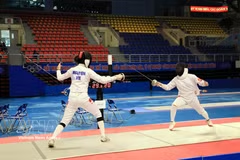
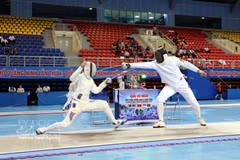
The women’s team final in the épée event between two Vietnamese teams (Photo: VNA)

Vietnam tops Southeast Asian Fencing Championships with 27 medals

Vietnam topped the medal table at the Southeast Asian Fencing Championships 2026 with 27 medals, including nine golds, three silvers and 15 bronzes, as the tournament wrapped up in the northern city of Quang Ninh on October 23 after nearly a week of competition.

Singer Dang Duong is among the artists featured in the national concert Proud to Be Vietnamese 2026. (Photo of the organisers)

Concert to celebrate unity and pride

The programme carries profound political, cultural and social significance, helping promote historical values and the Vietnamese tradition of paying tribute to the past generations, while nurturing love for the homeland and country and strengthening bonds among generations of Vietnamese people.

A visitor watches a calligraphy demonstration at the first Vietnam Calligraphy Festival 2026. (Photo: VNA)

Vietnam Calligraphy Festival celebrates national cultural heritage

The festival features more than 100 exhibition booths, bringing together calligraphy clubs from across the country, calligraphers, artisans, culture researchers, businesses and representatives of traditional craft villages. Exhibitions, exchanges, discussions and hands-on activities celebrate calligraphy and promote Vietnam’s cultural values.

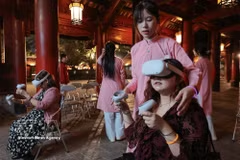
Tourists experience writing calligraphy through virtual reality at Hanoi's Temple of Literature. (Photo: VNA

Hanoi works to unlock heritage resources

When innovation deepens understanding of traditional values rather than replacing them, heritage becomes not only something to preserve but also a resource for sustainable tourism, economic development and reinforcement of Hanoi’s position as a UNESCO Creative City.

Following the launch ceremony, the 100-motorbike convoy travels from Dong Van across Ma Pi Leng Pass, taking in spectacular mountain scenery and the Nho Que River before finishing at Pa Vi Ha in Meo Vac commune. (Photo: VNA)

100 motorbikes conquer Ma Pi Leng Pass to promote safe travel

A convoy of 100 motorbikes set off on a journey across Ma Pi Leng Pass on October 21 as part of a roadshow campaign to promote safe motorcycle travel in the northern province of Tuyen Quang, home to the Dong Van Karst Plateau UNESCO Global Geopark.

The work "Khong gian cua nui" (The Space of Mountains) by Le Lang Luong. (Photo: Published by VNA)

Vietnam-Japan sculpture exhibition to bring artists together in Kanagawa

The “Dialogue” exhibition in Japan's Kanagawa prefecture from November 8-11 will feature more than 30 works by artists from both countries, including 26 pieces by 13 contemporary Vietnamese sculptors from different generations. These artists have developed distinctive artistic languages and made their own marks on Vietnam’s contemporary art scene.

A performance at the event (Photo: VNA)

Vietnamese in Hungary stage first Great National Unity Festival

The event also served as a showcase for Vietnamese culture, customs, cuisine and traditions, in step with Vietnamese Culture Day. It encouraged Vietnamese of all generations to hold onto their cultural identity while spreading the image of Vietnam and its people among Hungarians, adding to people-to-people exchanges and mutual understanding between the two countries.

An ao dai fashion show at the festival. (Photo: VNA)

Vietnamese culture shines at festival in RoK

A celebration marking the seventh founding anniversary of the Vietnamese Migrant Women’s Association (VMWA) in Ansan, Gyeonggi province, the Republic of Korea, took place on October 18, featuring cultural exchanges and activities to mark Vietnamese Women’s Day (October 20).

Vietnam harnesses culture as growth driver

Vietnam harnesses culture as growth driver

Under a March 17, 2026 action plan from the municipal Party Committee, which follows the Politburo’s Resolution 80-NQ/TW dated January 7, 2026, on Vietnamese cultural development, the city is moving beyond preservation alone. It is now upholding heritage values while developing cultural products, spaces and markets tied to innovation and global integration.