UNESCO Representative to Vietnam Jonathan Wallace Baker (Photo: VNA)
Hanoi (VNA) - UNESCO Representative to Vietnam Jonathan Wallace Baker has highlighted Vietnam’s remarkable achievements at the organisation last year as evidence of its active participation, enormous potentials, and valuable experiences.
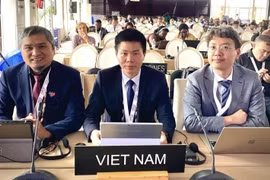
The head of the United Nations Educational, Scientific and Cultural Organisation’s Office in Hanoi said in a recent interview with the Vietnam News Agency on the occasion of Tet or Vietnamese Traditional Lunar New Year that the year 2023 marked a series of highlights that Vietnam had achieved at the UN cultural agency, with the nation for the first time serving in five institutional structures of the organisation.
Vietnam currently serves as members of UNESCO Executive Board for the 2021-2025 tenure, World Heritage Committee 2023 – 2027 and UNESCO 2003 Intangible Cultural Heritage Convention’s Intergovernmental Committee 2022 – 2026.
The Southeast Asian country also acts as Vice Chair of UNESCO Committee for Protection of Cultural Expression Diversity for the 2021 – 2025 tenure and is one among 31 Vice Presidents of the UNESCO’ General Conference from 2023.
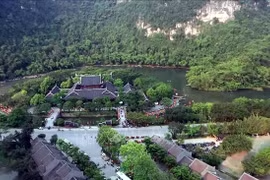
The year also saw Vietnam expanding its UNESCO Creative Cities Network (UCCN), with the recognition of Hoi An – an ancient city in the central province of Quang Nam – in craft and folk arts, and Da Lat – the largest city of the Central Highlands region – in music.
Meanwhile, the progenitor of Vietnamese traditional medicine Hai Thuong Lan Ong Le Huu Trac (1724 - 1791) was included in the list of eminent personalities and historical events commemorated in 2023 – 2024 passed by the UNESCO General Conference at its 42nd session in Paris last November.
According to the UNESCO representative, these achievements are certainly the evidence that Vietnam has convinced other member states of its active participation to all mechanisms of UNESCO, as well as preparation of quality dossiers that could demonstrate the enormous potentials and the valuable experiences that the nation could bring and contribute to the common knowledge and values upheld by UNESCO and all its member states.
“Most recently, the fact that Vietnam has been elected in the World Heritage Committee while it has already been serving in many other convention mechanisms indicated that it gained a high level of trust as well as the international expectations for its potential contributions,” he said.
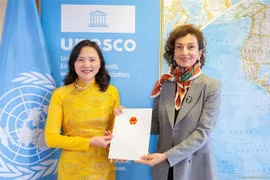
He went on noting that: “As suggested by UNESCO Director General Audrey Azoulay during her official visit to Vietnam and meeting with H.E Prime Minister Pham Minh Chinh, we hope that Vietnam could consider to host the international committee meetings which would be much meaningful during its serving terms for the demonstrations of the practical results of the UNESCO Conventions in the national context. I believe those opportunities would be highly appreciated by all other Member States and international delegates.”
“Vietnam has been a pioneer Member State in initiating the forums on the UNESCO designations and sustainable development,” Baker said, referring to the country’s efforts in preserving and harnessing UNESCO designations for economic development.
He held that each designation under different framework and mechanisms shall follow the respective operational guidelines. Some required highly monitored preservation work such as the World Heritage sites, of which the listed attributes of Outstanding Universal Values must not be undermined or diluted for any reasons; while other designations are completely open to the idea of promoting and enabling the innovation and culture creativity such as the UNESCO Creative Cities or UNESCO Learning Cities.
“There is no such one size fits all approach for all types of UNESCO designations and I find that the Vietnamese Government, together with various local partners have placed a great importance in the ultimate goal of ensuring sustainability in all programmes and actions,” he added.
According to him, that long-term vision would be fundamental for guiding immediate plans which seek to foster the creativity, mobilise the dynamics of cultural and social capitals and the young talents and creative businesses without scarifying the valuable heritage and other natural assets for the shortsighted decisions.
Talking about Vietnam’s potentials and advantages regarding cultural industry development, he said cultural and creative industries are not merely conduits of economic growth, but are pivotal to a holistic model of sustainable development. These industries resonate across the foundational facets of economic, environmental, cultural, and social sustainability.
“Vietnam demonstrates notable potentials to be further explored. The country’s historical and cultural landscape is interwoven with the dynamic threads of cultural and creative industries. These industries not only serve as vehicles for economic prosperity but also as guardians of tradition, fostering social cohesion, and driving sustainable practices,” he noted.
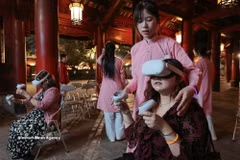
According to Baker, Hanoi is one of the country’s pioneers in development of cultural industry policies, thanks to its rich tapestry of cultural resources including thousands of heritage sites, traditional craft villages, and an emerging community of designers and innovators and creative spaces across the city.
Hoi An, a UNESCO-designated site, harmoniously balances cultural preservation with economic prosperity. The creative economy thrives through traditional crafts and culinary treasures, engaging both local communities and tourists. The town's architectural treasures, combined with cultural experiences like traditional craftsmanship and culinary delights, magnetize tourists and generate revenue. This synergy vividly portrays the potential of cultural industries to not only invigorate local economies but also safeguard heritage.
“Pivoting from existing paradigms of cultural and creative industries for sustainable development, Vietnam needs to further capitalise on the potential of culture through cohesive strategies and policies. The following measures suggested by the UN System Task Team on the Post-2015 UN Development Agenda can serve as a helpful point of reference for public and private stakeholders,” Baker said.
He gave some suggestions for Vietnam to develop its cultural industries and
enhance the contribution of these industries to the nation’s economy.
First, policy makers should continue integrating culture into governance such as formulation and practice of development programmes and legislations.
Second, a stronger push for culture and creative industries to grow as powerful economic sub-sectors that generate employment, local development and entrepreneurship while taking into account the protection of fragile cultural and heritage assets is necessary.
Third, environment sustainability should become a new focus as sustainable environmental understanding get integrated more consistently into cultural and creative practices.
Last but not least, the local community needs to remain at the centre in culture industries for development paradigms through intercultural dialogue and knowledge transfer for social cohesion and empowerment, especially among youth and vulnerable groups.
“At the same time, the specific context of Vietnam and each region working on cultural industries in sustainability should enrich the frameworks above to ensure that policies and incentives are locally aware and based to maximise synergies and progress,” he concluded./.