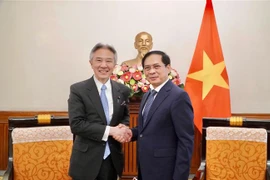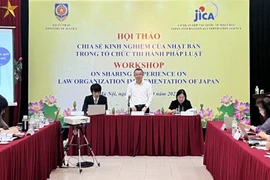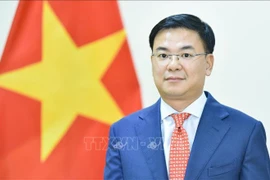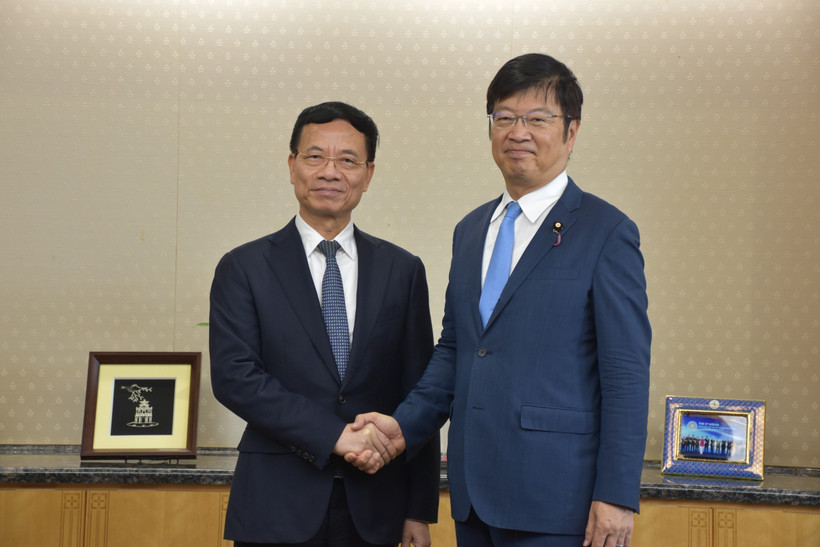
Hanoi (VNA) - Minister of Science and Technology Nguyen Manh Hung held meetings with leaders of Japan’s Ministry of Internal Affairs and Communications (MIC) and the Japan Science and Technology Agency (JST) on October 2 as part of his working visit to Japan.
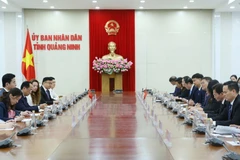
At the MIC headquarters, State Minister Internal Affairs and Communications Adachi Masashi expressed his hope that the meeting will further deepen science and technology cooperation between the two countries.
He recalled Prime Minister Shigeru Ishiba’s April visit to Vietnam, during which the Japanese PM pledged stronger collaboration with Vietnam in this field, stressing that science and technology is set to become a key pillar of bilateral ties.
Minister Hung briefed Adachi on Vietnam’s ongoing administrative reform, noting that his ministry, formed after the merger of the former Ministry of Science and Technology with the Ministry of Information and Communications, is responsible for scienc-technology, including digial technology and transformation.
He said that more than 60 Vietnamese IT firms are currently operating in the Japanese market. He also informed his host of Vietnam’s newly issued artificial intelligence (AI) strategy, under which mobile infrastructure and AI are identified as priority areas, and expressed his wish that the Japanese government and enterprises will take part in Vietnam's process.
At the JST headquarters, JST President Kazuhito Hashimoto thanked Minister Hung for supporting the JST’s NEXUS programme, a major initiative to boost scientific collaboration with ASEAN.
He said Japan and Vietnam had agreed to make semiconductors the central focus of their cooperation. Vietnam will send 60 young researchers pursuing a PhD to Japan to join joint semiconductor research, with the goal of developing 500 highly skilled professionals for the sector.
Minister Hung underlined that science, technology, innovation, and digital transformation are now Vietnam’s main drivers of development, and therefore a pillar of comprehensive cooperation with Japan.
He said Vietnam considers semiconductors a strategic field, and the JST has already signed an agreement with Vietnam’s Department of International Cooperation on joint research in chip design and materials. Vietnam also hopes to expand into advanced packaging, and both sides will work to co-finance term five- to ten-year projects with higher investment levels.
Beyond semiconductors, Minister Hung suggested expanding cooperation into other strategic areas and supporting commercialisation of research outcomes in both countries.
Hashimoto, who also serves as Science and Technology Advisor to Prime Minister Ishiba, welcomed the proposals and pledged to submit recommendations to the Japanese government.
Minister Hung reaffirmed Vietnam’s goal of becoming a high middle-income country driven by science and technology, expressing confidence in Japan’s continued role as a key partner on this path./.