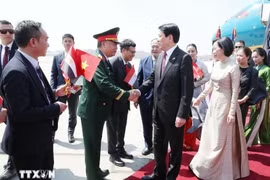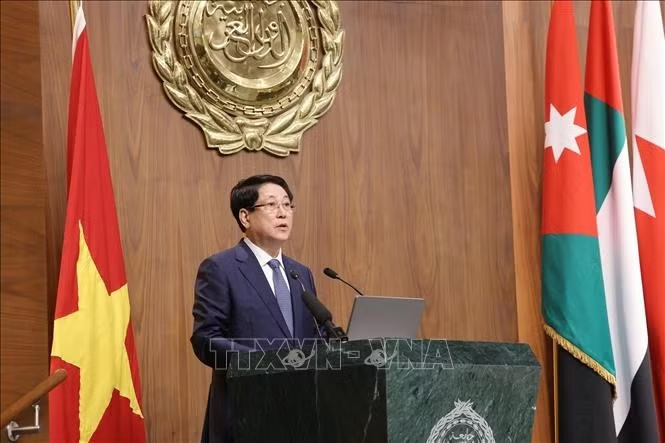
Cairo (VNA) – State President Luong Cuong has expressed Vietnam's desire to join hands with Arab countries to write a new chapter of multidimensional cooperation for peace, collaboration, and development, which is based on the history of solidarity, close attachement and traditional friendship.
While delivering a policy address at the League of Arab States’ headquarters in Cairo on August 4 as part of his state visit to Egypt, President Cuong shared Vietnam’s views on the current global and regional situation, the country's achievements during the Doi moi (renewal) process, directions in the new era, and vision for ties between Vietnam and Arab countries in the coming time.
He stressed that although peace and development remain major trends and common aspirations of all nations, the world is facing unprecedented challenges. Ongoing traditional security hotspots, coupled with intensifying non-traditional threats like climate change, water security, food security, cyber security, protectionism, trade wars, global fragmentation and supply chain disruptions, have impacted the legitimated rights of developing countries, including Vietnam and Arab nations.
Amidst the complicated situation, he called on countries worldwide to demonstrate clear responsibility for world peace, uphold multilateralism, respect the UN Charter, international law, and widely recognised common principles of conduct, while respecting the legitimate interests of medium and small countries. Underscoring the strength of solidarity, President Cuong noted that Vietnam and Arab states should promote multilateralism, hold aloft the banner of multilateralism and actively contribute to building a fair and equal global economic and political order based on international law.
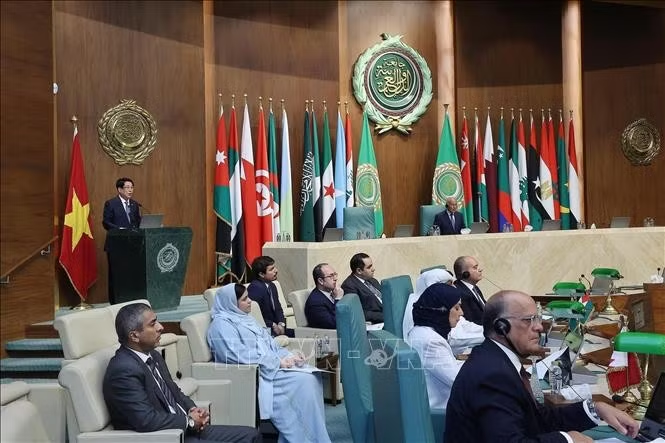
Once a war-ravaged nation, Vietnam deeply understands the value of pace, he said, pointing to the country’s partnerships with former adversaries as a demonstration of the power of dialogue, reconciliation, and the spirit of setting aside the past and looking forwards to the future.
President Cuong voiced Vietnam’s concern over the current use of force, prolonged conflicts, and humanitarian crises in the Middle East, and at the same time, expressed his hope that all parties involved will find peaceful and sustainable solutions to regional conflicts and disagreements based on international law and through dialogue. The President reiterated Vietnam's consistent position on the Middle East peace process, steadfastly supporting the two-state solution in accordance with international law, the UN Charter, and relevant UN resolutions.
Briefing participants on Vietnam's significant achievements in nearly 40 years of Doi moi, he highlighted its three foundational elements, namely building socialist democracy, building a socialist rule-of-law state, and building a socialist-oriented market economy.
The State leader attributed Vietnam’s progress to steadfastly pursuing the goals of national independence and socialism as well as the renewal policy; maintaining and enhancing the leadership and ruling role of the Communist Party; thoroughly grasping the people-centred approach; issuing rational and timely policies; renewing and completing mechanisms to unlock resources for national development; and renovating the mindset, especially strategic thinking.
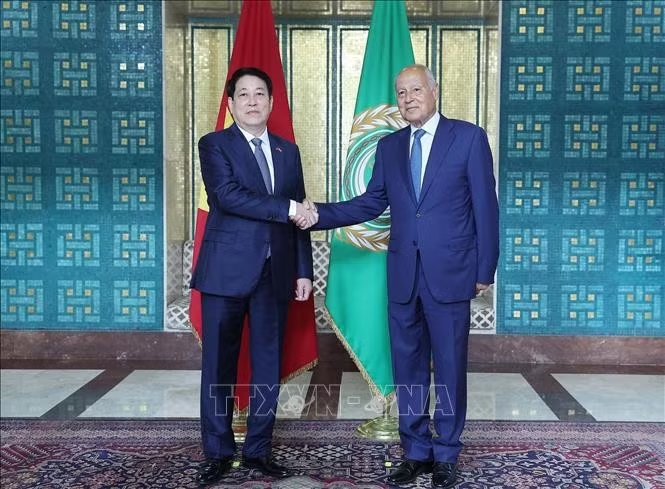
Regarding Vietnam’s new era - the era of the nation’s rise to become a prosperous and civilised country, the President said that the leaders of the Party and State of Vietnam, headed by Party General Secretary To Lam, has put forward a new vision, striving to successfully realise two strategic centennial goals: by 2030, marking the 100th founding anniversary of the Communist Party of Vietnam, Vietnam will become a developing country with modern industry and upper-middle income; and by 2045, marking the 100th founding anniversary of the country, it will become a developed country with high income.
For foreign affairs, Vietnam will continue to consistently implement the foreign policy of independence, peace, self-reliance, multilateralisation and diversification of relations, comprehensive and deep international integration; proactively and responsibly participating in addressing common regional and international issues. In the new era, Vietnam will promote comprehensive, modern, and professional diplomacy, in line with the country’s historical stature, culture and position; enhancing Vietnam’s role and position in the world politics, the global economy, and the humankind civilisation.
On the historical relationship between the people of Vietnam and the Arab nations, the President pointed out that during his journey to find a way to save the nation in the early 20th century, patriotic young man Nguyen Ai Quoc — later great President Ho Chi Minh of Vietnam — made stops in Egypt, Algeria, and Tunisia. The close bonds between the people of Vietnam and Arab nations have a historical foundation, personally nurtured by President Ho Chi Minh and leaders of many Arab countries.
He affirmed that throughout the struggle for national liberation and reunification in the past, as well as in the current process of national construction, Vietnam and Arab countries have always given each other valuable support and encouragement. Vietnam always treasures, preserves, and takes great pride in having diplomatic relations with all 22 member countries of the League of Arab States, with increasingly practical and effective cooperation in many fields.
As the world is facing many instabilities, the aspiration for peace, cooperation, and development among the peoples is stronger than ever. The President believed that the traditional friendship between Vietnam and Arab countries in general, and Egypt in particular, built on a foundation of history, trust, and shared development goals, will continue to bear fruit.
With that spirit, to deepen the friendship and multifaceted cooperation between Vietnam and Egypt as well as other Arab countries in a stable and sustainable manner, President Cuong proposed continuing to strengthen political trust as a solid foundation for cooperation; and expressed his desire to further promote the exchanges of delegations at all levels with Arab countries and the League of Arab States, both bilaterally and at multilateral conferences and forums.
Believing that economic, trade, and investment cooperation should be deepened, the President pointed out that the two economies are relatively complementary, creating favourable conditions for promoting more substantive, multifaceted cooperation. The two sides should also promote joint development in science, technology, innovation, and digital transformation. Vietnam and Arab countries can also enhance cooperation in developing solar energy, wind power, green hydrogen production, and energy storage technologies - a promising direction that takes advantage of Arab nations’ capital and technology strengths and Vietnam’s renewable energy potential.
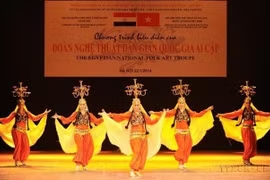
In addition, through the important role of the League of Arab States, President Cuong also hoped that the governments of its member states will continue to create favourable conditions for over 30,000 Vietnamese workers currently working in regional countries such as Saudi Arabia, Kuwait, Qatar, and the UAE to live and work stably, contributing more actively to the socio-economic development of the host countries as well as to their relations with Vietnam. Moreover, both sides should actively promote cultural and artistic exchange programmes and increase scholarships, especially for Vietnamese students studying Arabic in the regional countries.
The President also proposed both sides further strengthen coordination at regional and international multilateral forums. As an active member of the Association of Southeast Asian Nations (ASEAN), Vietnam has been making increasingly positive contributions to addressing common regional and global issues and is ready to act as a bridge to further promote cooperation between ASEAN and the League of Arab States, especially in safeguarding peace and promoting the building of a fair, equal world order based on international law, where the voices and legitimate aspirations of developing countries are heard and respected.
The League of Arab States, established in 1945, serves as the intergovernmental organisation for Arab nations across North Africa, the Horn of Africa, and the Arabian Peninsula. The organisation's primary mission focuses on promoting cooperation, coordinating policies, and protecting member states' interests. The 22-member league includes influential regional powers such as Egypt, Saudi Arabia, and the United Arab Emirates.
The Vietnamese Ministry of Foreign Affairs and the League's Secretariat established a cooperation mechanism in July 2023./.