Vietnam to offer unprecedented incentives for digital tech companies

According to the Law on Digital Technology Industry, the incentives include full corporate income tax exemption for the first two years and 50 % reduction in the four following years, as well as land rent waivers for three years.

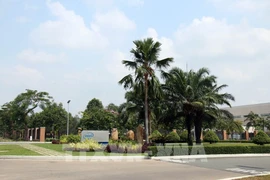
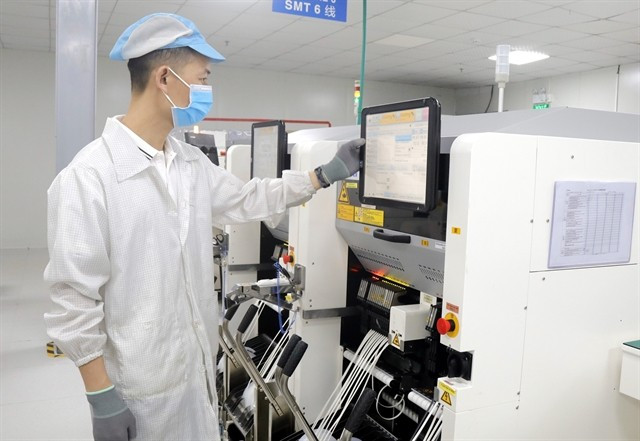
Companies investing in digital technology will enjoy unprecedented incentives. (Photo: VNA)

Hanoi (VNS/VNA) - Vietnam will offer unprecedented incentives for digital technology companies under a new law set to take effect from the beginning of 2026, an official from the Ministry of Science and Technology said at a press conference on July 7.

According to the Law on Digital Technology Industry, the incentives include full corporate income tax exemption for the first two years and 50% reduction in the four following years, as well as land rent waivers for three years.

These are just some of the huge incentives offered to digital technology companies, Director of the ministry’s Department of Information Technology Industry Nguyen Khac Lich said.

For companies operating in key areas such as semiconductors, artificial intelligence (AI) and high-performance computing (HPC), a preferential corporate tax rate of 10% will be applied for 15 years, together with an exemption from CIT for four years and a 50% reduction for the following nine years, along with up to 15 years of land rent exemption.

For large-scale projects in semiconductors, AI or HPC with a total investment of 6 trillion VND (230 million USD) or more, investors will enjoy tax incentives similar to projects worth 30 trillion VND under the established regulations.

Specifically, the corporate income tax rate is 5% for 37 years, with a tax exemption for the first six years and a 50% reduction for the next 13 years. Land and water surface rents will be waived for 22 years and cut by 57% thereafter.

The Government will also focus on developing a workforce for the digital technology industry.

To attract talent, foreign experts meeting specific criteria will receive temporary residence cards valid for up to five years. Their spouses and children under 18 will also be eligible for residency and facilitated access to education and employment in Vietnam./.

VNA
See more

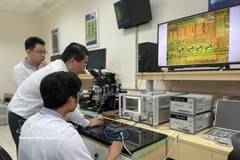
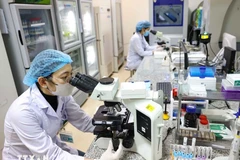
A biotechnology laboratory of the International University at Vietnam National University-Ho Chi Minh City. (Photo: VNA)

Resolution 57: Role of intellectuals in advancing science and technology research

Prof. Dr. Tran Dai Lam, Director of the Institute of Materials Science at the Vietnam Academy of Science and Technology (VAST), emphasised that intellectuals should nurture national responsibility and ambition, be ready to take on challenges, evaluate research outcomes by international standards, and engage in collaboration across different sectors.

Professor Vu Minh Khuong, of the Lee Kuan Yew School of Public Policy (right), talks to a Vietnam News Agency correspondent in Singapore. (Photo: VNA)

Resolution 57 - catalyst for scientific and technological breakthroughs

The resolution also seeks to create stronger mechanisms to mobilise social and private resources and support an innovation ecosystem; link digital transformation in the public sector with the modernisation of national governance; and prioritise the development of elite human resources and internationally-standard research infrastructure.

Workers produce electronic components (Photo: VNA)

Science, technology drive Vietnam’s rising global profile: expert

Assoc. Prof. Le Duc Anh from Tokyo University held that for fast and sustainable development, Vietnam should prioritise science – technology and innovation as the main driver of productivity, focusing on sectors with high spillover effects such as semiconductors, AI, data, new energy and materials, biomedical technology, automation – robotics, and cybersecurity.

An overview of the workshop. (Photo: nafosted.gov.vn)

National portal expected to transform innovation into reality

The portal, which can be accessed at sangkien.gov.vn, was built to address the urgent need to mobilise collective intelligence and unlock the creativity of the entire population, in accordance with the directives of the steering committee for the implementation of the Politburo’s Resolution No. 57-NQ/TW on creating breakthroughs in science, technology, innovation and national digital transformation.

Sucker-mouthed minnow (Supradiscus varidiscus). (Photo: researchgate.net)

Vietnamese fish, bee named among 70 species newly identified in 2025

One of the most notable “hidden” finds is a small sucker-mouthed minnow endemic to Vietnam’s highlands, discovered in the Lo River. Scientifically named Supradiscus varidiscus, the specimen was collected and shelved some 25 years ago but has only now been studied and formally described.

The Ministry of Science and Technology launches a centralised one-stop-shop unit on December 19. (Photo: VNA)

Vietnam pushes sci-tech, innovation as growth drivers under Resolution 57

The Ministry of Science and Technology (MoST) bears the responsibility of “paving the way”, guided by a consistent spirit of transitioning from a management-oriented mindset to a facilitative one, from “input-based management” to “output-based evaluation”, and from fragmented investment to a focused approach centred on strategic technologies.

Prime Minister Pham Minh Chinh visits a display of science and technology development, innovation and digital transformation. (Photo: VNA)

Gov't leader requests greater efforts to step up development of sci-tech, innovation

Emphasising three strategic digital breakthroughs - digital institutions, digital infrastructure and digital human resources - PM Chinh called for close integration of science and technology development, innovation, administrative reforms, digital transformation and Project 06 with efforts to streamline the organisational apparatus and modernise leadership, management and working styles.

Doctors from Cho Ray Hospital (Ho Chi Minh City) and Vinh Long General Hospital (Vinh Long province) test the operation of a linear accelerator radiotherapy system for cancer treatment (Photo: VNA)

Vietnam sets orientations for applying nuclear energy across sectors

The plan aims to ensure the effective implementation of Decision No. 245/QD-TTg dated February 5, 2025, which approved the national master plan, while concretising objectives, orientations, solutions and resources for applying radiation and radioisotopes across sectors. It also assigns responsibilities to ministries, sectors and localities, and sets roadmaps and priorities for key programmes and projects.