Vietnam, UK boost partnership in trade, clean energy

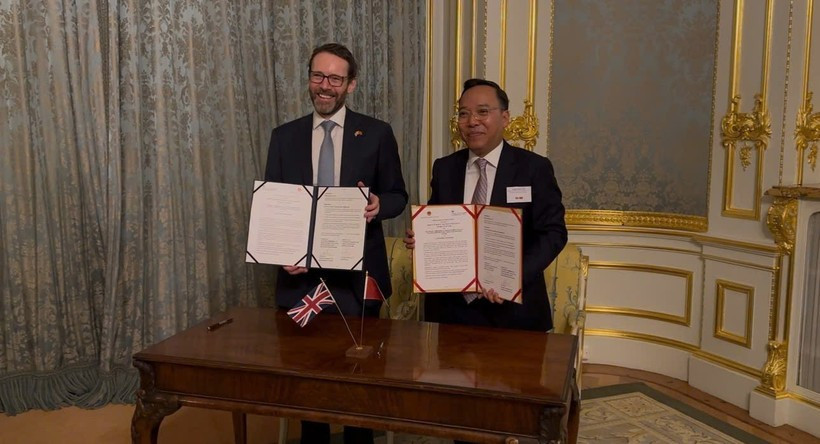
The Vietnamese Ministry of Industry and Trade (MoIT) signed a memorandum of understanding (MoU) on clean energy cooperation with the UK Foreign, Commonwealth and Development Office, and another MoU on product safety with the UK Department for Business and Trade.

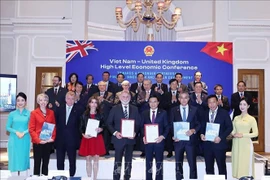
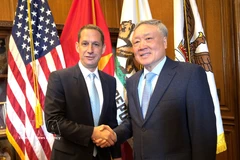
Deputy Minister of Industry and Trade Nguyen Hoang Long (right) and UK Ambassador to Vietnam Iain Frew sign an MoU on clean energy cooperation between the Vietnamese Ministry of Industry and Trade and the UK Foreign, Commonwealth and Development Office (Photo: VNA)

London (VNA) - Deputy Minister of Industry and Trade Nguyen Hoang Long and Minister for Industry in the UK Department for Business and Trade Chris McDonald have agreed to further step up cooperation in clean energy and trade during their working session in London.

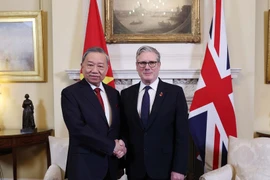
At the working session, held on the occasion of Vietnamese Party General Secretary To Lam’s official visit to the UK, the two sides discussed the active bilateral and multilateral cooperation between the two countries in trade and energy.

At the event, the Vietnamese Ministry of Industry and Trade (MoIT) signed a memorandum of understanding (MoU) on clean energy cooperation with the UK Foreign, Commonwealth and Development Office, and another MoU on product safety with the UK Department for Business and Trade.

The MoUs, built on the strong and effective partnership between the MoIT and UK counterparts in trade and clean energy, outline concrete cooperation directions and underscore the promising potential for future development under the key pillars of the Comprehensive Strategic Partnership established during Party General Secretary To Lam’s visit to the European nation.

The MoU on clean energy cooperation establishes the UK – Vietnam clean energy partnership framework, marking a strategic step forward in alignment with both countries’ net-zero emission and sustainable growth goals, and complementing a green finance cooperation agreement signed with Vietnam’s Ministry of Finance.

Under this framework, the two sides will deepen and broaden their clean energy cooperation by expanding renewable energy development, enhancing power grid infrastructure and transmission, mobilising public and private financing for green transition, refining the legal framework to encourage clean energy investment, and accelerating innovation and technology exchange to promote sustainable green growth in the future.

Meanwhile, the MoU on product safety reflects the two sides’ commitment to enhancing trade cooperation and fostering the healthy growth of bilateral goods trade. It aims to boost collaboration on measures to prevent unsafe products, enhance knowledge and awareness in product safety, and facilitate the exchange of experience and good practices in developing, managing and operating e-commerce platforms.

The signing of these agreements helps promote the effective implementation of existing cooperation frameworks and translates into action the commitments set out in the Joint Statement on upgrading the bilateral relations to a Comprehensive Strategic Partnership, generating positive impacts and contributing to promoting economic development in the two nations.

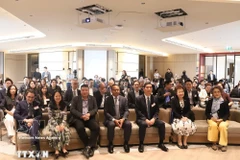
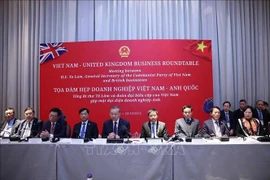
Immediately after the meeting with McDonald, Long attended a Vietnam–UK business reception, organised by the UK Department for Business and Trade and chaired by the UK Prime Minister’s Trade Envoy to Vietnam, Matt Western, where he highlighted the key achievements of bilateral cooperation and outlined future directions and opportunities./.
VNA

See more

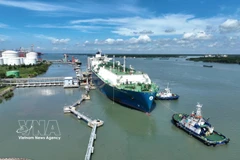
An LNG tanker docks at the Thi Vai LNG terminal in Ho Chi Minh City (Photo: VNA)

Solutions proposed to support firms amid Middle East conflict impacts

Top priority should be given to stabilising energy prices to ease input cost pressures and ensure supply stability – the most widely supported recommendation, chosen by 61.9% of surveyed firms. Businesses urged close monitoring of global fuel prices and supply risks, along with flexible measures to curb abnormal domestic price fluctuations and secure supplies of fuel and essential materials.

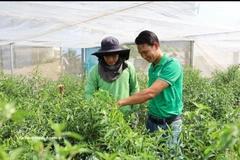
Nguyen Viet Tu (right) and a cooperative technician inspect a bird’s eye chilli field ready for harvest for export to European countries. (Photo: VNA)

Vietnamese herbs gain ground in European market

The Chau Pha Agricultural Production and Services Cooperative model is widely seen as an illustration of a new direction for Vietnam’s agriculture sector, one that combines clean production practices, modern management and proactive engagement with global markets.

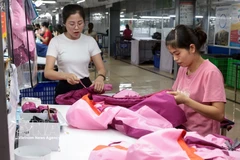
Garment production for export to the EU at the TNG company in Thai Nguyen province (Photo: VNA)

Businesses pivot strategies to sustain export growth momentum

Enterprises are shifting toward reasonably priced, easy-to-consume products such as tra fish, tilapia, canned items and surimi, instead of focusing mainly on high-end products like large-sized shrimp, which are facing weaker demand in some markets.

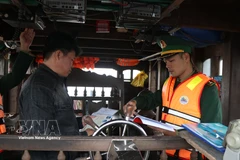
Border guards inspect and verify fishing vessels’ documents and procedural records before departure. (Photo: VNA)

Hue accelerates tech upgrades, strengthens vessel monitoring to combat IUU fishing

During the first quarter, the Department of Agriculture and Environment worked closely with city police and the Border Guard Command to inspect and supervise so-called “three-no” fishing vessels — those lacking registration, licences, or inspection certification — along with boats deemed ineligible for operation in Thuan An, Quang Dien, Vinh Loc, and Chan May–Lang Co.

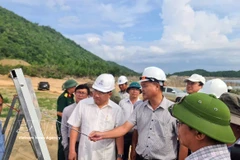
Officials of former Ninh Thuan province (which is part of Khanh Hoa province now) inspect the progress of Bac Ai pumped-storage hydropower plant. (Photo: VNA)

Efforts made to keep Bac Ai pumped-storage hydropower project on schedule

The project, which is included in the approved National Power Development Plan for 2021–2030 with a vision towards 2050, is developed to strengthen national energy security, support a circular economy and contribute to Vietnam’s commitment to achieving net-zero emissions by 2050, as pledged at the COP26 climate conference.

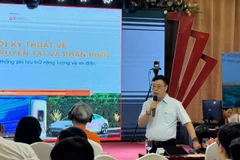
NSMO Chairman Nguyen Duc Cuong speaks at the event (Photo: VNA)

Experts seek to improve power dispatch in new energy era

Electricity demand is expected to rise strongly, while global energy markets remain volatile. In this context, rooftop solar and BESS are emerging as key solutions to improve flexibility and ensure supply, especially during peak periods.

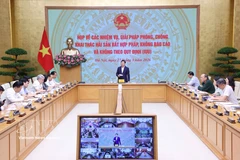
Prime Minister Pham Minh Chinh speaks at the conference. (Photo: VNA)

Enterprises must pioneer in achieving double-digit economic growth from 2026: PM

Reports delivered at the conference showed that Vietnam had about 1 million active enterprises by late 2025, up more than 25% from 2020, contributing roughly 60% of GDP and employing more than 16 million workers. They also account for the bulk of the country’s trade turnover, while Vietnam ranks among the world’s top 15 destinations for foreign direct investment.

Visitors browse the Vietnamese product display booths at the "Vitality of Vietnamese Goods" exhibition and livestream in Hanoi from March 7-9, 2026. (Photo: VNA)

Vietnamese goods promotion: Greater transparency needed

As transparency, traceability and social responsibility increasingly become essential entry requirements, proactive compliance will give Vietnamese enterprises a clear advantage in building trust among international partners.

Trade Counsellor Hoang Duc Nhuan of the Vietnam Trade Office in Algeria speaks at the online export consultancy session on the markets of Algeria, Senegal and Tunisia for more than 40 Vietnamese agencies and enterprises on March 26. (Photo: VNA)

Opportunities for Vietnamese businesses to promote exports to African markets

Vietnamese exporters were advised to seek partners through reputable channels and to use secure payment methods, such as irrevocable letters of credit confirmed by trusted European or American banks, or documentary collection with a deposit of at least 20% of the contract value. Deferred payment arrangements should be avoided.