Vietnamese, Chinese enterprises enhance logistics connectivity

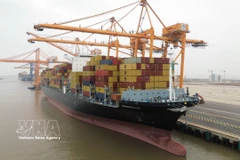
Vietnamese and Chinese enterprises have agreed to establish a new maritime shipping corridor, named “Two Ports, One Route,” directly linking Weifang Port in Shandong province of China with Long An International Port in Tay Ninh province of Vietnam, with the aim of boosting two-way cargo capacity and promoting bilateral trade

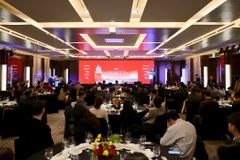
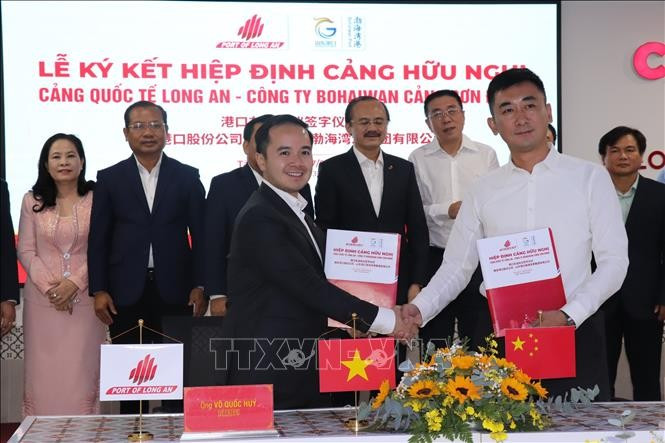
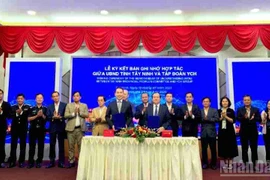
Chairman of the Board of Long An International Port, Vo Quoc Huy (left), signs a cooperation agreement with Chinese partner. (Photo: VNA)

Tay Ninh (VNA) - Vietnamese and Chinese enterprises have agreed to establish a new maritime shipping corridor, named “Two Ports, One Route,” directly linking Weifang Port in Shandong province of China with Long An International Port in Tay Ninh province of Vietnam, with the aim of boosting two-way cargo capacity and promoting bilateral trade.

Under a cooperation agreement signed between Long An International Port (Vietnam), SPG Bohaiwan Port, and Bohwa Shipping (China), the three parties will strengthen cooperation in port operations, maritime shipping, and logistics services. Key areas include expanding freight shipping routes; launching container and dry bulk cargo services; integrating international warehousing; and providing support services such as customs clearance, finance, and insurance. The plan also involves developing a specialised logistics hub for machinery exports and agricultural imports.

The alliance will form an integrated logistics ecosystem, aimed at optimising business costs, enhancing operational efficiency, and promoting a sustainable, green supply chain between Vietnam and China.

Cui Tiecheng, Deputy General Director of SPG Bohaiwan Port, expressed his hope that the project will serve as a model of economic and trade cooperation between the two countries, facilitating the global export of strategic products from both sides.

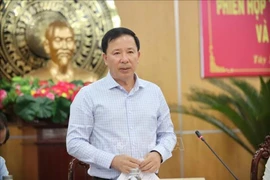
Meanwhile, Huynh Van Son, Vice Chairman of the Tay Ninh provincial People’s Committee, emphasised that the establishment of a fixed maritime shipping route will not only accelerate trade promotion but also help reduce logistics costs and enhance the competitiveness of local enterprises.

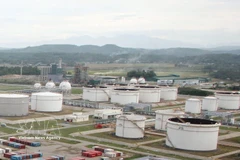
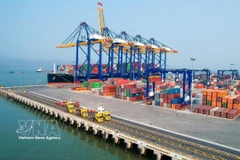
Strategically located as a southern gateway of Vietnam, the Long An International Port connects the key economic zones of the Southeast region, Ho Chi Minh City, the Mekong Delta, and international shipping routes. The port is capable of accommodating vessels of up to 70,000 DWT and is equipped with a comprehensive logistics infrastructure. It is among the region’s key logistics centres under development, poised to become a major transshipment hub for southern Vietnam, contributing to Tay Ninh province’s and the country’s sustainable economic growth./.
VNA

See more

Promoting stronger foreign direct investment (FDI) inflows is considered an important solution to help drive economic growth. (Photo: VNA)

Vietnam emerges as hub for high-quality FDI

Vietnam is gradually becoming a strategic destination for high-quality global FDI. Investment flows are increasingly directed toward sectors such as high-tech manufacturing, electronics, digital infrastructure, modern logistics, and industries that are closely linked to global supply chains.

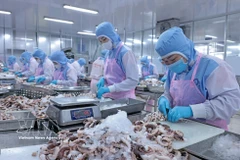
Shrimp processing for export at Huy Nam company, An Giang province. (Photo: VNA)

Fisheries sector proactively adjusts to emerging challenges

In addition to food safety regulations, the US continues to closely monitor the origin of imported seafood through the Seafood Import Monitoring Programme (SIMP) administered by the National Oceanic and Atmospheric Administration (NOAA). Requirements linked to the Marine Mammal Protection Act (MMPA) are also a major concern for businesses.

Pham Van Cong, Chairman of the Vietnam Cashew Association, speaks in a conference reviewing the industry’s 2025 performance and deploying procurement plans for 2026 in HCM City on March 13. (Photo: VNA)

Cashew sector braces for challenges in 2026 amid global uncertainties

Vietnam’s cashew industry recorded export turnover of about 5.5 billion USD in 2025, the highest level ever. He noted that the result reflects the industry’s remarkable development, dynamism and timely adaptation to complex and unpredictable challenges both domestically and globally.

An Phát Complex Industrial Park in Hai Phong City is one of the eco-friendly industrial parks. (Photo: VNA)

Green industrial parks become new magnet for FDI

Statistics show that about 80% of FDI enterprises prioritise investing in industrial parks with green energy infrastructure, reflecting a growing shift in investment preferences amid tightening global environmental standards.

Wood panel production at the Thuan An Wood JSC in Ho Chi Minh City (Photo: VNA)

Vietnamese businesses ride wave of investment in green manufacturing

Recent developments in private investment show that as confidence in the private sector has grown and is a key driver of economic development, investors are strengthening support for enterprises not only through capital but also management expertise and market connectivity.

Officers and soldiers of Son Tra Border Guard Station, Da Nang City Border Guard Command tell local fishermen about IUU fishing. (Photo: VNA)

Fishing solidarity groups help Vietnam with IUU “yellow card” warning removal

Over the years, coastal authorities in Da Nang have intensified efforts to educate fishermen about regulations, particularly the need to avoid illegal fishing in foreign waters. Local administrations and competent forces have also strengthened vessel registration and inspection procedures, installed vessel monitoring systems and ensured transparent declarations of catches at ports.

Representatives of Central Retail Vietnam and Lotte Plaza Market sign a distribution cooperation agreement at the networking event in Ho Chi Minh City on March 13. (Photo: VNA)

Vietnamese firms step up cooperation with international distribution chains

Connecting Vietnamese businesses with international distribution networks has been a key component of government-led trade promotion programmes for many years, which are designed to help domestic companies place goods directly into global retail systems rather than exporting solely through intermediaries.