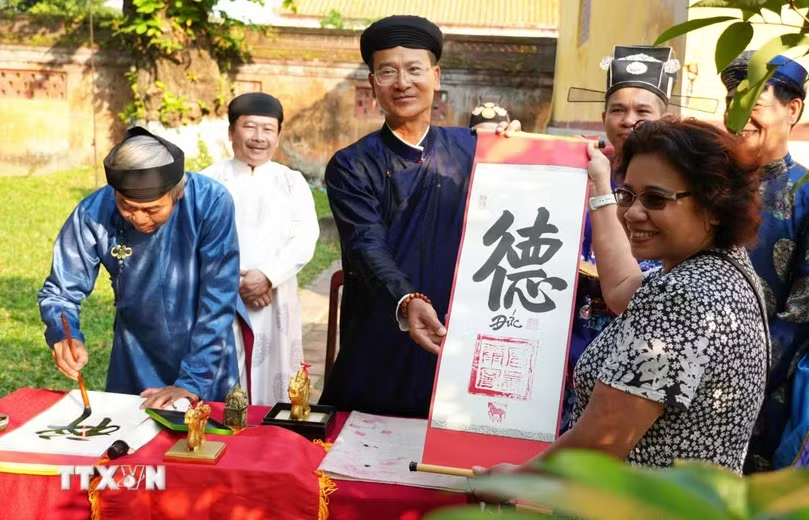
Hanoi (VNA) – As Vietnam enters a new stage of development with ambitions for fast economic expansion, its tourism sector is poised for a take-off, which requests an improved institutional framework, a renewed administrative mindset, and a long-term strategic vision.
Tourism is increasingly seen as a crucial driver of economic growth, with fresh opportunities emerging as the country advances toward a new development cycle.
More open visa and immigration policies have played an important role in enhancing Vietnam’s appeal to international visitors. The recent policy improvements are expected to not only remove longstanding bottlenecks but also expand the development space, paving the way for accelerated growth, enhanced competitiveness, and sustainable development.
Given this, refining institutional frameworks and fostering a favourable and modern business environment has become crucial for the entire industry.
Drivers for breakthrough
The Vietnam National Authority of Tourism said the perfection of the State Steering Committee for Tourism under the Prime Minister’s Decision No. 1532/QD-TTg, dated July 15, 2025, is one of the sector’s key milestones.
The action plan for the 2025–2026 period, along with the Steering Committee’s working regulations and inter-agency coordination mechanism, has also been strengthened, ensuring concentrated and unified direction from the central to local levels. This enables the timely handling of cross-sectoral tourism issues and provides a crucial cornerstone for synchronously implementing tourism development solutions in the new context.
The Prime Minister’s Official Dispatch No. 34/CD-TTg, issued in April 2025, further underscores the Government’s strong commitment to developing tourism as a contributor to double-digit economic growth.
It highlights the need to stimulate demand, diversify tourism products, accelerate digital transformation, improve the business environment, and enhance service quality. Ministries and localities have also been urged to take decisive action to address bottlenecks related to administrative procedures, infrastructure, and human resources.

Another key policy instrument is the Prime Minister’s Decision No. 382/QD-TTg, dated February 21, 2025, which outlines a scheme for implementing the national tourism system master plan for 2021–2030, with a vision to 2045. It sets clear tasks, deadlines, responsibilities and mechanisms for coordination among ministries, sectors, and localities, thereby providing a unified framework for mobilising resources and developing tourism infrastructure, products, and markets.
Visa policy reforms, including expanded exemptions, greater incentives for key markets, and additional entry points for e-visa holders, are described as “soft leverage” to attract international visitors. These measures are particularly effective in drawing high-quality tourists with longer stays and higher spending, thereby boosting revenues and creating spillover effects across aviation, hospitality, retail, and services. Selective incentives have also helped draw investors, experts, and MICE travellers.
Many administrative procedures for travel services, tour guides, and accommodation facilities have been reviewed and simplified. Notably, the rollout of a two-tier local administration model since July 2025, alongside stronger decentralisation, has enabled more flexible and responsive governance at the local level, thus improving the effectiveness and efficiency of state management.
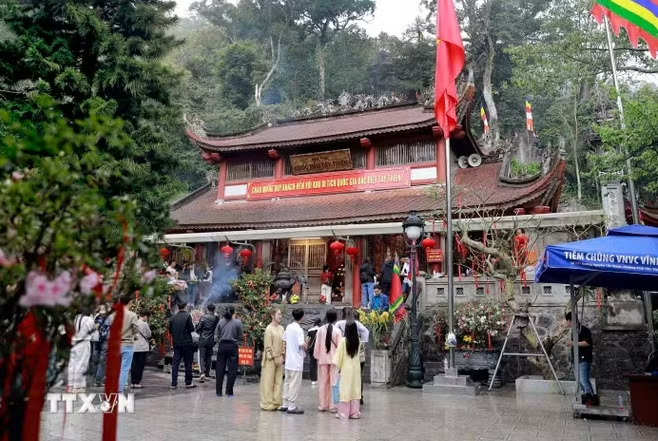
New opportunities, new strategies
Looking ahead, 2026 is seen as a pivotal year for the whole tourism industry. Efforts will continue to focus on revising the 2017 Tourism Law and related regulations to better align with emerging trends such as digital transformation, the platform economy, green tourism, and smart tourism.
After nearly a decade of implementation, the current law has provided an important legal foundation. However, new developments and business models are increasingly outpacing existing regulations, making legal reform both urgent and necessary to enhance competitiveness, attract investment, adapt to global trends, and truly become a key economic sector.
VNAT Director Nguyen Trung Khanh said the sector must shift toward a growth model driven by high added value, service quality, innovation, and sustainability. It must also clearly identify target markets, high-spending segments, key products, and regional development zones, along with restructuring investment, infrastructure and human resources, and promoting digital transformation.
Experts also stressed the need to reorganise tourism development space according to newly expanded administrative boundaries, thus facilitating the formation of integrated tourism regions with diverse resources. They noted that this will enable better planning of destination networks, tourism corridors, and thematic products while strengthening connectivity in infrastructure, data, and promotion.
This also offers an opportunity to form new tourism growth poles, improve resource utilization, and enhance the region-based competitiveness of destinations, they added.
With strong momentum built in 2025, Vietnam’s tourism industry is entering a new phase that demands a more advanced policy framework, an innovative governance mindset, a strategic vision, and coordinated action by all stakeholders.
As the legal corridor are strengthened, development space restructured scientifically, and policies better aligned with the market, businesses and travellers, the tourism industry is well-positioned to accelerate and become a spearhead economic sector in the years ahead./.