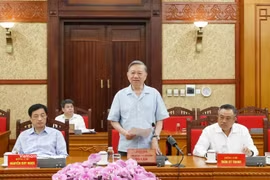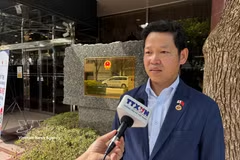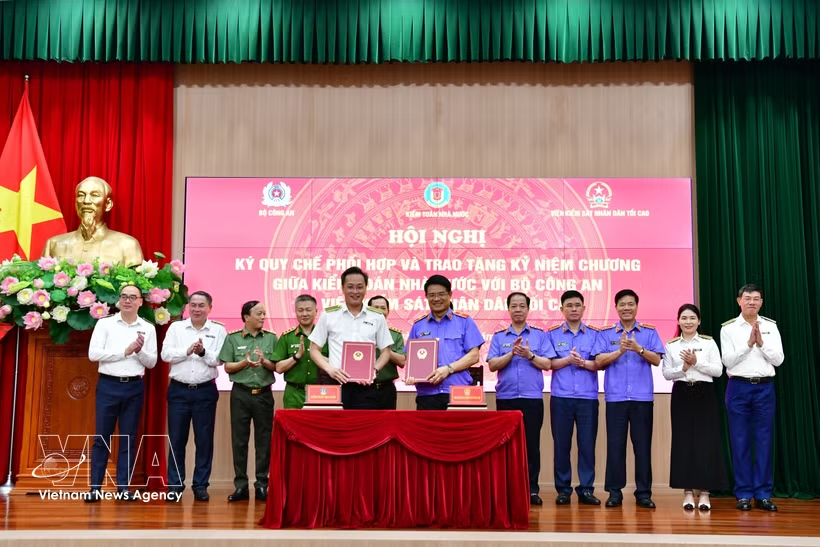
Hanoi (VNA) – The State Audit Office of Vietnam (SAV), Ministry of Public Security and Supreme People’s Procuracy convened a webinar in Hanoi on August 27 to share experience in the fight against corruption, wastefulness and misconduct.
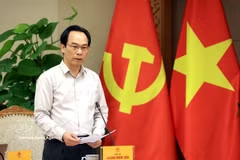
In his opening speech, Deputy Auditor General Doan Anh Tho said the event provided a platform to identify obstacles and propose solutions to sharpen enforcement.
Tho said deeper coordination among the three bodies is both a statutory duty and a shared obligation to combat corruption, wastefulness and misconduct, better protect public assets, State interests, and ensure the rights and legitimate interests of organisations and individuals.
Deputy Director of the Ministry of Public Security’s Police Department for Economic Crimes Pham Truong Giang said investigations have exposed collusion in “interest groups”, manipulation from the policy-making and planning stage, bid rigging, use of “backyard” firms, abuse of asset valuations and public investment; and the legalisation, concealment and dispersal of assets.
Since 2020, economic crime police have uncovered and initiated proceedings against more than 3,700 cases involving 8,900 suspects accused of corruption, wastefulness and other misconduct, with asset recoveries exceeding 600 trillion VND (23 billion USD).
Pham Van Dung, Deputy Director-General of the Supreme People’s Procuracy’s department overseeing economic and corruption investigations, cited dual accounting books, money-flow laundering, abuse of power to steer or legitimise decisions, concealment of ownership and beneficial interests, split transactions, layers of intermediaries, and exploitation of bidding, auctions, investment and public-asset procurement to create vested interests.
In major economic and position-related cases, Dung said investigators must identify “points of suspicion” early to locate the core of a case, reconstruct the entire process of policymaking and enforcement, and trace actual benefits. Money flows and beneficial ownership are the key lines of proof.
Participants said corruption and related crimes have become more complex and sophisticated, often hidden inside seemingly lawful economic activity and embedded in decision-making before being legitimised through procedures, records, contracts and documents. Some are linked chains spanning policy interference and collusion to document legalisation and asset concealment.
They stressed that prevention must precede enforcement, power controls must be tied to accountability, and oversight of assets, income and interests should be strengthened with more data and information technology applied.
They called for early-warning mechanisms in high-risk areas, including land management, finance, banking, public investment, bidding, procurement, public asset management, equitisation, State capital management in enterprises and natural resource extraction.
In particular, they urged stronger coordination and information sharing among the three bodies starting at the risk identification stage, rather than after a case breaks.
Investigators could give the SAV information on emerging criminal methods and lists of sensitive, high-risk sectors to shape audit plans and risk targeting, they said./.