500-year-old Phuoc Tich village draws visitors thanks to heritage tourism

The village is now home to 40 traditional wooden houses aged between 100 and 300 years. They share a common architectural lineage, built by master carpenters from famed My Xuyen carpentry village using sturdy frames joined with pegs and mortise techniques, without iron nails.

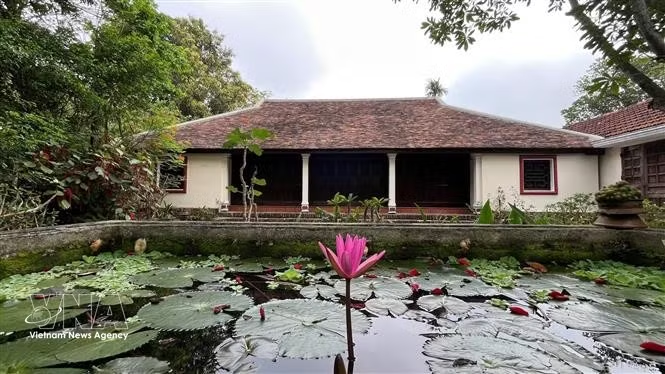
A traditional-style house in Phuoc Tich village (Photo: VNA)

Hue (VNA) – Phuoc Tich, a village more than five centuries old set along the O Lau River roughly 40 km north of Hue, holds a quiet, weathered beauty that captures the stamp of traditional north-central Vietnamese rural life.

Home to heritage wooden houses

The village is now home to 40 traditional wooden houses aged between 100 and 300 years. They share a common architectural lineage, built by master carpenters from famed My Xuyen carpentry village using sturdy frames joined with pegs and mortise techniques, without iron nails.

Crossbeams, decorative doors, rafters and roof trusses are carved with fine motifs and patterns drawn from ancient Vietnamese culture.
vnanet-v.jpg
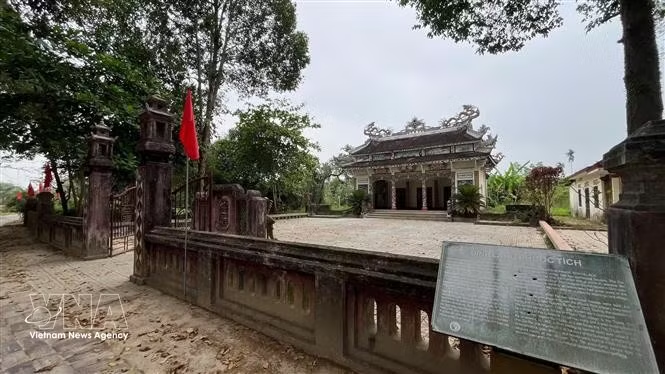
The Phuoc Tich communal house (Photo: VNA)

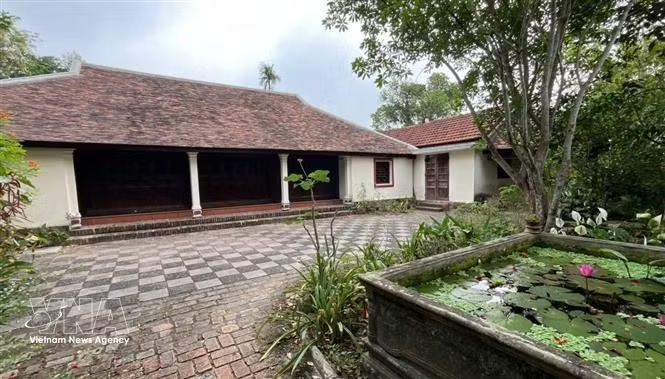
Each house follows a Hue-style layout with gateways, gardens, ponds, decorative screens and trimmed hedges. Visitors touring the homes get a briefing on their architecture, cultural significance and history.

Beyond the wooden dwellings, the village holds a rich mix of spiritual and religious structures, including communal houses, pagodas and shrines.

Tourism push

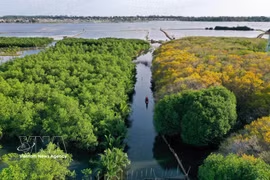
Phuoc Tich’s landscape blends into its natural surroundings, wrapped in bamboo groves and centuries-old trees. Homes and lanes, separated not by walls but by lush green hedges, create an uninterrupted swath of green and an open settlement pattern typical of Vietnam’s north-central countryside.

Cultural researcher Assoc. Prof. Dr. Nguyen Van Manh said it is exceptionally rare for a village in central Vietnam, a region battered by prolonged war and bombing, to have preserved its ancient structures, temples, and trees as remarkably as Phuoc Tich.

The village was recognised as a National Heritage Village in 2009. Seventeen years on, it has made progress in both conservation and tourism. From 2024 through late 2025, the village welcomed more than 50,000 visitors, generating over 3.2 billion VND (123,000 USD) in tourism revenue.

Nguyen Ngoc Nam, Deputy Director of the Public Service Centre of Phong Dinh ward (Hue city), said the village now offers nine tourism service categories engaging about 40 local residents, including heritage house tours, food services, bicycle rentals, guided tours, pottery demonstrations, traditional cake-making, and folk cultural exchanges.
vnanet-b.jpg
A traditional-style house in Phuoc Tich village (Photo: VNA)

Among the preserved ancient houses, 11 now welcome visitors, four run homestays, and four offer culinary experiences.

To bring in more arrivals, local authorities have been working with over 40 travel agents and schools that arrange educational and experiential tours to Phuoc Tich.

Local authorities are also planning to step up training for residents and guides, develop new tourism products and improve homestay services. The aim is for visitors to do more than sightsee and stay, but immerse themselves in the village’s cultural identity and local hospitality, spreading Phuoc Tich’s image across Vietnam and beyond./.
VNA

See more

Book displays and introductions help foster a love of reading and spread reading culture throughout the community. (Photo: VNA)

Vietnam seeks strong global presence for its children's books

Vietnamese children’s literature has steadily expanded its presence in international literary circles in recent years. From a few notable titles earning recognition in respected competitions, the sector has shown encouraging progress in bringing Vietnamese stories to readers around the world.

A stall offering discounted combo meals of bread and drinks at the fourth Banh mi Festival in Ho Chi Minh City on April 23 (Photo: VNA)

Ho Chi Minh City ranks among world’s top culinary destinations

According to Time Out, the appeal of Ho Chi Minh City’s cuisine lies in its creativity, much of which was shaped during challenging periods in history. Iconic dishes such as banh mi (sandwiches) and com tam (broken rice) are highlighted as examples of this resourcefulness.

The international short documentary film festival “Viet Culture in Motion” officially opens at the Saint-André des Arts cinema in Paris on June 11 (Photo: organising board)

Vietnamese youth tell cultural stories on European screen

The international short documentary film festival “Viet Culture in Motion” highlights the efforts of young Vietnamese and overseas Vietnamese filmmakers to introduce Vietnam’s culture and people to international audiences through documentary storytelling. It has brought together professional filmmakers, screenwriters and cultural and film activists from Vietnam and abroad.

Delegates to the 107th meeting of the AIMF Executive Bureau 2026 (Photo: VNA)

Hue spreads heritage city values within Francophone community

Its participation marked an important step for the central city of Hue to expand its international partnerships, deepen integration with municipalities worldwide, and cement its role and standing as a dynamic and responsible heritage city within the Francophone network.

With its rich history, aesthetic grace, and spiritual meaning, the lotus stands as a central symbol in defining Hue’s cultural identity. (Photo: tapchidongnama.vn)

Lotus Festival lights up Hue’s summer

Scheduled for June 19-21 at Bong Lai Islet on Tinh Tam Lotus Lake in Phu Xuan ward, one of Hue’s most renowned scenic landmarks and a symbol of royal garden art, the festival draws inspiration from the lotus’s enduring beauty in court culture. The event aims to honour local heritage while offering visitors a distinctive summer tourism experience.

The “Vietnam Pavilion” at Aldea Global 2026 (Photo: VNA)

World Cup 2026: Vietnam leaves distinct mark at global cultural showcase

The “Vietnam Pavilion” at Aldea Global 2026 offers Mexican visitors and international guests an opportunity to explore the country’s rich cultural heritage, history and people through exhibitions, tourism promotion activities, traditional arts presentations and displays of representative cultural products.

Michelin Guide Vietnam recognises 11 one-Michelin star restaurants (Photo: Michelin Guide Vietnam)

Local ingredients, cultural roots propel Vietnam’s Michelin journey

One of the clearest examples is Hieu Luc, a modest fish soup eatery on Hai Ba Trung Street in Hanoi, which has been included in the Michelin Selected category for the second consecutive year. Known for its clear, delicately sweet broth made from freshwater perch and mustard greens, the restaurant serves a traditional specialty from Hung Yen province.

Delegates attending the ASEAN City Leaders Conference 2026 visit the Imperial Citadel of Thang Long on June 9. (Photo: VNA)

ASEAN city leaders explore Hanoi’s heritage sites

At the Imperial Citadel of Thang Long, delegates visited the Doan Mon Gate and learnt about the formation and development of the ancient capital through different historical periods at display spaces. They also explored the Kinh Thien Palace’s Dragon Steps (large stone steps with dragon carvings), regarded as the political and ceremonial centre of the imperial citadel during successive Vietnamese dynasties.

Ly Hoang Nam is Asia's No. 1 pickleball player. (Photo: webthethao.vn)

Ly Hoang Nam tops Asian pickleball rankings

Vietnam boasts five players in the DUPR Asian top 10, with Nam leading the rankings on 6,267 points ahead of competitors from the Philippines, India, Hong Kong (China) and Chinese Taipei.

Visitors to the booth of the Vietnamese Embassy at the Embassies Food and Culture Festival held in Prague, the Czech Republic, on June 6 (Photo: VNA)

Vietnamese culture, cuisine leave lasting impression in Czech Republic

Featuring more than 100 booths representing diverse cultures from around the world, the festival transformed the heart of Prague into a vibrant multicultural space where visitors could sample traditional dishes, enjoy folk performances, listen to traditional music and experience unique cultural showcases from different continents.