AI infrastructure emerges as Southeast Asia's new growth engine

Data centres have accelerated in growth throughout Southeast Asia. Much of the region’s recent data centre growth has shifted towards Malaysia; Thailand, Indonesia and Vietnam are also building capacity.

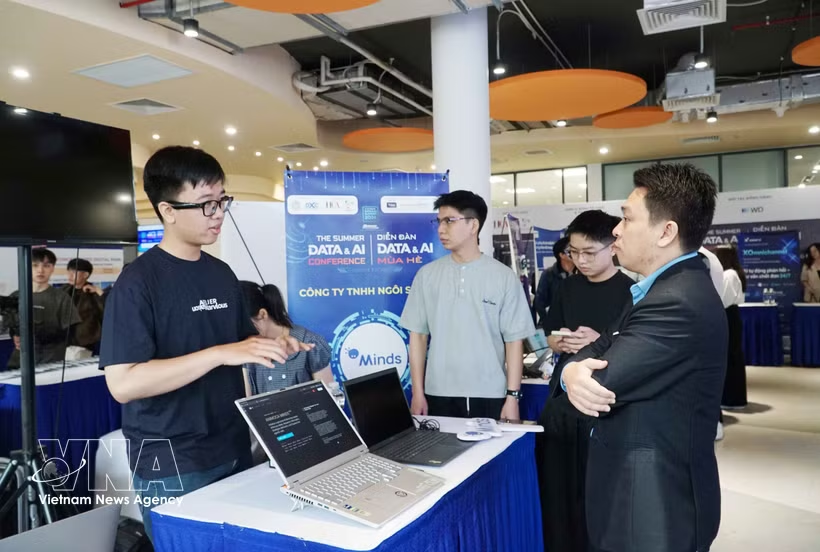
Much of Southeast Asia's recent data centre growth has shifted towards Malaysia; Thailand, Indonesia and Vietnam are also building capacity. (Illustrative photo: VNA)

Hanoi (VNA) – The AI story is not just a technology story, but also an economic growth one, Edmund Leong, head of group corporate banking and sector solutions group and Investment Banking at the United Overseas Bank (UOB) said at the recent ASEAN Conference 2026, organised by the Singapore Business Federation.

As reported by The Business Times, a Singaporean news source, Leong said data centres have accelerated in growth throughout Southeast Asia. Much of the region’s recent data centre growth has shifted towards Malaysia; Thailand, Indonesia and Vietnam are also building capacity, he noted.

Leong said that Southeast Asia must overcome two bottlenecks to allow AI infrastructure deployment to flourish.

One of these is power. The region, he noted, will need to invest more in renewable energy and grid infrastructure to enable its data centre growth to accelerate.

The other constraint is semiconductor supply. “There is currently a shortage of semiconductor and memory chips,” he said as quoted by the site, noting that strong demand continues to outpace manufacturing capacity.

He said he believes that when there is tremendous demand for certain things, it will also lead to supply coming through. As those constraints ease, AI infrastructure should become more affordable for enterprises, supporting wider adoption across the economy./.

VNA

See more

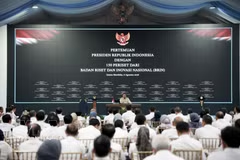
A view of the meeting between Indonesian President Prabowo Subianto and 150 researchers from the National Research and Innovation Agency (BRIN) on August 6 (Photo: VNA)

Indonesia sees technology mastery as key to national progress

Addressing a meeting with 150 researchers from the National Research and Innovation Agency (BRIN) on August 6, Indonesian President Prabowo Subianto affirmed that mastery of science and technology is essential for accelerating national development and enhancing Indonesia's global competitiveness.

Cambodia eyes higher value-added manufacturing

Cambodia eyes higher value-added manufacturing

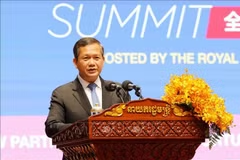
Cambodian Deputy Prime Minister Sun Chanthol urged the private sector to work closely with the government in preparing for the next phase of industrial development by moving upstream into higher value‑added manufacturing and strengthening supply chain capabilities.

Malaysia steps up drive to build world-class startup ecosystem

Malaysia steps up drive to build world-class startup ecosystem

For KL20 2026, four new priority areas have been added, aligning with Malaysia's 13th Malaysia Plan (2026–2030), which seeks to increase economic complexity, strengthen high-value industries and expand domestic production of value-added goods and services.

Thai Prime Minister Anutin Charnvirakul (front, right) and Myanmar President Min Aung Hlaing (front, left) at their meeting in Bangkok on August 6, 2026 (Photo: Kyodo/VNA)

Thailand, Myanmar jointly tackle cross-border pollution

Speaking at the signing ceremony, Thai Minister of Natural Resources and Environment Suchart Chomklin described the TOR signing as an important milestone in bilateral environmental cooperation, saying it would enhance water resource management, protect ecosystems and improve life quality for those living in border areas.

Thailand, Japan deepen cooperation in smart agriculture

Thailand, Japan deepen cooperation in smart agriculture

The two sides agreed to strengthen cooperation in smart agriculture through the application of automation, the Internet of Things (IoT), advanced technologies and innovation, while promoting the use of modern agricultural machinery and expanding workforce training.

Thai Prime Minister Anutin Charnvirakul (left) and Myanmar President Min Aung Hlaing (centre) at the official welcome ceremony for the latter in Bangkok on August 6, 2026. (Photo: Kyodo/VNA)

Thailand, Myanmar promote economic, space technology cooperation

At the Thailand-Myanmar Business Forum in Bangkok, attended by Thai Prime Minister Anutin Charnvirakul, President Min Aung Hlaing and more than 700 representatives from government agencies, businesses and the business communities of both countries, the two leaders outlined orientations for boosting economic cooperation and expanding bilateral ties.

At least four killed in Philippines landslides

At least four killed in Philippines landslides

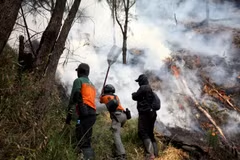
Philippine authorities said four days of heavy rain on the island of Luzon have triggered multiple landslides. In Benguet province, a hillside collapsed onto a small restaurant on August 6, burying three employees working in the kitchen.

Thai rice exports decline nearly 19% in first half of 2026

Thai rice exports decline nearly 19% in first half of 2026

DFT Director-General Arada Fuangthong attributed the decline to abundant global rice supplies, which have intensified price competition. In addition, conflicts in the Middle East disrupted Thai rice exports to Iraq – one of its key markets – from March.

Buildings in Kuala Lumpur, Malaysia (Illustrative photo: AFP/VNA)

Malaysia businesses thrive on AI boom

Nineteen Malaysian companies enter Forbes Asia’s 2026 list of the 200 best companies with annual revenues of less than 1 billion USD, more than double the number from the previous year.

An electric vehicle on display at an auto exhibition in Kuala Lumpur, Malaysia, in June 2026. (Photo: VNA)

Malaysia considers levy on EV sales to fund public charging infrastructure

Speaking during a question-and-answer session in the Senate on August 5, Minister of Investment, Trade and Industry Johari Abdul Ghani said the proposal followed the government's loss of 3.3 billion MYR (825 million USD) in tax revenue through incentives for imported EVs, while investment in public charging infrastructure had fallen short of expectations.