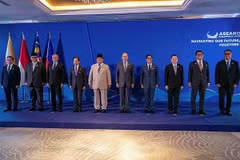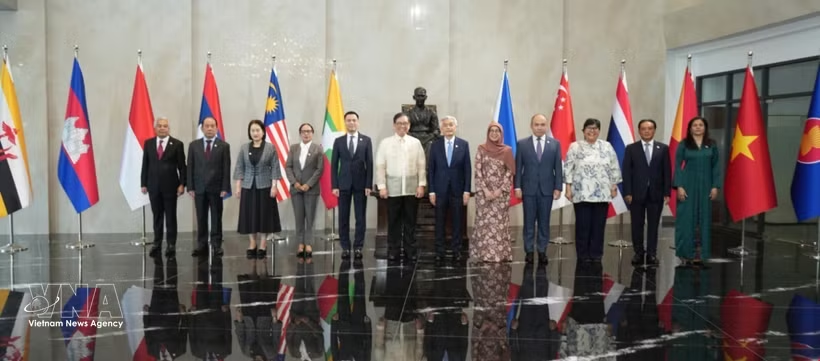
Hanoi (VNA) – The 48th ASEAN Summit, taking place in Cebu, the Philippines, from May 7 to 8, comes as geopolitical and economic volatility continues to intensify, placing pressure on the bloc to strengthen solidarity, enhance resilience and reaffirm its central role in the evolving regional architecture.
A complex backdrop
The summit is being held amid multiple global and regional challenges affecting Southeast Asia. Tensions in the Middle East have fuelled energy price volatility and supply chain disruptions, heaping pressure on fuel-importing economies across the region. Rising inflation, slower growth and macroeconomic risks remain major concerns.
At the same time, intensifying strategic competition among major powers is accelerating supply chain fragmentation and reshaping global trade. ASEAN faces the challenge of maintaining strategic balance while making use of shifting investment and trade flows.
Internal issues also continue to test the bloc. The prolonged crisis in Myanmar and the slow implementation of the Five-Point Consensus have exposed limitations in ASEAN’s engagement mechanism for handling complex regional challenges.
Meanwhile, developments in the East Sea remain a key concern for member states, highlighting the need to maintain peace, stability, security and safety of navigation while upholding international law. Differences among some regional countries, including Thailand and Cambodia, are also being closely monitored, underlining the importance of dialogue and consensus enhancement.
Non-traditional challenges such as climate change, extreme weather, cyber security threats and transnational crime are also becoming more severe. Rapid digitalisation has further increased cyber risks across the region.
Observers say ASEAN is facing a “dual challenge” – responding effectively to external shocks while strengthening internal capacity to preserve its central role in an increasingly fragmented regional order.
Shaping priorities
In response, the summit agenda is focused on the strategic pillars to enhance resilience and promote sustainable development.
Economically, ASEAN is prioritising supply chain diversification to reduce dependence on certain markets and suppliers. Energy and food security remain high on the agenda, alongside initiatives on renewable energy, the regional power grid and strategic reserves. Financial and monetary cooperation, including cross-border payments and currency swap arrangements, is also being strengthened to reduce external risks.
Deeper economic integration is another major focus. The bloc is accelerating negotiations on the ASEAN Digital Economy Framework Agreement (DEFA), expected to become a legal foundation for regional digital trade. The effective implementation of agreements such as the Regional Comprehensive Economic Partnership (RCEP) is also seen as essential to sustaining growth amid weaker global trade.
In the security sphere, ASEAN continues pursuing a comprehensive approach covering both traditional and non-traditional challenges, including maritime security, counter-terrorism, transnational crime fight and cyber security.
Regarding the East Sea, member states continue to stress the importance of international law, particularly the 1982 United Nations Convention on the Law of the Sea (UNCLOS), while pushing for an effective and substantive Code of Conduct in the East Sea (COC).
Digital transformation and innovation are also emerging as new growth drivers. With a population of more than 600 million and high internet penetration, ASEAN is seeking to establish common frameworks for data governance, artificial intelligence and e-commerce to ensure a secure and interconnected digital space.
Notably, 2026 is viewed as the starting point for implementing the ASEAN Community Vision 2045, which aims to build a cohesive, resilient and innovative community while promoting peace, stability and inclusive development.
A strategic test
As ASEAN Chair in 2026, the Philippines is expected to play a key role in shaping priorities and fostering consensus within the bloc, likely adopting a more proactive and substantive approach to sensitive regional issues.
On international flashpoints, ASEAN is set to seek a common voice to ease tensions and minimise spillover effects on the region. Regarding Myanmar, more flexible mechanisms may be promoted to step up dialogue and humanitarian assistance though progress will depend on the goodwill of relevant parties.
In the East Sea issue, adherence to international law and efforts to finalise the COC will remain central priorities. ASEAN is also expected to strengthen its role in managing internal tensions to preserve regional stability.
Another overarching priority is reinforcing intra-bloc solidarity. Analysts say that despite mounting challenges, ASEAN still possesses important strengths, including decades of cooperation, complementary economic diversity and a shared commitment to peace and stability.
If the bloc can effectively harness new growth drivers such as the green economy, digital economy and artificial intelligence, it could maintain its position as one of the world’s most dynamic growth centres.
The 48th ASEAN Summit is therefore seen not only as a high-level dialogue platform, but also as a test of ASEAN’s adaptability and the Philippine chairmanship’s coordination capacity in an increasingly volatile strategic environment./.
📝OP-ED: Vietnam affirms proactive, constructive role in ASEAN
As Southeast Asia becomes increasingly hit by strategic competition among major powers, maintaining unity and cohesion within ASEAN has become a prerequisite to preserve the bloc’s central role. In this process, Vietnam has emerged as an important balancing force.