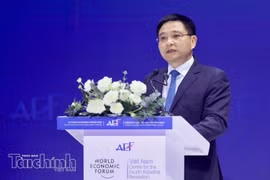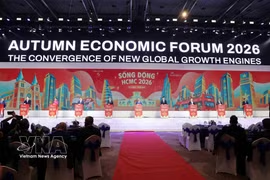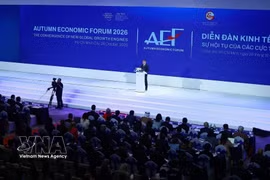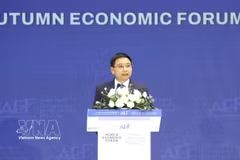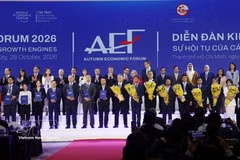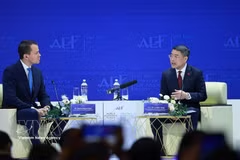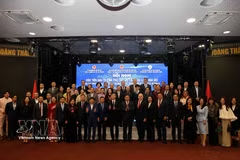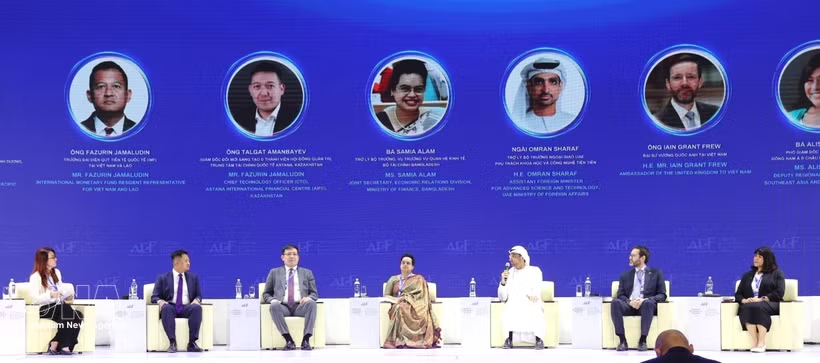
Ho Chi Minh City (VNA) – An in-depth assessment of capabilities, identification of barriers and solutions to overcome them, and stronger connections and cooperation to help Vietnam and Ho Chi Minh City seize new growth drivers in a changing world were the focus of a discussion on cooperation frameworks for a new era held on October 28 as part of the Autumn Economic Forum (AEF) 2026 in Ho Chi Minh City.
Challenges and prospects for Vietnam
Devendra Jain, Senior Manager for Advanced Manufacturing and Supply Chains at the World Economic Forum (WEF), said Vietnam has built an impressive growth model, becoming a major manufacturing hub, an investment destination and an increasingly interconnected economy. The country now needs to move beyond simply building connections and become a smartly connected economy.
Vietnam’s competitiveness will depend not only on building factories, seaports, supply chain networks, roads or industrial parks, but also on how effectively these assets work together, he said, stressing the significant role of smart infrastructure, which combines physical infrastructure, connectivity, data, and artificial intelligence (AI) to enhance productivity, resilience, and investment appeal.
According to Jain, Vietnam’s priorities and Ho Chi Minh City’s master plan to 2050 point to two urgent opportunities for smart infrastructure. The first is to connect factories, logistics providers, inland warehouses and seaports along export corridors. The second is to develop shared smart infrastructure for small- and medium-sized enterprises (SMEs), providing digital infrastructure, AI tools, data standards and cybersecurity services that factories and SMEs can access jointly.
Vietnam needs to act urgently to seize the wave of smart infrastructure transformation and move towards higher-value segments of global value chains, he noted, adding that the WEF stands ready to support the country in piloting these models by connecting the Government and businesses with global expertise to turn opportunities into practical action.
Sharing his views on Vietnam’s challenges and opportunities in the new era, Denis Depoux, Global Managing Director of Roland Berger, said the presence of major manufacturing and technology firms from China and the US has made Vietnam a key link in global value chains. The country’s export structure has improved significantly, with electronics and machinery accounting for nearly 60% of exports, up from 37% in 2016.
He held that Vietnam needs not only capital but also higher productivity, greater efficiency and improved performance in public services, state-owned enterprises, private businesses and foreign-invested enterprises.
Based on his analysis of Vietnam’s economic strengths and development challenges, Depoux proposed seven recommendations, including developing the corporate bond market to reach 20% of GDP, from the current 10–11%; securing an investment-grade sovereign credit rating to attract investment capital; and adopting asset recycling models to unlock funds from existing assets for reinvestment.
He also called for closer integration of real-world manufacturing with digital and AI technologies to build smart manufacturing value chains; stronger domestic and international connectivity; and the development of supply chain finance hubs, with Ho Chi Minh City and Da Nang positioned as financial centres for supply chains. Low-carbon standards should also serve as a foundation for the competitiveness of Vietnamese exports.
Proposed development model for Ho Chi Minh City
Focusing on opportunities to connect Ho Chi Minh City’s existing resources into an integrated, smart innovation ecosystem with international competitiveness, Prof. Dr Truong Quoc Cuong, a member of the Science – Technology, Innovation and Digital Transformation Subcommittee under the Ho Chi Minh City Development Research Board, said the city aims to achieve double-digit GRDP growth driven by science, technology and innovation.
Drawing on Ho Chi Minh City’s current situation, Cuong proposed establishing a technology corridor comprising six specialised but complementary functional poles within a shared value chain. These will focus on knowledge, high technology, advanced manufacturing, innovation and finance, global logistics, and the green and maritime economies. The corridor would be driven by six key flows: knowledge and human resources, technology, capital, innovation, logistics, data and global connectivity.
Alongside proposals for an integrated innovation governance framework to guide the corridor’s operation and a roadmap for implementation, Cuong recommended strengthening coordination mechanisms, incorporating the corridor into the overall master plan, transforming high-tech parks into science parks, establishing financial connectivity mechanisms, developing logistics and digital infrastructure, accelerating the green transition, shifting from attracting FDI towards promoting technology spillovers under appropriate conditions, and proactively pursuing international cooperation and technology diplomacy.
He perceived that Ho Chi Minh City needs to transform its growth model towards one driven by science, technology and innovation, moving from isolated functional zones to an interconnected regional corridor. Effective regional coordination, close cooperation among stakeholders and proactive international engagement will be key to its success./.
See more
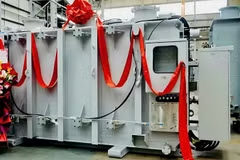
Quang Ninh firm exports first transformer shipment to the Philippines
The shipment, valued at more than 700,000 USD, comprises 69 Kv to 13.8 Kv distribution transformers. The products were exported to Cotabato Light and Power Company, a subsidiary of the Philippines’ Aboitiz Power Group, to serve electricity transmission in the country.
Vietnam’s export outlook holding firm
“The four EFTA markets do not import much Vietnamese seafood at present, but having a free trade agreement will make two-way trade easier and widen cooperation between Vietnamese companies and partners strong in fishing, processing and seafood technology,” said Deputy Secretary General of the Vietnam Association of Seafood Exporters and Producers (VASEP) Le Hang.
VEFTA opens opportunities for high-tech cooperation, innovation
According to Vice President of the Foreign Trade University Associate Professor Dr. Dao Ngoc Tien, the VEFTA’s long-term value lies largely in its non-tariff commitments, which establish institutional frameworks, principles and cooperation mechanisms with lasting economic impacts.
Reference exchange rate goes up on October 29
With the current trading band of ±5%, the ceiling rate applicable to commercial banks stood at 26,926 VND/USD, while the floor rate was 24,352 VND/USD.
Vietnamese aircraft fleet climbs to 261
Among them, Vietjet registered 107 aircraft, including 16 Airbus A320s, 83 A321s and eight A330s. Vietnam Airlines has 94, including four A320s, 59 A321s, 14 A350s and 17 Boeing 787s.
Ca Mau approves wind power project worth nearly 154.7 million USD
To ensure the project stays on schedule, Huynh Chi Nguyen, Vice Chairman of the provincial People’s Committee, has assigned the Department of Agriculture and Environment to take the lead and coordinate with relevant agencies in guiding procedures for land allocation and leasing, the allocation of marine areas, and environmental protection. Relevant departments and agencies are responsible for state management, inspection, supervision and handling issues arising within their respective jurisdictions.
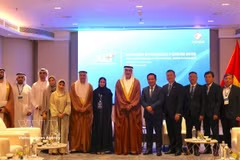
Ho Chi Minh City seeks to expand energy cooperation with UAE
A Ho Chi Minh City official called on major UAE energy groups to consider investing in the project in the Ba Ria–Vung Tau area, which aims to establish an energy hub in southern Vietnam to serve domestic and regional markets.
Gold's headline price tells only part of trading story
Gold prices are often quoted as a single figure, making it easy to compare movements across different periods. However, a change in the quoted price does not translate into the same financial outcome for everyone exposed to the market. The result depends on how gold is traded, the size of the position, and the costs and contractual terms attached to the transaction.
Vietnam must strengthen domestic capacity to move up global supply chains: Deputy PM
Thang stressed that Vietnam could not remain a passive recipient or an outside observer. Instead, it must build its own capacity and actively define its role in global production networks. The goal is not simply to join existing or emerging value chains, but to create the conditions, mechanisms and capabilities for Vietnam and its international partners to participate more directly in value creation.
VIFC-HCMC announces first 10 official members
The 10 first members have a combined registered charter capital and committed capital contribution of 33.63 million USD. They plan to invest in and develop projects across infrastructure, education, energy, technology and financial services.
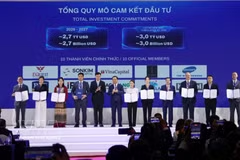
Ho Chi Minh City unveils 12 investment projects worth over 13 billion USD
Ho Chi Minh City announced 12 projects granted investment policy approval or investment registration certificates on October 28, with total investment exceeding 337.22 trillion VND (about 13.58 billion USD), at the Autumn Economic Forum 2026.
Vietnam proactively adapts to change, creates new growth drivers: PM
Vietnam aims to become an emerging digital technology hub, a hub for new, green and clean energy, and a centre for green agricultural production in the region and the world at large, said Prime Minister Le Minh Hung.
Vietnamese enterprises raise standards to expand export markets
Despite exporting to the US, Europe and other markets, the Viet Enterprise Investment and Trade Promotion Company in Ho Chi Minh City continues to seek new destinations for Vietnamese agricultural products.
Resolution opens new pathways for Vietnamese SMEs
Pham Van Viet, Chairman of the Board of Directors of Viet Thang Jean Co., Ltd. (VitaJean), said continued dependence on low labour costs will drive profit margins towards zero. The company has therefore invested in 3D design and laser-cutting technologies, reducing the time required for certain production stages from weeks to just hours. This has helped cut costs and meet the rapidly changing requirements of international orders.
Phu Tho promotes investment, trade in Czech Republic
Phu Tho, located in Vietnam’s northern midland and mountainous region, has considerable potential in industry, agriculture, services and tourism. Czech businesses’ strengths in manufacturing, engineering, technology, energy and environmental solutions offer promising opportunities for collaboration. Other potential areas include high-tech agriculture, food processing, tourism and human resources training.
Vietnam promotes green hydrogen investment opportunities in Europe
The trade office introduced four investment priorities of Vietnam. These includes renewable hydrogen production, covering electrolysis, offshore wind-to-hydrogen, green ammonia and liquid hydrogen exports; storage, compression, pipelines, transport networks and port logistics; industrial decarbonisation and fuel switching in heavy transport and shipping; and hydrogen applications in steel, fertilisers, chemicals, cement, power generation and heavy transport.
Reference exchange rate down 2 VND on October 28
With the current trading band of ±5%, the ceiling rate applicable to commercial banks stood at 26,913 VND/USD, while the floor rate was 24,349 VND/USD.
Vietnam considers electricity price cut from November 1, petrol excise tax cut to zero
Deputy Prime Minister Nguyen Van Thang urged the Vietnam Electricity (EVN) Group to review its costs and maximise savings to develop a plan to reduce the average retail electricity price from November 1, 2026, to March 31, 2027, in accordance with relevant regulations. The move aims to support people and businesses and ensure social welfare.
Top ten securities firms hold 10.6 billion USD in margin loans
Based on third-quarter 2026 financial statements and company disclosures, the figure represents principal outstanding from margin lending and excludes advances against proceeds from securities sales.
Vietnam’s textile, garment exports top 36 bln USD in nine months
Vinatex posted revenue of nearly 1.6 trillion VND (61.94 billion USD) in the first nine months of this year, or 57.1% of plan, and pre-tax profit of 336.6 billion VND, 129.5% of plan and up 218.7%.