China’s Guangxi advances “three connectivity” with Vietnam

The Guangxi Zhuang Autonomous Region of China is stepping up cooperation with Vietnamese localities through three key pillars “hard connectivity” in infrastructure, “soft connectivity” in trade and investment, and “people-to-people connectivity” through cultural exchanges.

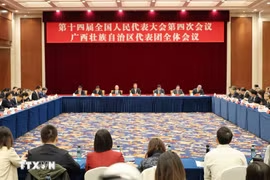
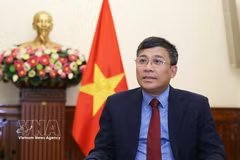
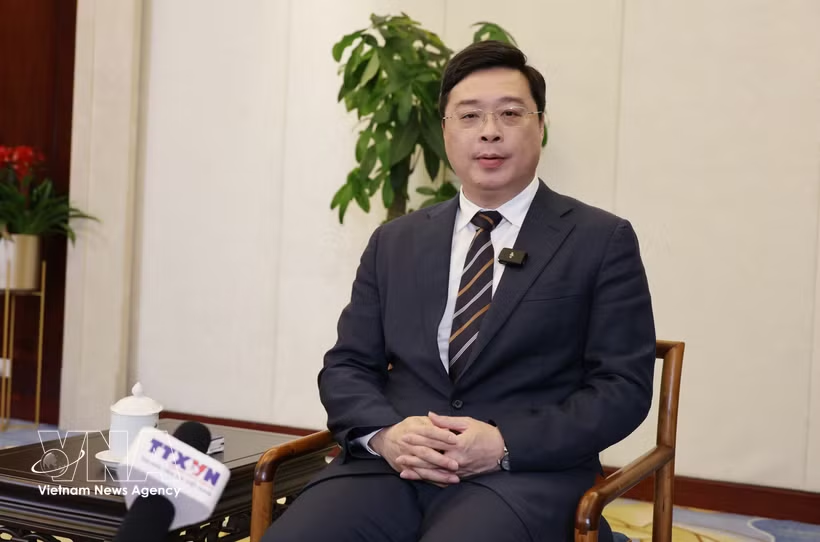
Wei Tao, Deputy Secretary of the Party Committee and Chairman of the Guangxi Zhuang Autonomous Region (Photo: VNA)

Beijing (VNA) – The Guangxi Zhuang Autonomous Region of China is stepping up cooperation with Vietnamese localities through three key pillars “hard connectivity” in infrastructure, “soft connectivity” in trade and investment, and “people-to-people connectivity” through cultural exchanges.

In an interview with Vietnam News Agency correspondents in China, Wei Tao, Deputy Secretary of the Party Committee and Chairman of the Guangxi Zhuang Autonomous Region, stressed that infrastructure connectivity forms the foundation of cooperation, enabling smoother flows of goods and people.

Bordering Vietnam along 696 km, Guangxi has three cities and eight districts adjacent to Vietnam. In recent years, the region has actively expanded cross-border infrastructure links. It now operates two railway lines connecting to the China–Vietnam border and has planned or built 13 expressways leading to border gates, with 10 already completed. Guangxi also has nine land border crossings with Vietnam, including Dongxing, the busiest in passenger traffic, and Youyiguan, the most advanced in infrastructure and technology.

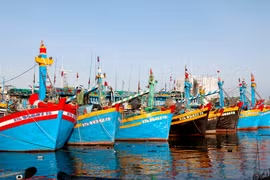
The region is also promoting smart border gates to enable 24/7 and automated customs clearance. In maritime connectivity, the Beibu Gulf Port maintain 35 container shipping routes with Vietnam, linking with five Vietnamese ports, including Hai Phong and Ho Chi Minh City.

Following a visit to Vietnam in November 2025, Wei said Guangxi reached important agreements with relevant Vietnamese ministries and sectors on enhancing infrastructure links. The Vietnamese side said it is pushing the construction of two standard-gauge railway lines: Dong Dang–Hanoi and Mong Cai–Ha Long–Hai Phong, along with expressways and smart ports connecting to Guangxi, Wei said.

Wei expressed confidence that once these projects are implemented, connectivity between the two countries will be further enhanced, and bilateral trade and industrial cooperation will become more robust.

On “soft connectivity,” Guangxi holds a unique position as the only Chinese region bordering Vietnam both by land and sea. Trade and investment ties have expanded steadily in recent years. In 2025, trade turnover between Guangxi and Vietnam reached around 45 billion USD, up 5.4% year-on-year, accounting for about 38% of Guangxi’s total foreign trade.

Guangxi has become a key distribution hub for Vietnamese fruit exports to China, with the Youyiguan Border Gate serving as the country’s largest durian import gateway. Business cooperation is also intensifying, with major Guangxi firms such as Yuchai, Liugong and Meisida increasing investment in Vietnam. Partnerships like that between SAIC-GM-Wuling and Vietnam’s TMT Motors are also gaining momentum.

In the time to come, Wei said Guangxi plans to deepen cooperation in cross-border e-commerce, finance and logistics, while expanding collaboration in sectors such as automobiles, machinery, materials, electronics and light industry. The region is also working with Vietnam’s Quang Ninh province to explore pilot models for cross-border economic cooperation zones, and continue diversifying trade promotion activities, strengthening production–consumption linkages, and boosting trade.

Highlighting “people-to-people connectivity,” Wei noted that strong bilateral ties are rooted in close bonds between citizens. He stressed that Guangxi and Vietnam share geographic proximity and cultural similarities, with frequent exchanges at multiple levels.

Guangxi also holds historical significance as a place where President Ho Chi Minh once conducted revolutionary activities, symbolising the long-standing friendship between the two nations, he said.

As of late 2025, more than 3,400 Vietnamese students were studying and living in Guangxi, making it one of the top Chinese destinations for Vietnamese students. These students, Wei said, serve as “ambassadors of friendship,” fostering mutual understanding between the two sides.

Guangxi will leverage historical and cultural resources to expand exchanges, including joint tourism projects such as the Detian (China) – Ban Gioc (Vietnam) cross-border waterfall tourism zone. It will also promote exchanges among youth, women’s and labour organisations, as well as twinning cities, through activities such as cultural festivals, sports events and community exchanges, the Chinse official went on./.
VNA

See more

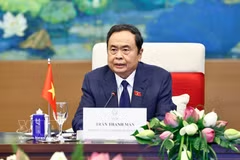
Chairman of the National Assembly Tran Thanh Man (Photo: VNA)

Vietnam reinforces proactive, responsible role in Inter-Parliamentary Union

Through the IPU platform, Vietnam has advanced parliamentary diplomacy to protect national interests, deepen ties with other legislatures, and elevate its global profile while contributing initiatives in areas such as sustainable development, climate change, gender equality, child protection, and digital transformation.

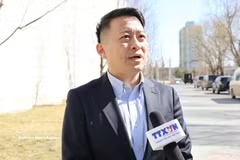
Professor Qu Qiang of the Minzu University of China grants an interview to the Vietnam News Agency. (Photo: VNA)

Vietnam–China partnership advances towards deeper trust and connectivity: Chinese scholar

On the visit’s key agenda, Professor Qu Qiang of the Minzu University of China highlighted the need to effectively implement common perceptions and overarching directions reached by senior leaders, particularly the “six major orientations” guiding bilateral ties, including more substantive cooperation, stronger security, closer coordination, and higher political trust.

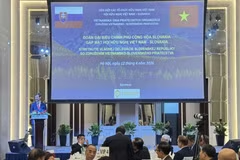
The meeting takes place in Hanoi on April 12. (Photo: VNA)

People-to-people ties between Vietnam and Slovakia strengthened

A meeting was held in Hanoi on April 12 between a delegation of the Slovak Government and representatives of Vietnamese people who have strong affection for Slovakia, on the occasion of the official visit to Vietnam by the Slovak Prime Minister and a government delegation.

Politburo member, Secretary of the Party Central Committee and Chairman of its Commission for Information, Education and Mass Mobilisation Trinh Van Quyet speaks at the national conference. (Photo: VNA)

New regulation on political, ideological work in Party highlighted at national conference

The regulation, adopted at the second plenum of the 14th Party Central Committee and issued as Regulation No. 19-QD/TW on April 8, 2026, marks the first comprehensive and systematic framework governing political and ideological work in the Party. It reflects a new step in theoretical mindset and strong political resolve to enhance Party building as well as the Party's leadership and combat capacity.

Politburo member, Secretary of the Party Central Committee, and Chairman of the Party Central Committee's Inspection Commission Tran Sy Thanh speaks at the conference. (Photo: VNA)

Party conference spotlights key reforms in inspection, disciplinary work

Resolution 05 introduces a number of breakthrough viewpoints, positioning inspection and supervision as one of the Party’s most critical leadership functions. It is defined as a mechanism for self-correction and self-improvement, a key tool to control power and uphold Party discipline and order, ensuring that the Party’s guidelines are implemented rigorously and effectively in practice.

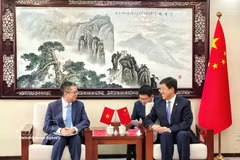
Vietnamese Ambassador to China Pham Thanh Binh (left) and First Secretary of the Communist Youth League of China (CYLC) Central Committee A Dong at their meeting in Beijing on April 12 (Photo: VNA)

Vietnam, China strengthen youth exchanges to deepen bilateral ties

The Vietnamese diplomat stressed that during the upcoming state visit by General Secretary and State President To Lam, the meeting between senior leaders of the two countries and youth participating in the ninth edition of “Red study tour” programme in China reflects the special attention paid by the top leaders of both Parties and countries to nurturing and educating younger generations, enabling them to carry forward the revolutionary traditions of previous generations.

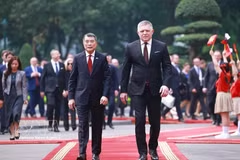
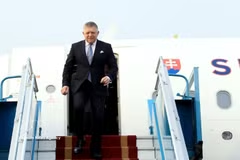
Slovak Prime Minister Robert Fico (Photo: VNA)

Slovak Prime Minister begins official visit to Vietnam

According to Ambassador Giang, the official visit by Slovak Prime Minister Robert Fico marks the first by a foreign government leader after Vietnam completed the restructuring of its state apparatus following the 14th National Party Congress, and opens up opportunities for more substantive cooperation following previous high-level visits, based on the need to strengthen collaboration and high political trust between the two sides.

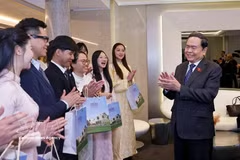
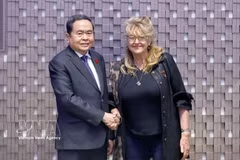
Chairman of the National Assembly (NA) Tran Thanh Man (L) receives Vietnam’s Honorary Consul in Torino Sandra Scagliotti (Photo: VNA)

NA leader receives Vietnam’s Honorary Consul in Torino

Expressing his special impressions upon visiting Italy, a country rich in cultural traditions and beauty that maintains a longstanding friendship with Vietnam, NA Chairman Tran Thanh Man said that his visit takes place at a time when Vietnam–Italy relations are developing strongly after more than 50 years of diplomatic ties and over a decade of the Strategic Partnership framework.

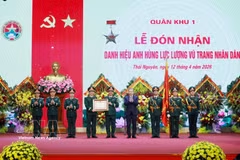
General Secretary and State President Lam presents the title “Hero of the People’s Armed Forces” to Military Region 1 (Photo: VNA)

Party, State leader asks Military Region 1 to position itself as comprehensively strong force

Party General Secretary and State President Lam, who is also Secretary of the Central Military Commission, urged Military Region 1 to continue thoroughly grasping the Party’s guidelines on national defence and military strategy in the new context, maintain a firm control of the situation, and provide timely strategic advice to prevent any unexpected developments.

Prime Minister Le Minh Hung attends a ceremony marking the 80th anniversary of the Police Force for Administrative Management of Social Order on April 12 (Photo: VNA)

PM urges development of service-oriented administration

Prime Minister Le Minh Hung underscored that in the period of renewal and international integration, the force has continued to play a key role in advising and implementing major initiatives in state management of security and order. Its responsibilities have included population management, issuance and management of citizen identification, regulation of weapons and explosives, management of conditional business sectors, and the maintenance of public order.