Domestic airlines urged to resume, expand domestic air routes by year-end

Director of the Civil Aviation Authority of Vietnam (CAAV) suggested that airlines should identify routes to be resumed or newly launched, as well as existing routes on which flight frequencies could be increased. They should also outline implementation plans and timelines for the final months of 2026 and 2027, assess market demand, and evaluate fleet deployment options and operational sustainability.

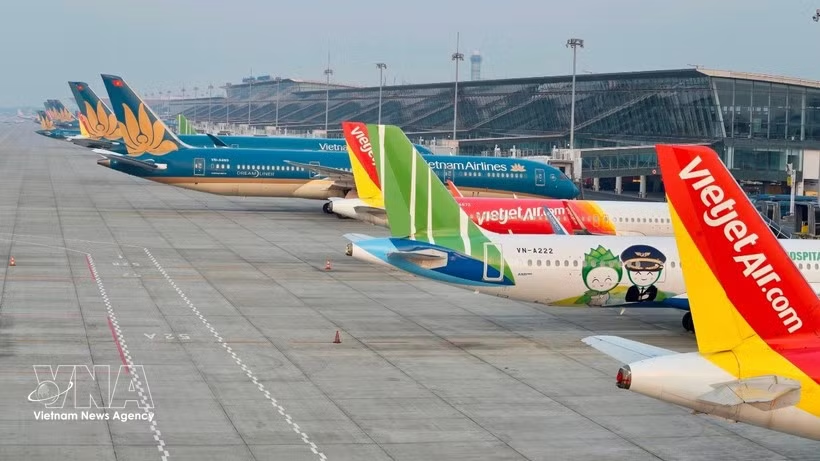
Aircraft of Vietnamese airlines at Noi Bai International Airport. (Photo: VNA)

Hanoi (VNA) – Domestic airlines have been urged to proactively develop plans to resume, maintain and expand their domestic flight networks in late 2026 and 2027.

In an interview granted to the Vietnam News Agency (VNA), Director of the Civil Aviation Authority of Vietnam (CAAV) suggested that airlines should identify routes to be resumed or newly launched, as well as existing routes on which flight frequencies could be increased. They should also outline implementation plans and timelines for the final months of 2026 and 2027, assess market demand, and evaluate fleet deployment options and operational sustainability.

Airlines were also encouraged to share difficulties and obstacles and propose solutions concerning infrastructure conditions, aviation services, coordination mechanisms with local authorities and support measures for route development.

According to the CAAV, air transport plays an important role in strengthening connectivity among localities and economic regions, promoting trade, attracting investment, developing tourism and meeting people's travel needs.

In particular, resuming and developing direct domestic routes between localities would improve access to air services and shorten travel time, while helping unlock the potential and advantages of individual regions and localities as well as promoting socio-economic development and improving the efficiency of investment in aviation infrastructure.

In recent years, airports nationwide have been undergoing investment, upgrade, renovation, expansion and gradual modernisation. Several aviation infrastructure projects have been completed, while others are under way, helping increase service capacity and create favourable conditions for expanding flight networks and air transport operations.

To maximise aviation's contribution to socio-economic and tourism development, strengthen regional connectivity and make effective use of existing infrastructure, the CAAV called on domestic airlines to comprehensively review their current networks and routes that have been suspended.

They were asked to explore the resumption of routes with strong market potential and sufficient demand for travel, trade and tourism, provided that operating conditions are suitable. Airlines should also consider increasing frequencies on existing routes to better serve passengers and tourists.

The authority further encouraged carriers to explore new direct routes between localities, particularly those linking economic and tourism centres and key economic regions. Such connections would strengthen regional integration, reduce travel time and costs, and lessen reliance on connecting flights through major airport hubs, thereby creating fresh momentum for local socio-economic development.

In addition, airlines should coordinate proactively with airport operators and aviation service providers to prepare the necessary conditions for expanding operations, gradually increasing passenger traffic and improving the effectiveness of aviation infrastructure investment.

The CAAV also called for closer cooperation among airlines, local authorities, airport operators, tourism and travel businesses, and other relevant stakeholders to assess market demand and develop joint programmes to promote destinations, develop tourism products, improve transport connectivity and stimulate air travel.

Carriers were encouraged to study cooperation mechanisms and appropriate support measures for route development in accordance with the law, ensuring a balance between the interests of the State, localities, businesses and the public./.


VNA

See more

A customer uses a smartphone to make a payment at a LOTTE mart in Tay Ninh province. (Photo: VNA)

Vietnam’s cross-border QR payments gain traction

Cross-border QR payments are widening Vietnam’s tourism, retail and services links to international markets. But turning cost and technology gains into business results requires a broader acceptance network, transactions tied to sales management and end-to-end operational security.

The German delegation and Can Tho officials poses for a group photo at the meeting on November 5, 32026. (Photo: VNA)

Can Tho, Germany step up cooperation in green economy, logistics

Can Tho hopes to continue receiving support from the German Ambassador, Consul General and GIZ in connecting it with cooperation programmes, experts and resources of Germany, particularly in sustainable agriculture and fisheries, water resource management, environmental protection, climate change response and circular economy development.

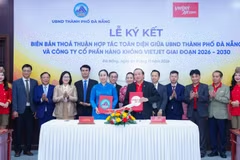
The signing ceremony for a comprehensive partnership between Da Nang and Vietjet for the 2026–2030 period on November 4, 32026. (Photo: Vietjet)

Da Nang, Vietjet sign comprehensive cooperation agreement for 2026–2030

This collaboration aims to strengthen the relationship between the two parties, leverage their respective strengths and resources, and jointly implement programmes and activities in areas of mutual interest—all in alignment with the city’s development orientation and Vietjet’s operational strategy.

Cutting the excise tax on petrol is expected to help reduce costs for households and businesses. (Illustrative photo: VNA)

Energy price cuts to help curb inflation, boost growth: experts

The Government's decision to cut the average retail electricity price by 2% and reduce the petrol excise taxes to zero percent from November 1 is expected to ease cost pressures on consumer prices and support economic activity, particularly for businesses facing high input costs.

A production line at Yadea Vietnam’s smart manufacturing plant, which has an investment of more than 100 million USD, in Tan Hung Industrial Park, Bac Ninh city (Photo: VNA)

Improving FDI quality to strengthen growth momentum

Rapid growth in registered capital is encouraging, but unless these commitments are promptly converted into implemented projects and productive capacity, their contribution to economic growth will remain constrained.

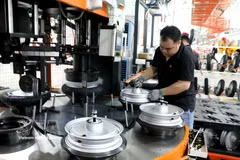
At a workshop of Vietnam Precision Industrial No. 1 Co., Ltd (Photo: VNA)

Vietnam well-positioned to attract high-quality European investment: insiders

Vietnam has established a considerable manufacturing and export base, giving it an advantage in attracting investment from European corporations. However, amid the restructuring of global supply chains, the key objective is not merely to attract more investment, but also to enhance the quality of investment and the value it generates.

Speakers at a discussion on prospects for cooperation in developing new value chains in the context of a changing global landscape (Photo: VNA)

Vietnam, EU shape future of green economy, new value chains

In his remarks Deputy Minister of Industry and Trade Luong Hoang Thai said the ninth edition of the forum serves as an effective channel for regular exchanges between government agencies and business communities on policies, market development, trade connectivity and investment.

Ho Chi Minh City hosts five international industrial exhibitions (Photo: VNA)

Five industrial exhibitions open in Ho Chi Minh City

The five exhibitions comprise the 17th International Water Supply, Sanitation, Water Resources and Purification Exhibition and Conference (Vietwater 2026); Vietnam Energy Week; an international exhibition on refrigeration, air conditioning and smart buildings; Vietnam Supporting Industry Fair (VSIF); and the Vietnam Data Centre & Cloud Confex.

State Bank of Vietnam (SBV) Deputy Governor Pham Thanh Ha speaks at the Government’s regular press briefing in Hanoi on November 4. Photo: VNA

Commercial banks cut listed deposit rates by 0.5 percentage points

In October, the State Bank of Vietnam directed credit institutions to mobilise all available resources, cut operating costs, share profits and step up efforts to lower interest rates. Under its directive, banks were required to cut listed deposit rates and rates on newly mobilised deposits by 0.5 percentage points per year for tenors of six months or longer, while reducing lending rates by 1.5-2 percentage points per year for production, business activities and priority sectors.