Hanoi, January 30 (VNA) – Vietnam’s impressive GDP growth of 8.02% in 2025 marks a pivotal moment for the economy, calling for a shift in growth drivers and a stronger focus on private capital and long-term funding to hit the 10% growth goal for 2026, according to a recent FiinRatings report.
The report said the country can no longer depend heavily on public investment and foreign direct investment (FDI) but needs to unlock private sector investment and deepen capital markets.
FiinRatings analysts noted that although the 8.02% growth rate reflects solid performance, underlying data point to concerns about the sustainability of internal growth momentum.
Economic expansion in 2025 was driven mainly by public investment, which rose 26.6% year-on-year, and FDI disbursement, up 11.7%. Meanwhile, private investment, considered the backbone of the economy, grew only 8.4%, a level deemed insufficient to sustain high and stable long-term growth.
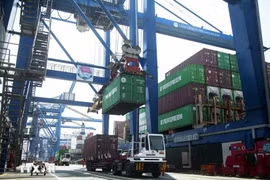
This imbalance was also reflected in trade performance. While Vietnam posted a trade surplus of 20.1 billion USD, the FDI sector recorded a surplus of more than 48.1 billion USD, offsetting a nearly 28 billion USD deficit by domestic enterprises. This suggests that the competitiveness and participation of local firms in global export value chains remain relatively limited.
Another bottleneck highlighted in the report is weak domestic consumption. Real retail sales rose only 6.7%, marking the third consecutive year below the pre-pandemic average of 8.8%. Given the large share of consumption in GDP, sluggish domestic demand reduces the economy’s natural growth momentum.
Looking ahead to 2026, FiinRatings said that public investment, FDI and exports are expected to maintain growth but are unlikely to generate breakthroughs in scale. Achieving the 10% target will depend on two decisive factors: stronger private sector investment and a clear recovery in domestic consumption. Both, however, require improved access to medium- and long-term capital at reasonable costs.

Meeting high growth targets will require substantial capital. Total social investment in 2025 was estimated at about 4.2 quadrillion VND (158.3 billion USD), equivalent to 32.3% of GDP. The Government aims to raise this ratio to nearly 40% by 2030, creating significant demand for long-term funding, particularly for large infrastructure projects and private manufacturing expansion.
FiinRatings warned that the economy cannot continue relying primarily on bank credit. By the end of 2025, Vietnam’s credit-to-GDP ratio had reached about 146%, while commercial banks are facing tightening capital safety constraints. The ratio of short-term funds used for medium- and long-term lending has approached the regulatory ceiling, and capital adequacy at major state-owned banks remains modest amid the roadmap for Basel III implementation.
Given these limitations, the corporate bond market is expected to play a more strategic role in capital mobilisation. In 2025, new bond issuance reached around 644 trillion VND, though non-bank corporate bonds accounted for only 32%. FiinRatings forecast stronger growth in 2026 as enterprises diversify funding sources amid less accommodative monetary policy and tightening bank lending capacity.
The outlook is also supported by improving legal clarity on capital use and project requirements, particularly in real estate and infrastructure, a broader investor base through investment and pension funds, and enhanced transparency via credit ratings and upgraded trading infrastructure.
The stock market is also expected to become a major equity financing channel. Capital mobilisation reached a record 150.5 trillion VND in 2025. In 2026, potential large initial public offerings, possible listings by FDI enterprises, and expectations of market reclassification to emerging status by MSCI or FTSE could attract stronger foreign portfolio inflows.
In addition, international borrowing remains an important option. With global interest rates trending downward, Vietnamese firms may access external funding more easily if they improve credit profiles, currently around the BB+ level, and develop projects that meet international standards.
State-owned enterprises (SOEs) are also seen as key players. With relatively lower leverage compared to large private conglomerates, SOEs still have room to expand borrowing and improve governance. FiinRatings said that stronger capital absorption by SOEs could help mobilize funding for national infrastructure projects and create a “catalyst effect” to attract private participation through public-private partnerships.

Overall, the report concluded that the ability to mobilise and allocate long-term investment capital will be a decisive factor for Vietnam’s growth prospects. Once this financing challenge is addressed, the 10% growth target from 2026 could become achievable on the foundation of stronger domestic capacity and deeper financial markets./.