Four major railway development projects call for foreign investment in 2026-2030

The four projects require a combined capital of over 445 trillion VND (approximately 17 billion USD). All are structured under the public-private partnership (PPP) model, with individual investment thresholds starting from nearly 25 trillion VND.

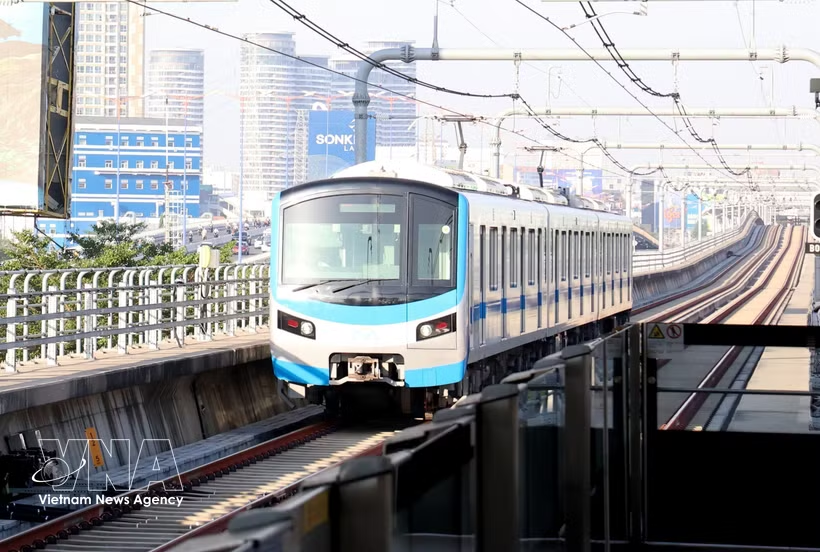
Ben Thanh - Suoi Tien Metro Line No. 1 in Ho Chi Minh City. (Photo: VNA)

Hanoi (VNA) – The Ministry of Construction has submitted a document to the Ministry of Finance to include four major railway development projects in the national list of projects calling for foreign direct investment (FDI) during the 2026–2030 period.

The four projects require a combined capital of over 445 trillion VND (approximately 17 billion USD). All are structured under the public-private partnership (PPP) model, with individual investment thresholds starting from nearly 25 trillion VND.

The projects include Bien Hoa – Vung Tau route; Ho Chi Minh City – Can Tho – Ca Mau route, Mu Gia – Vung Ang route, and Thap Cham – Da Lat route.

According to the Ministry of Construction, all the four projects align with national railway planning, transport sector development strategies, and the government policy of mobilising non-budget capital for infrastructure development.

Nguyen Anh Dung, Deputy Director of the Ministry of Construction's Department of Planning and Finance, said that focusing on railways aims to build a modern, high-capacity transport system, thus lowering logistics costs and improving regional links between key economic hubs, deep-water seaports, international border gates, and logistic hubs.

Dung added that prioritising railway infrastructure helps shift transport volume away from roads, reducing traffic congestion and road accidents. The initiative also aligns with Vietnam's green growth targets and its commitment to achieving net-zero carbon emissions.

Explaining the decision to prioritise railways over other transport sub-sectors, Dung noted that maritime and inland waterway projects are largely decentralised to local authorities, while national highway networks rely primarily on public funding or domestic private capital. Air transport remains subject to a strict 30% foreign ownership cap due to national security regulations.

However, attracting foreign investors to railway projects presents distinct hurdles. Infrastructure development projects in this sector require immense capital outlay and long payback periods, while financial returns remain relatively low. Furthermore, existing PPP risk-sharing mechanisms have not proven sufficiently attractive to global capital.

Of the nine major infrastructure projects promoted in the 2021–2025 foreign investment portfolio, several road projects shifted to public investment or domestic private developers, while others saw limited foreign engagement.

To address these bottlenecks, Tran Chung, Chairman of the Vietnam Association of Road Traffic Investors (VARSI), emphasised the need to refine existing policies. He urged authorities to enhance risk-sharing provisions, clarify state support mechanisms, and ensure robust project feasibility studies prior to international market roadshows./.​

VNA

See more

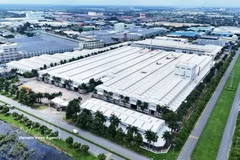
A view of Vinh Loc 2 Industrial Park in My Yen commune, Tay Ninh province (Photo: VNA)

FDI surge fuels new real estate demand

According to Savills experts, FDI continues to flow into manufacturing, logistics, technology and digital infrastructure, changing property requirements for investors.

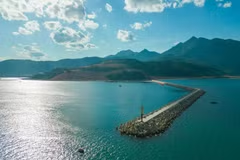
Lien Chieu Port is under construction in central Da Nang city. (Photo: VNA)

Energy infrastructure underpins marine economy development

The integrated investment in energy infrastructure will provide a vital infrastructure foundation for effectively harnessing the marine potential, helping realise the goal of making Vietnam a strong maritime nation and achieving sustainable and prosperous development from the sea./.

The Australia-Vietnam Policy Institute Forum in Ho Chi Minh City on August 25, 2026 discusses how Australian expertise, partnerships and capital can support Vietnam's growth, and how to build stronger connections between the two countries' business communities. (Photo: VNA)

Vietnam, Australia seek new space for economic cooperation

The Australia–Vietnam Policy Institute Forum was held in Ho Chi Minh City on August 25, bringing together policymakers, businesses, and organisations for discussing how the business communities of Australia and Vietnam can build stronger connections.

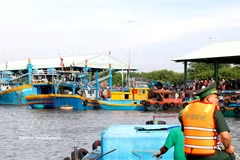
Officers from Thanh Hai Border Guard Station (Phu Thuy ward, Lam Dong province) patrol and monitor fishing vessels entering and leaving the port. (Photo: VNA)

Lam Dong province deploys 10 key measures to combat IUU fishing

The measures target key gaps, including ineligible fishing vessels, port controls, electronic fishing-trip data, seafood traceability and vessel monitoring system (VMS) violations. Authorities will also act against vessels detained by foreign authorities, submit weekly progress reports and draw up specific action plans.

Speakers at the seminar (Photo: VNA)

Legal transparency key to making VIFC more attractive: experts

Dominic Scriven, Chairman and Founder of Dragon Capital, said legal clarity, consistency and predictability are essential to strengthening investor confidence, enabling long-term business planning and encouraging firm capital commitments to Vietnam.

Illustrative photo (Photo: VNA)

Vietnam promotes cooperation to remove barriers to rice trade with Philippines

Vietnam proposed studying a higher-level cooperation framework on rice trade to provide a more stable and long-term foundation for Vietnam-Philippine rice trade while balancing the interests of farmers, businesses and consumers, and providing sustainable livelihoods for rice growers and stable living conditions for Philippine consumers.

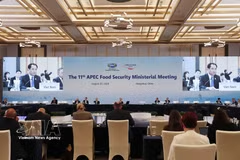
An overview of the 11th APEC Food Security Ministerial Meeting in Hangzhou on August 25. (Photo: VNA)

Vietnam proposes four strategic cooperation directions at APEC Food Security Ministerial Meeting

Vietnam’s proposals at the 11th APEC Food Security Ministerial Meeting, which took place in Hangzhou, China received broad support and consensus from participating economies. Several members expressed their desire to work with Vietnam to further build consensus, with a view to ensuring that the APEC Food Security Ministerial Meeting in Vietnam in 2027 will produce a shared vision and a substantive action programme.

Vietnam Post accelerates the adoption of modern technology, elevates logistics capabilities, and boosts the digital economy. (Photo: VNA)

Breakthrough opportunities for businesses in digital economy

Only when businesses view digital transformation as a fundamental change in their business models, while the State provides an enabling framework, data infrastructure and sufficiently broad markets for innovation, can the digital economy become a substantive growth driver.

A lecturer guides students on how to diagnose diseases in aquatic animals. (Photo: VNA)

Vietnam leans on digital workforce to unlock productivity boom

Vietnam needs a cohesive national strategy linking the State, enterprises, and training establishments. The strategy must prioritise standardising training to international norms and investing in technological infrastructure to boost national productivity.

A factory in Bac Ninh province (Photo: VNA)

Vietnam directs more credit to SMEs

With deposit rates still relatively high, banks’ room to cut lending rates sharply is limited. Lenders must stay efficient and cannot fund at high cost while lending at very low rates.