Implementing World Heritage Convention: Opportunity for Vietnam to demonstrate int’l responsibility

Following a field mission, the Reactive Monitoring Team from the World Heritage Centre and the International Union for Conservation of Nature (IUCN) have issued several recommendations for managing Vietnam’s first trans-provincial World Heritage site.

di-san-1.jpg
Cruise ships operate in the area of Ha Long Bay – Cat Ba Archipelago. (Photo: Vietnam+)

Hanoi (VNA) - The Reactive Monitoring Team from the World Heritage Centre and IUCN recently concluded a working visit to Vietnam from March 10–16 to assess conservation and management efforts at the Ha Long Bay – Cat Ba Archipelago World Heritage site, which spans Quang Ninh province and Hai Phong city, according to the Ministry of Culture, Sports and Tourism.

Notably, the mission resulted in a series of practical recommendations for managing Vietnam’s first trans-provincial World Heritage site.

Opportunity to enhance outstanding universal value

Despite forming a single natural complex, Ha Long Bay and the Cat Ba Archipelago have long been managed separately by Quang Ninh and Hai Phong. This divide has posed challenges for cruise tourism and visitor services. To bridge this management gap and unlock the full potential of the site’s World Heritage status, experts stressed the urgent need for unified management—a longstanding issue that has persisted for over a decade.

After nearly a week of meetings with relevant agencies and local authorities, Luba Janikova, representative of the World Heritage Centre, acknowledged the difficulties and complexities in coordinating the management of Vietnam’s first inter-provincial World Heritage site. She also noted the broader challenge of balancing conservation and development—an issue that affects World Heritage sites globally.

Echoing her views, Amran Hamzah, representative of IUCN, observed that although coordination between stakeholders has proven difficult, this remains an important opportunity for Vietnam to demonstrate its commitment to the World Heritage Convention and fulfill its international responsibilities. In particular, he emphasized the importance of safeguarding the site’s Outstanding Universal Value (OUV).

Hamzah recommended that Vietnam regularly update the World Heritage Centre and UNESCO-affiliated agencies on all development projects—ongoing, planned, or proposed—within the Ha Long Bay – Cat Ba Archipelago World Heritage area. He also stressed the importance of aligning all planning and implementation efforts with UNESCO’s guidance and regulations.
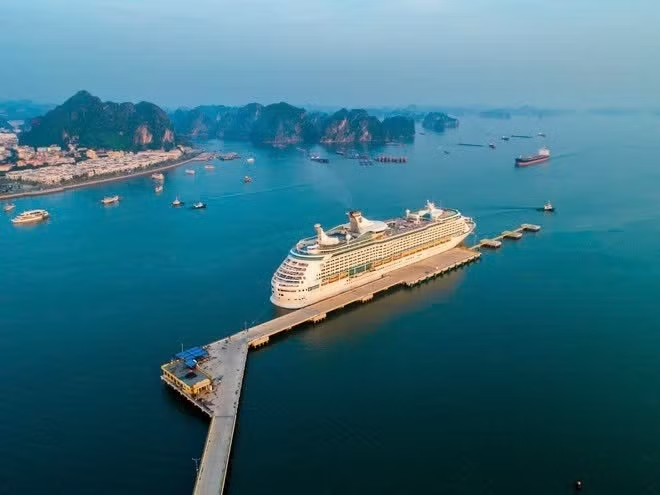
di-san-2.jpg
The international passenger port serves as a key entry point for international visitors to Quang Ninh. (Photo: Vietnam+)

He further urged local authorities to apply key tools such as Strategic Environmental Assessments (SEA), Environmental Impact Assessments (EIA), and Heritage Impact Assessments (HIA) not only during planning and implementation phases but also after project completion to evaluate the broader effects on the heritage site.

Regarding visitor capacity, the Monitoring Team advised Vietnam to conduct comprehensive carrying capacity assessments for the entire heritage area. These assessments should take into account both tangible and intangible factors influencing tourists’ experiences to ensure appropriate tourism management strategies.

No trade-off between economic growth and heritage protection

In response to the experts' recommendations, officials from Quang Ninh province, Hai Phong city, and the Department of Cultural Heritage reaffirmed their commitment to adhering to the World Heritage Convention. They also pledged to improve Vietnam’s legal framework for heritage protection, especially through the newly passed Law on Cultural Heritage and related regulatory documents currently under development.

The local authorities also confirmed their dedication to environmental protection, including wastewater treatment and waste management.

They highlighted ongoing efforts to implement sustainable tourism development strategies, carry out visitor capacity research, and use such findings as a foundation for decision-making.

Additionally, they are advancing scientific research on the site’s values and ensuring the availability of institutional and financial resources for long-term conservation and promotion.

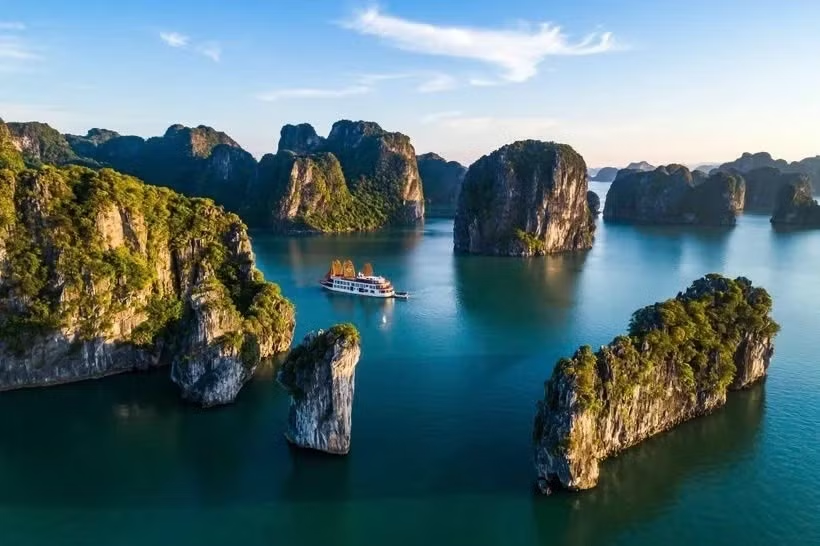
di-san-3.jpg
Untouched natural beauty on small islands. (Photo: Vietnam+)

Deputy Minister of Culture, Sports and Tourism Hoang Dao Cuong acknowledged the Monitoring Team’s recommendations as highly valuable contributions to the improvement of heritage management in Vietnam—particularly for UNESCO-listed World Heritage sites like the Ha Long Bay – Cat Ba Archipelago.

He called on Hai Phong and Quang Ninh to continue working closely together and support the completion of follow-up reports for submission to the World Heritage Centre and IUCN.

Cruise ships operate in Ha Long Bay. (Photo: Lux Group/Vietnam+)

Deputy Minister Cuong emphasized that the Ministry will continue to ensure local authorities comply with the World Heritage Convention and its operational guidelines, particularly when implementing development projects.

He also stressed that while the Vietnamese government prioritizes high economic growth—aiming for double-digit growth in the near future—this will not come at the expense of environmental protection or the conservation and promotion of heritage values, especially those recognised by UNESCO./.
See more

Participants in the 20th Cong hien (Devotion) Awards presentation ceremony in Hanoi on April 15 (Photo: VNA)

Devotion Awards mark two decades of honouring excellence in music, sports

Nguyen Thien Thuat, Editor-in-Chief of the The Thao & Van Hoa newspaper and Head of the organising board of the awards, said, noting that their achievements reflect the spirit of the Politburo’s Resolution No. 80, which emphasises preserving national cultural values while selectively absorbing the essence of world culture.

Artisans and students take part in cultural activities and exchanges in the Xoan singing performance space at Hung Lo ancient communal house in Phu Tho province (Photo: VNA)

Ancestral legends revived through contemporary performance

Beyond cultural value, well-organised festival programmes linked with tourism and media can contribute to the development of cultural industries and enhance Vietnam’s cultural soft power, positioning heritage-based events as distinctive national cultural brands in the international arena.

Khue Van Cac (Khue Van Pavilion) stands as a defining cultural symbol of Hanoi, closely associated with Vietnam’s long-standing tradition of valuing education and honouring knowledge. (Photo: VNA)

Greater efforts needed for heritage to shape Hanoi’s identity

As suggested by UNESCO experts, heritage should be approached as an integrated system encompassing space, people and everyday life. This perspective can inform urban planning, cultural tourism development and the creation of clear economic drivers.

Participants at the gathering (Photo: VNA)

Lao, Cambodian students welcome traditional New Year in Ho Chi Minh City

In his speech, Vice Chairman of the municipal People’s Committee Nguyen Manh Cuong said the municipal Party organisation, authorities and people always value the close ties and solidarity among Vietnam, Laos and Cambodia. He described the three nations’ longstanding ties, forged through shared hardships, as an invaluable spiritual asset and a bedrock for sustainable development.

Vietnamese kickboxers win 32 gold medals at the Kickboxing World Cup 2026. (Photo: Vietnam Kickboxing Federation)

Vietnam finish third at Kickboxing World Cup 2026

According to Vu Duc Thinh, President of the Vietnam Kickboxing Federation, the strong results reflected careful preparation by local training centres and the determination of Vietnamese fighters. The team’s participation, funded largely through socialised and local resources, also demonstrated growing support for the development of kickboxing in Vietnam.

Politburo member, Secretary of the Party Central Committee and Head of the Party Central Committee’s Commission for Information, Education and Mass Mobilisation Trinh Van Quyet speaks at the event (Photo: VNA)

National Radio Festival opens in Quang Ninh

The opening night was combined with an artistic programme titled “sounds of the new era,” drawing around 50,000 spectators. The programme was structured in three chapters: Origins of Sound, Heritage Sound, and Sound of the New Era.

Vietnamese puppetry faces pressure to adapt to modern lifestyles, particularly amid growing competition from diverse entertainment forms (Photo: VNA)

Vietnamese puppetry seeks renewal amid preservation challenges

People’s Artist Nguyen Hoang Tuan, Chairman of the Hanoi Theatre Association, noted that while northern Vietnam had 27 puppetry guilds in 1986, only 14 remain today. Many traditional plays and original scripts have been lost, hurting restoration and preservation efforts.

Visitors enjoy the "Stone History Preserves Memories" exhibition, featuring a traditional format combined with digital technology solutions (Photo: VNA)

Project on digital transformation in cultural sector approved

By 2030, the project targets the establishment of shared digital platforms across 100% of cultural sectors. All digitised cultural heritage will be standardised under the national data framework and shared in accordance with regulations, while 80% of public digital heritage assets are expected to receive digital identifiers to clarify ownership and management, encouraging organisations and individuals to do the same and support market development.