Investment must focus on essential fields in national target programmes: Deputy PM

For the 2026–2030 period, Deputy PM Ho Quoc Dung emphasised prioritising resources for ethnic minority, mountainous, border and insular regions, focusing on essential areas such as clean water, farmland, health care, education, and housing while steering clear of fragmented investment.

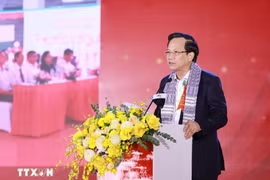
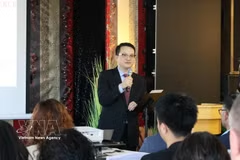
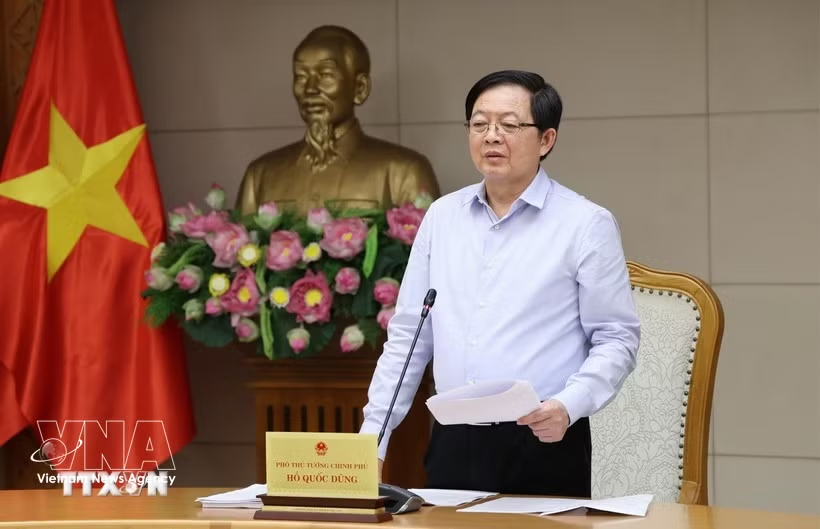
Deputy Prime Minister Ho Quoc Dung addresses the meeting on April 23. (Photo: VNA)

Hanoi (VNA) – Deputy Prime Minister Ho Quoc Dung on April 23 chaired a meeting reviewing the implementation of the national target programme on new-style rural area building, sustainable poverty reduction, and socio-economic development in ethnic minority and mountainous areas for 2026–2035, while outlining key tasks through 2026.

A report by the Ministry of Agriculture and Environment showed that following the National Assembly’s Resolution No. 257/2025/QH15 that approves the programme, ministries and agencies have largely completed mechanisms, policies, and guiding documents for the 2026–2030 phase.

Localities are currently issuing detailed guidelines, completing procedures to carry over 2025 funds, and drafting plans to meet programme targets by 2030. The One Commune, One Product (OCOP) programme continues to play a growing role in boosting economic value and competitiveness of rural products.

The ministry is also working with relevant agencies to develop the medium-term public investment allocation plan for 2026–2030 and the 2026 central budget plan for programme implementation. Total central funding demand for 2026–2030 is estimated at over 20.5 trillion VND (778.6 million USD) for public investment and about 7 trillion VND for tasks under the programme.

Concluding the meeting, Deputy PM Dung commended ministries and agencies for close coordination in merging three programmes into a unified framework, calling it a significant reform step. However, he pointed out shortcomings, including delays in issuing guidelines and slow public investment disbursement.

He urged the swift establishment of steering committees and supporting bodies at all levels, and requested ministries to promptly issue necessary guidance documents.

The Ministry of Agriculture and Environment was tasked with compiling a concise and user-friendly handbook to guide the programme implementation.

Dung stressed the need to fully disburse funds carried over from 2021–2025, remove procedural bottlenecks, and avoid capital staying idle or being reclaimed, particularly in disadvantaged areas.

For the 2026–2030 period, he emphasised prioritising resources for ethnic minority, mountainous, border and insular regions, focusing on essential areas such as clean water, farmland, health care, education, and housing while steering clear of fragmented investment.

The State Bank of Vietnam was assigned to develop preferential credit policies for disadvantaged regions to support livelihood development. Meanwhile, local authorities were told to proactively implement policies, address challenges, report any difficulties or bottlenecks arising to the Government for consideration and resolution, and prioritise key infrastructure projects to ensure targeted and efficient spending.

The Deputy PM called for breakthroughs in rural and mountainous development, particularly through digital transformation linked with tourism, to improve life quality and ensure effective and targeted implementation./.

VNA
See more

Ngo Hoang Minh and Nguyen Thai Minh win gold medals at the 60th International Mendeleev Chemistry Olympiad (Photo: VNA)

All four Vietnamese students sweep medals at Moscow int’l chemistry olympiad

Specifically, two gold medals were awarded to Ngo Hoang Minh, a 12th-grade student at Hanoi–Amsterdam High School for the Gifted, who placed second overall; and Nguyen Thai Minh, an 11th-grade student at the High School for Gifted Students under the Vietnam National University, Hanoi (VNU-Hanoi), who ranked 11th.

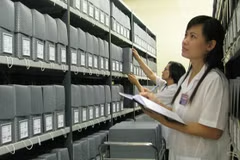
A corner of the archives of the Archives Department of the Communist Party of Vietnam Central Committee Office (Photo courtesy of the office)

Vietnam, Russia review progress in archival cooperation

The preservation and study of historical heritage form an important foundation for Russia–Vietnam relations. Archival collections contain valuable documents that testify to the longstanding friendship and cooperation between the two countries.

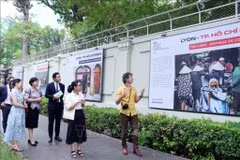
Adrien Jean (right) introduces his photos at the exhibition (Photo: VNA)

Vietnam - France friendship captured through photographs

The “Lyon – Ho Chi Minh City” exhibition showcases 14 large-format photographs by Adrien Jean, a French photographer living in Ho Chi Minh City, and Tony Noel, a French-Vietnamese photographer based in Lyon. The works are displayed along the exterior wall of the French Residence at 6 Le Duan street, making art accessible to a wide public - from passers-by to photography enthusiasts.

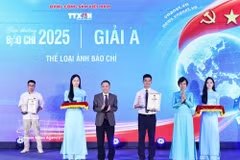
VNA General Director Vu Viet Trang (second from right) and Permanent Vice Chairman of the Vietnam Journalists Association Nguyen Duc Loi (fourth from right) present the A Prize to the winners. (Photo: VNA)

VNA Press Awards 2025 inspire professional commitment, innovation in digital era

A notable feature of this edition is the significant rise in both the number and diversity of entries across all categories. These figures reflect not only growing engagement but also a more coordinated and professional approach among editorial departments and domestic and overseas bureaus, forming a consistent and multi-dimensional flow of information.

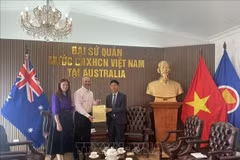
Glenn Mathews and his wife hand over the diary of Vietnamese martyr Vo Van Cong to Minister Counsellor Nghiem Xuan Hoa, representing the Embassy of Vietnam in Australia. (Photo: VNA)

Australian veteran’s son returns diary of Vietnamese martyr

Entries in the diary show that Vo Van Cong was born in 1944 in the former Phuoc Tho commune, Nhon Trach district, Bien Hoa province, now Dong Nai province. He joined the revolutionary movement in April 1961 and was admitted to the Communist Party of Vietnam in May 1962.

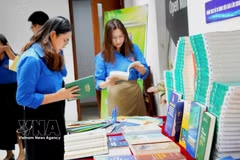
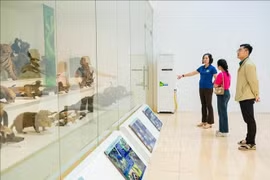
A number of youth union members at the Vietnam Academy of Social Sciences visit the exhibition space showcasing books and materials on culture. (Photo: VNA)

Book week underscores role of knowledge in policymaking

The highlight is a series of activities on April 21, including a book and document exhibition on culture, the launch of a special publication titled “Special scientific information for leadership” and initiatives promoting reading culture, including a book donation programme and a book review contest.

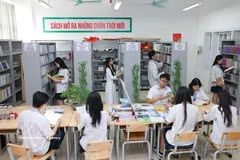
Hanoi has over 1,100 libraries and numerous cultural and educational spaces in the community. (Photo: VNA)

Spreading value of books, building foundations of learning society

Each weekend in Hanoi, the “Reading with Children” Club brings together students to practise reading, explore language, and express ideas creatively. According to founder of the club Nguyen Thuy Anh, the club encourages children to reflect, retell stories, and connect books with personal experiences, making reading more vivid and meaningful.