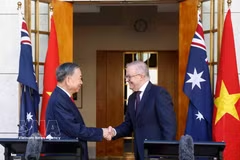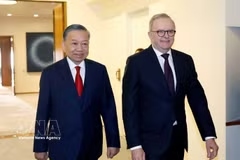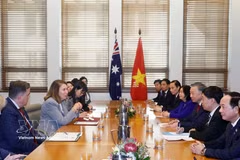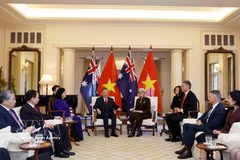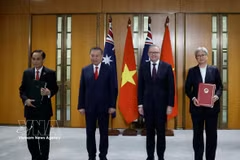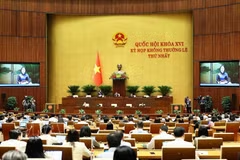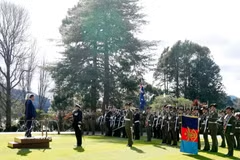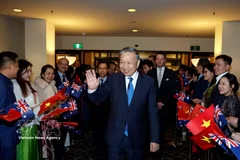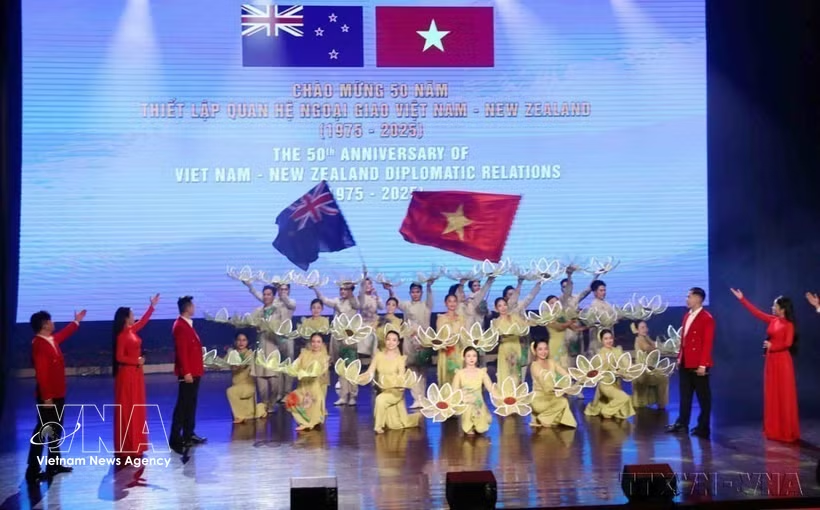
Hanoi (VNA) - Following his state visit to Australia, General Secretary of the Communist Party of Vietnam Central Committee and President To Lam will lead a high-ranking Vietnamese delegation on a state visit to New Zealand from August 12-14 at the invitation of its Governor-General Cindy Kiro.
The trip comes as bilateral ties are growing on a foundation of strong political trust and mounting strategic confidence. It carries historic significance as the first state visit to New Zealand by a top Vietnamese Party and State leader, a signal of Vietnam’s high regard and priority for New Zealand - a vital and effective Comprehensive Strategic Partner in the region, and an affirmation of Vietnam’s growing interest in the South Pacific.
Close and trusted political ties across all channels
Vietnam and New Zealand share a long history. Though separated by geography, the two nations moved quickly to establish diplomatic ties on June 19, 1975.
Over the past more than five decades, both sides have consistently shown a determination to drive cooperation and build a stable, long-term partnership. The relationship was elevated to a Comprehensive Partnership during Party General Secretary Nong Duc Manh’s visit to New Zealand in September 2009, upgraded to a Strategic Partnership in July 2020, and most notably, lifted to a Comprehensive Strategic Partnership in February 2025 when New Zealand Prime Minister Christopher Luxon paid an official visit to Vietnam.
Since then, the two countries have effectively rolled out the new partnership, turning political commitments into concrete action. They are now actively coordinating the Action Plan for the Vietnam-New Zealand Comprehensive Strategic Partnership for 2025–2030, with a target of reaching 3 billion USD in two-way trade.
The two sides have kept up a steady number of high-level and working-level exchanges, buttressed by a range of bilateral mechanisms, including the Foreign Ministers’ Meeting, deputy foreign minister-level political consultations, the Vietnam-New Zealand Maritime Dialogue, the Joint Trade and Economic Commission, a senior officials’ dialogue on agriculture, the deputy defence minister-level Defence Policy Dialogue, and defence consultations between the two countries’ foreign affairs departments.
Within multilateral frameworks, Vietnam and New Zealand maintain close cooperation and support each other at major international and regional organisations and forums of which both countries are members, including the United Nations (UN), the World Trade Organisation (WTO), the Asia-Pacific Economic Cooperation (APEC), the Asia-Europe Meeting (ASEM), the Association of Southeast Asian Nations (ASEAN), and ASEAN-led cooperation mechanisms. The two countries also work together to drive cooperation under shared free trade pacts, including the Comprehensive and Progressive Agreement for Trans-Pacific Partnership (CPTPP) and the Regional Comprehensive Economic Partnership (RCEP).
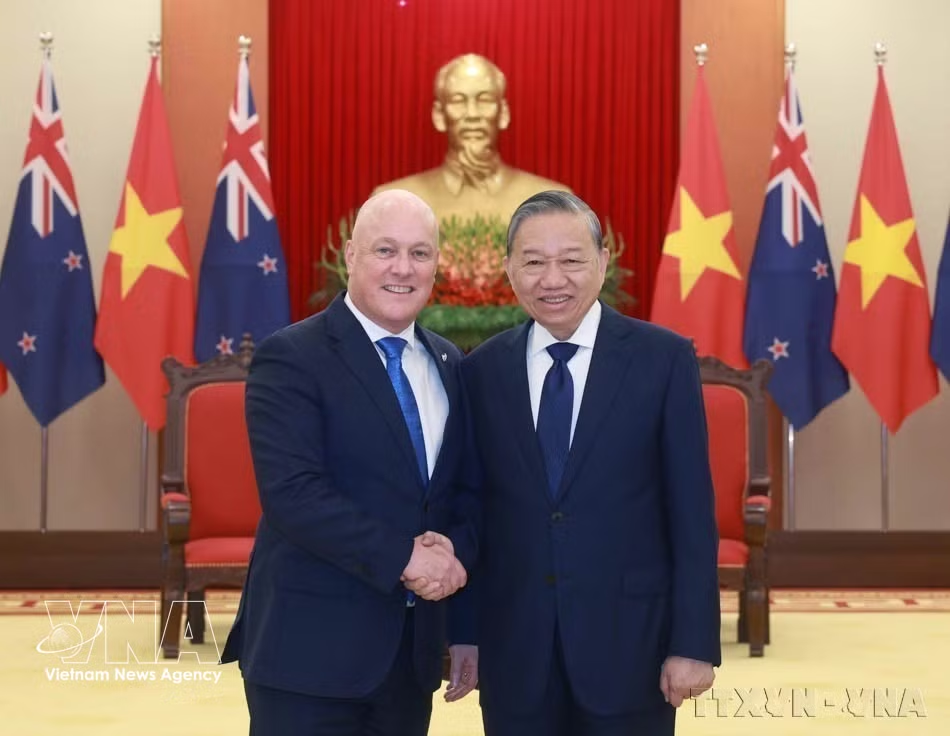
Vietnam is serving as ASEAN-New Zealand Country Coordinator for the 2024–2027 period. In that role, it has partnered with New Zealand to push ASEAN-New Zealand ties to a Comprehensive Strategic Partnership, bringing New Zealand into even closer engagement with Southeast Asia.
Road to 3 billion USD in trade
Vietnam is now New Zealand’s 14th largest trade partner worldwide, with two-way trade hitting 1.3 billion USD in both 2023 and 2024, then climbing to roughly 2 billion USD in 2025.
Both sides are now pushing to reach 3 billion USD in bilateral trade in 2026. That push includes opening markets for farm goods, clearing technical barriers, and making the most of shared free trade pacts like the CPTPP, the RCEP, and the ASEAN-Australia-New Zealand Free Trade Area (AANZFTA).
Vietnam ships phones and components, computers, electronics, seafood, cashew nuts, and footwear to New Zealand. In return, it buys dairy products, fruit, timber, textile and footwear materials, machinery, equipment, tools, iron and steel scrap, and a range of iron and steel goods.
According to Deputy Foreign Minister Nguyen Manh Cuong, a defining feature of Vietnam-New Zealand ties is how well the two economies complement each other, opening up wide room to work together toward sustainable growth.
Vietnam brings a large market, rapid economic expansion, a strong industrial base, and a regional role that is growing in importance. New Zealand counters with strengths in breeding, post-harvest technology, value chain management, and low-emission agriculture - exactly the areas Vietnam needs. So the two sides are scaling up cooperation in smart farming, climate adaptation, and carbon markets, matching Vietnam’s green growth ambitions.
Projects backed by New Zealand in the Mekong Delta have already lifted farmers’ incomes and slashed emissions from rice production by a half. Expanding this partnership could help Vietnam build a low-emission rice industry while helping farmers stay ahead of climate change.
The two countries are also seizing opportunities in high-tech agriculture, healthcare, education, AI, and digital economy, which will shape the future prosperity and resilience of both nations.
In official development assistance (ODA), New Zealand is a key partner and one of Vietnam’s top ODA providers, funding knowledge transfer, capacity building, training for central-level officials, transport infrastructure, agriculture, climate change response and disaster management, gender equality, among others.
New Zealand is also a strategic education and training partner of Vietnam, with strong potential in science, technology, digital transformation, and green transition. Going back to the 1990s when Vietnam was just opening up, New Zealand supported English-language training for Vietnamese officials through its ELTO programme. Generations of Vietnamese officials have since benefited from New Zealand scholarships, and cooperation now reaches into vocational education, skills training, and the development of a highly qualified workforce.
Defence-security ties are thriving as well. The two sides could step up coordination in peacekeeping, sharpen maritime domain awareness, carry out mine clearance, combat transnational crime, and advance the Women, Peace, and Security (WPS) agenda.
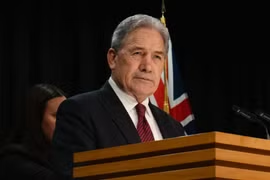
Looking ahead, New Zealand Foreign Minister Winston Peters said there is huge room to grow cooperation in maritime security, fighting transnational organised crime, tackling cybersecurity threats, AI and digital technology, building disaster resilience, and developing agriculture adapted to climate change.
In a world of unpredictable changes, Peters said Vietnam and New Zealand need to coordinate more closely, engage in frank dialogue, respect the rules, and focus on practical cooperation areas for better security and prosperity of both countries.
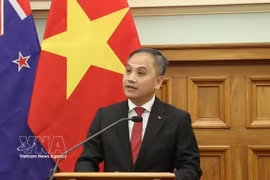
Vietnamese Ambassador to New Zealand Phan Minh Giang added that to turn the 2025–2030 Action Plan into reality, the two countries should move quickly toward establishing direct air routes or convenient connecting flights between Vietnam and New Zealand.
A driving force of Vietnam-New Zealand Comprehensive Strategic Partnership
The state visit to New Zealand by General Secretary and President Lam from August 12-14 is a vivid expression of the Party and State’s foreign policy in the new era, marked by the spirit of independence, self-reliance, peace, friendship, cooperation and development, diversification and multilateralisation of external ties in line with the 14th National Party Congress’s direction.
The visit reaffirms Vietnam’s consistent policy of attaching importance to relations with New Zealand, a friendly and promising partner that shares common interests and similarities with Vietnam in the South Pacific. It stands as an important milestone in pushing the Vietnam-New Zealand Comprehensive Strategic Partnership forward in a stronger, more substantive and effective way in the new period.
Deputy Foreign Minister Nguyen Manh Cuong said the visit comes at a pivotal moment, with Vietnam entering a new development phase focused on quality workforce training, high-value agriculture, and green growth. These are fields where New Zealand has leading experience and a strong reputation, and where the two sides are already delivering highly effective cooperation. At the same time, both sides recognise that enormous untapped potential remains and needs to be fully harnessed going forward.
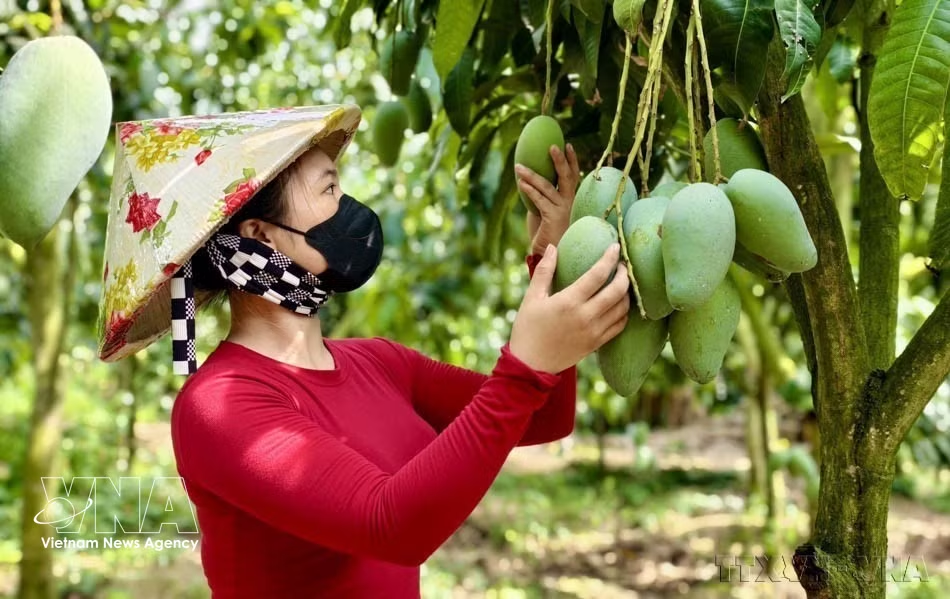
With that in mind, the agenda is designed to make Vietnam-New Zealand ties more substantive, with both sides promoting real cooperation in education, agriculture, trade, and sustainable development.
That will turn political commitments into practical benefits, programmes, and projects that serve each country’s development goals, while jointly contributing to regional peace, stability, sustainable development, and resilience.
Cuong stressed that the most important outcome is not the number of documents signed, but how quickly their commitments can be turned into concrete projects, knowledge and quality workforce for the country./.