Major policies pave way for clean energy

Vietnam’s energy transition is anchored by three major policy pillars: Power Development Plan VIII (PDP8), the Direct Power Purchase Agreement (DPPA) mechanism, and the Just Energy Transition Partnership (JETP).

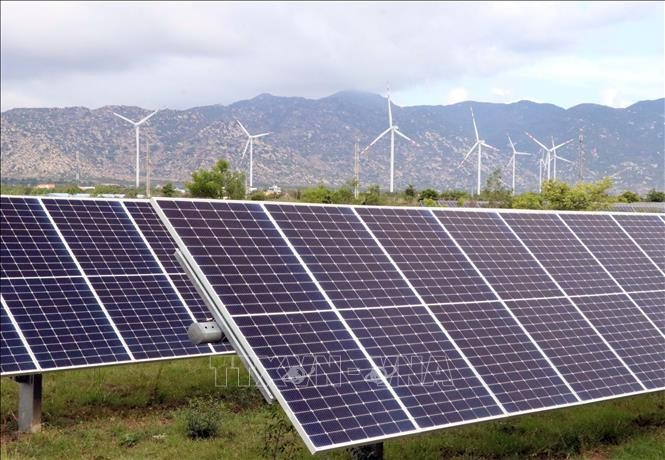
A solar power project in Thuan Nam district, Ninh Thuan province, now part of Khanh Hoa province. (Photo: VNA)

Hanoi (VNA) – A series of major policy breakthroughs are setting the stage for increased investment, removing transmission bottlenecks, and accelerating clean energy development in Vietnam.

On July 12, Prime Minister Pham Minh Chinh issued Directive No. 20/CT-TTg on urgent tasks to prevent and address environmental pollution. The move marks a shift in environmental policy and plays a key role in building a sustainable energy ecosystem. Addressing environmental and energy issues in tandem is expected to strengthen Vietnam’s power system, supporting green growth, energy security, and the country’s Net Zero target by 2050.

Vietnam’s energy transition is anchored by three major policy pillars: Power Development Plan VIII (PDP8), the Direct Power Purchase Agreement (DPPA) mechanism, and the Just Energy Transition Partnership (JETP). PDP8 outlines a long-term legal framework prioritising renewables and grid upgrades. The DPPA fosters a competitive electricity market, connecting businesses with green power and attracting private capital. JETP mobilises international funding and technical support to phase out coal and promote clean, equitable energy.

These policies are creating a robust legal foundation and helping to relieve transmission congestion, particularly in areas with high renewable energy potential.

Internationally, Vietnam is the first developing country to sign the JETP agreement with the G7 - a milestone that opens access to green finance, technology, and global expertise. At home, critical transmission projects are being accelerated, including the completed 500kV circuit-3 line and inter-regional substations, to unlock capacity from key energy hubs such as Khanh Hoa and Lam Dong.

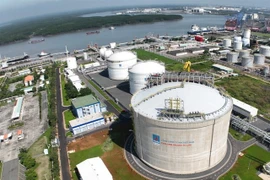
In the liquefied natural gas (LNG) sector, major projects like Nhon Trach 3 and 4 LNG-powered plants and the 4,500 MW Hai Phòng LNG centre are progressing rapidly. LNG development is expected to diversify energy supply and support the transition from coal to lower-emission sources.

However, several challenges remain. Dr. Tran Chi Thanh, President of the Vietnam Atomic Energy Institute, noted that restarting the nuclear programme in Ninh Thuan would require comprehensive preparation in infrastructure, legislation, and workforce.
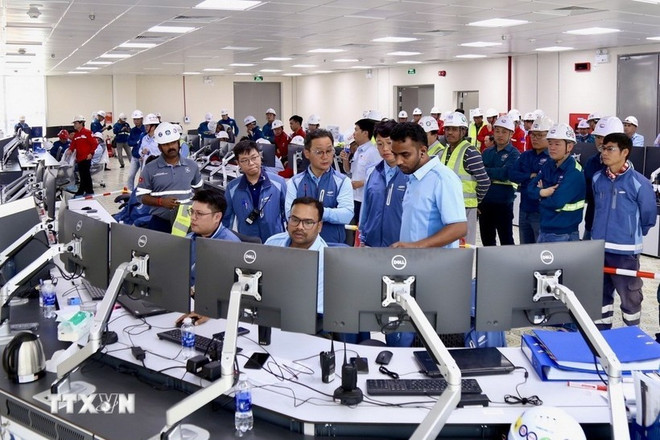
nha-may-nhon-trach-3.jpg
PV Power leaders and engineers officially operate the Nhon Trach 3 LNG-fuelled power plant as it connects to the national grid on February 5. (Photo: VNA)

Vietnam Energy Association Vice President and Secretary General Nguyen Anh Tuan warned of possible power shortages between 2026 and 2028 due to slow project rollout and incomplete pricing and bidding mechanisms.

Human resources also pose a constraint. The International Renewable Energy Agency (IRENA) found that training programmes have yet to meet the needs of modern technologies like wind and solar. Ta Dinh Thi, Vice Chairman of the National Assembly Committee on Science, Technology, and Environment, called for a strategy to develop “green jobs” aligned with the energy transition.

Green finance remains a major hurdle. Le Hoang Lan of the State Bank of Vietnam said green projects lack a unified legal framework despite high capital demand.

Dr. Nguyen Quoc Thap, Chairman of the Vietnam Petroleum Association, proposed a National Assembly resolution to designate energy as a core economic pillar to attract long-term investment.

Some localities are leading the charge. Former Ninh Thuan province (now part of Khanh Hoa province) has become a renewable hotspot with 57 projects totalling 3,750 MW. Investors like Trung Nam Group, BIM Group, and Thien Tan are active, with Trung Nam also exploring a green hydrogen complex with a projected capacity of 824,000 tonnes per year by 2050.

Despite progress, grid constraints and peak-hour curtailments persist. Projects such as the 1,500 MW LNG-fuelled Ca Na Power Plant, the Bac Ai pumped-storage hydropower station, and offshore wind farms are helping form a complete industrial energy ecosystem.

Turning policies into progress will require close coordination among central and local authorities and the private sector. Achieving Net Zero by 2050 demands synchronised action across regulation, finance, technology, and workforce development. /.

VNA

See more

Officials visit a booth at the festival. (Photo: VNA)

Vietnam OCOP Festival 2025 opens in Hanoi

The festival functions as a space to bring together regional OCOP excellence, a forum connecting OCOP stakeholders with distributors, investors, experts and consumers, and a platform to spread pride in indigenous culture, local knowledge, and the aspiration for legitimate prosperity.

Prime Minister Pham Minh Chinh (third from right) and officials launch the Ministry of Construction’s new information technology systems at the conference on December 21. (Photo: VNA)

Modern, comprehensive infrastructure – a need for fast, sustainable development: PM

The Party and State continue to define infrastructure development as one of the three strategic breakthroughs, with priority given to building comprehensive and modern infrastructure, particularly transport facilities, technological infrastructure, and green – digital transition infrastructure, to help realise the national target of double-digit growth, the PM said.

Prime Minister Pham Minh Chinh addresses he third meeting of the National Steering Committee implementing the Politburo’s Resolution 68 in Hanoi on December 20. (Photo: VNA)

PM pushes trust, breakthroughs to accelerate private sector growth

Prime Minister Pham Minh Chinh noted that since the rollout of Resolution 68, alongside supporting resolutions from the National Assembly (NA) and Government, there has been a marked change in understanding the private sector’s critical position and role in Vietnam’s socialist-oriented market economy.

PM Pham Minh Chinh chairs the meeting (Photo: VNA)

Private sector thrives eight months after Resolution 68’s launch: PM

The private sector has shown marked progress eight months after the launch of Resolution 68, registering about 18,000 new enterprises monthly and pushing the nationwide total to nearly 1.1 million, Prime Minister Pham Minh Chinh told the third meeting of the National Steering Committee in Hanoi on December 20.

Phin Ho Tra – a national five-star OCOP product. (Illustrative photo: VNA)

Hanoi to host Vietnam OCOP Festival 2025

The festival is seen a practical activity celebrating the achievements made by the capital and the country in 2025, affirming OCOP’s role in rural economic development, contributing to realising Vietnam’s aspiration for strong economic growth in the context of deep integration.

The expanded Hoa Binh Hydropower Plant (Photo baochinhphu.vn)

EVN launches major power projects

Among the flagship projects inaugurated was the expanded Hoa Binh Hydropower Plant with a total installed capacity of 480MW per year and average annual output of about 488 million kWh.

An ultra-intensive shrimp farming model linked with environmental protection in Ca Mau province. (Photo: VNA)

Fisheries take the lead in the Mekong Delta’s green transition

Across the Mekong Delta, leading aquaculture producers, processors and exporters, along with suppliers of inputs, are transitioning to circular, high-tech and clean production models that cut greenhouse gas emissions and comply with international certification standards.

A perspective view of the Red River Landscape Boulevard project in Hanoi (Photo: VNA)

Works starts on Hanoi’s Red River Landscape Boulevard Axis project

The project is among the 234 key works and projects being launched, inaugurated or technically opened simultaneously across 34 cities and provinces nationwide to mark the 14th National Party Congress. Its launch contributes to implementing the country’s strategic development orientations while concretising Hanoi’s development goals in the new period.