Malaysia successfully tests first 5.5G technology in Southeast Asia

Maxis, one of the oldest and largest telecommunications companies in Malaysia, announced on February 23 that it and Chinese tech giant Huawei have successfully staged the first 5G-Advanced technology trial in Malaysia and Southeast Asia.
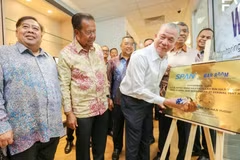
Malaysia successfully tests first 5.5G technology in Southeast Asia ảnh 1Delegates at 5G-Advanced Trial Showcase (Photo: Maxis)
Kuala Lumpur (VNA) - Maxis, one of the oldest and largesttelecommunications companies in Malaysia, announced on February 23 that it and Chinesetech giant Huawei have successfully staged the first 5G-Advanced technologytrial in Malaysia and Southeast Asia.

The ‘5G-Advanced Trial Showcase’ included a live speed testto demonstrate 5G-Advanced’s capabilities to achieve ultra-fast peak speeds ofup to 8Gbps.

5G-Advanced, also known as 5.5G, promises up to 10 timesimprovement in speed, connected devices, and latency compared to 5G.

Chairman of the Malaysian Communications and MultimediaCommission (MCMC) Tan Sri Mohamad Salim bin Fateh Din said that this 5.5G trialdemonstrates the potential of Malaysia’s telecommunications sector incontributing meaningfully to advancing communications connectivity.

He expressed his hope that more industry players willpioneer innovative technologies that will help Malaysian enterprises move upthe value chain through next-generation commercial and industrial solutions.This will position Malaysia as a front-runner in telecommunications globally,he added./.
VNA

See more

Malaysia considers establishing strategic petroleum reserve

Malaysia considers establishing strategic petroleum reserve

Malaysia, which was previously a net exporter, has now become a net importer due to declining domestic production and rising consumption, with demand estimated at around 800,000 barrels per day compared to production of about 400,000 barrels per day.

Indonesia to halt diesel imports from July

Indonesia to halt diesel imports from July

The move is part of the Indonesian Government’s efforts to strengthen national energy independence by utilising palm oil as an alternative fuel, said Agriculture Minister Andi Amran Sulaiman.

Malaysia’s growing microplastics crisis is largely self-inflicted, driven by domestic waste, weak recycling practices and everyday plastic use, said experts. (Photo: New Straits Times)

Malaysia seeks solutions to microplastic crisis

Microplastics originating from domestic waste and wastewater are increasingly entering the food chain, posing serious threats to seafood safety and the livelihoods of coastal communities.

The new mass emergency alert system SG Alert, which will be used during emergencies such as major fires, chemical or terror incidents, seen on an Apple and Android device on Apr 17, 2026. (Photo: CNA)

Singapore launches new national emergency alert system

SG Alert in Singapore uses cell broadcast technology, enabling alerts to be delivered within seconds without requiring mobile data or collecting personal information. Unlike conventional SMS, which may be delayed during network congestion or depend on internet connectivity, the system ensures fast and reliable message delivery. Alerts can be sent islandwide or targeted to specific affected areas.

Malaysia establishes ‘war room’ to ensure water security

Malaysia establishes ‘war room’ to ensure water security

The establishment of the war room reflects the Malaysian government’s commitment to shift from a reactive approach to a more proactive, data-driven one in managing national water challenges, particularly amid increasingly unpredictable weather conditions caused by global climate change

Indonesia diversifies supply sources to ensure energy security

Indonesia diversifies supply sources to ensure energy security

Indonesia is facing significant supply pressure as crude oil consumption reaches approximately 1.6 million barrels per day, much lower than the domestic production at only around 600,000 barrels per day, forcing the country to rely heavily on imports.