Malaysia considers establishing strategic petroleum reserve

Malaysia, which was previously a net exporter, has now become a net importer due to declining domestic production and rising consumption, with demand estimated at around 800,000 barrels per day compared to production of about 400,000 barrels per day.

Kuala Lumpur (VNA) – The Malaysian government is studying a proposal to establish a strategic petroleum reserve as part of the country’s long-term energy security plan, amid concerns over global supply disruptions.

The proposal is among the issues being discussed by the government as it assesses long-term preparedness following supply disruptions caused by the closure of the strategic Strait of Hormuz for 48 days, Deputy Economy Minister Shahar Abdullah said in an interview with Bernama TV.

Shahar noted that the reopening of the Strait of Hormuz will not lead to the immediate stabilisation of oil prices due to damage to refinery infrastructure in the Middle East.

He added that although the strait has reopened, the recovery process will take time, as refinery and production facilities may need between four and six months to return to full operation.

The disruption also exposed structural weaknesses in Malaysia’s energy landscape, particularly its increasing reliance on imported petroleum products.

Malaysia, which was previously a net exporter, has now become a net importer due to declining domestic production and rising consumption, with demand estimated at around 800,000 barrels per day compared to production of about 400,000 barrels per day.

The minister emphasised that this supply gap makes Malaysia more vulnerable to external shocks, and that long-term measures such as building strategic reserves and diversifying supply sources should be given serious attention./.

VNA

See more

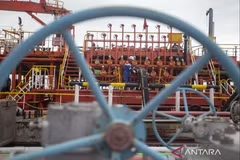
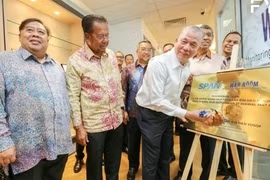
Illustrative Image (Photo: theedgemalaysia.com)

Malaysia rolls out financial support measures for businesses

Prime Minister Anwar Ibrahim said on April 20 that a key measure is a 5 billion MYR guarantee package (1.27 billion USD) under the Syarikat Jaminan Pembiayaan Perniagaan (SJPP) scheme. The financial guarantee ratio for businesses will be raised to 80% from the previous 70%, while the guarantee period will be extended to up to 10 years instead of seven years.

Indonesia to halt diesel imports from July

Indonesia to halt diesel imports from July

The move is part of the Indonesian Government’s efforts to strengthen national energy independence by utilising palm oil as an alternative fuel, said Agriculture Minister Andi Amran Sulaiman.

Malaysia’s growing microplastics crisis is largely self-inflicted, driven by domestic waste, weak recycling practices and everyday plastic use, said experts. (Photo: New Straits Times)

Malaysia seeks solutions to microplastic crisis

Microplastics originating from domestic waste and wastewater are increasingly entering the food chain, posing serious threats to seafood safety and the livelihoods of coastal communities.

The new mass emergency alert system SG Alert, which will be used during emergencies such as major fires, chemical or terror incidents, seen on an Apple and Android device on Apr 17, 2026. (Photo: CNA)

Singapore launches new national emergency alert system

SG Alert in Singapore uses cell broadcast technology, enabling alerts to be delivered within seconds without requiring mobile data or collecting personal information. Unlike conventional SMS, which may be delayed during network congestion or depend on internet connectivity, the system ensures fast and reliable message delivery. Alerts can be sent islandwide or targeted to specific affected areas.

Indonesia diversifies supply sources to ensure energy security

Indonesia diversifies supply sources to ensure energy security

Indonesia is facing significant supply pressure as crude oil consumption reaches approximately 1.6 million barrels per day, much lower than the domestic production at only around 600,000 barrels per day, forcing the country to rely heavily on imports.

Indonesian-branded cosmetic and personal care products are available at supermarkets and shopping malls (Photo: VNA)

Indonesia aims to master cosmetics industry value chain

Key drivers include its large population, expanding middle class, and rapidly rising demand for beauty products, especially among young consumers. The market has reached billions of US dollars and is projected to maintain strong growth in the medium term.

The Anthropic logo is seen in this illustration taken on Mar 1, 2026. (File photo: Reuters)

Singapore warns of cyber risks from Frontier AI models

According to CSA, advanced AI models – among the most cutting-edge systems today – can significantly shorten the time needed to identify system vulnerabilities and develop exploitation tools, reducing the process from months to just hours.