Thailand steps up nationwide cost-of-living relief programme

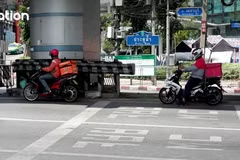
Thailand has ordered provincial and district officials nationwide to support the deployment of 3,800 mobile "Pum-Puang" vehicles under a Commerce Ministry initiative aimed at selling low-cost goods across the country.

Bangkok (VNA) – Thai ministries and agencies are actively accelerating the government’s programme to reduce living costs for people nationwide, as the economy faces impacts from tensions in the Middle East.

The Department of Provincial Administration under the Interior Ministry has ordered provincial and district officials nationwide to support the deployment of 3,800 mobile "Pum-Puang" vehicles under a Commerce Ministry initiative aimed at selling low-cost goods across the country.

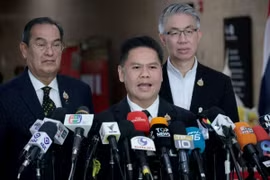
Deputy Prime Minister and Commerce Minister Suphajee Suthumpun said the directive followed a joint meeting between the Commerce Ministry, the Interior Ministry and other state agencies to advance the government's "cost-of-living relief" programme.

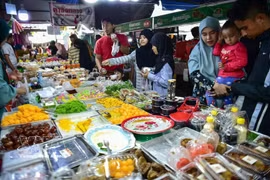
The initiative seeks to expand access to discounted goods, particularly in remote areas where residents cannot easily reach fixed "Blue Flag" (Thong Fah) outlets or markets.

Earlier, the Commerce Ministry announced a plan to organise 518 Blue Flag events nationwide from April to August. These include 12 large-scale fairs with 200 booths each, 76 medium-sized events with 50 booths, and 380 smaller ones across provinces, along with 50 events in Bangkok’s districts.

In addition, more than 5,000 mobile units, including street vendors, Pum-Puang trucks, and mobile Blue Flag vehicles, will be deployed using existing local networks. Authorities are also recruiting more operators to meet the target of 3,800 vehicles, and district chiefs have been instructed to support the rollout.

Suphajee also highlighted a parallel "co-payment interest" loan scheme designed to ease financial burdens on farmers. Approved by the cabinet with a budget of 30 billion THB (935.1 million USD), the scheme offers loans of up to 100,000 THB per farmer, with a maximum term of 12 months under a three-year programme framework. The interest rate is set at 6% annually, split equally between borrowers and the government, leaving farmers to pay only 3%./.

VNA

See more

Malaysia considers establishing strategic petroleum reserve

Malaysia considers establishing strategic petroleum reserve

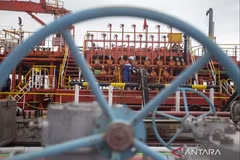
Malaysia, which was previously a net exporter, has now become a net importer due to declining domestic production and rising consumption, with demand estimated at around 800,000 barrels per day compared to production of about 400,000 barrels per day.

Indonesia to halt diesel imports from July

Indonesia to halt diesel imports from July

The move is part of the Indonesian Government’s efforts to strengthen national energy independence by utilising palm oil as an alternative fuel, said Agriculture Minister Andi Amran Sulaiman.

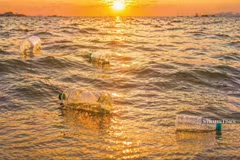
Malaysia’s growing microplastics crisis is largely self-inflicted, driven by domestic waste, weak recycling practices and everyday plastic use, said experts. (Photo: New Straits Times)

Malaysia seeks solutions to microplastic crisis

Microplastics originating from domestic waste and wastewater are increasingly entering the food chain, posing serious threats to seafood safety and the livelihoods of coastal communities.

The new mass emergency alert system SG Alert, which will be used during emergencies such as major fires, chemical or terror incidents, seen on an Apple and Android device on Apr 17, 2026. (Photo: CNA)

Singapore launches new national emergency alert system

SG Alert in Singapore uses cell broadcast technology, enabling alerts to be delivered within seconds without requiring mobile data or collecting personal information. Unlike conventional SMS, which may be delayed during network congestion or depend on internet connectivity, the system ensures fast and reliable message delivery. Alerts can be sent islandwide or targeted to specific affected areas.

Malaysia establishes ‘war room’ to ensure water security

Malaysia establishes ‘war room’ to ensure water security

The establishment of the war room reflects the Malaysian government’s commitment to shift from a reactive approach to a more proactive, data-driven one in managing national water challenges, particularly amid increasingly unpredictable weather conditions caused by global climate change

Indonesia diversifies supply sources to ensure energy security

Indonesia diversifies supply sources to ensure energy security

Indonesia is facing significant supply pressure as crude oil consumption reaches approximately 1.6 million barrels per day, much lower than the domestic production at only around 600,000 barrels per day, forcing the country to rely heavily on imports.