Thailand promotes low-emission vehicles with planned trade-in scheme

Thailand’s government is preparing to launch a car trade-in scheme later this year to encourage motorists to switch to electric and hybrid vehicles, as part of efforts to promote environmentally friendly transport.

Bangkok (VNA) – Thailand’s government is preparing to launch a car trade-in scheme later this year to encourage motorists to switch to electric and hybrid vehicles, as part of efforts to promote environmentally friendly transport.

According to a source from the Finance Ministry cited on April 17, the programme is currently under discussion, with the aim of accelerating the adoption of low-emission vehicles while managing the transition away from older cars. In its initial phase, the scheme will be limited due to budget constraints and to test systems for handling scrapped vehicles.

The programme will be implemented in multiple phases starting this year, with no fixed end date. Under proposed criteria, eligible new vehicles must meet two key requirements: low carbon emissions in line with the country’s excise tax structure and domestic production to support local industry, employment and investment.

Subsidies will be channelled to car manufacturers on the condition that they are passed directly to consumers through price reductions.

In addition, the Government Savings Bank will provide soft loans worth 5 billion THB (approximately 137 million USD). Individuals can borrow up to 2 million THB at interest rates capped at 3.5% during the first one to two years.

The loans will be available for purchasing electric cars or motorcycles, with applications to be open until March 31, 2027./.


VNA

See more

Illustrative Image (Photo: theedgemalaysia.com)

Malaysia rolls out financial support measures for businesses

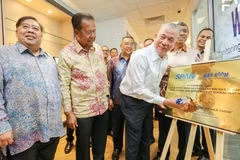
Prime Minister Anwar Ibrahim said on April 20 that a key measure is a 5 billion MYR guarantee package (1.27 billion USD) under the Syarikat Jaminan Pembiayaan Perniagaan (SJPP) scheme. The financial guarantee ratio for businesses will be raised to 80% from the previous 70%, while the guarantee period will be extended to up to 10 years instead of seven years.

Indonesia to halt diesel imports from July

Indonesia to halt diesel imports from July

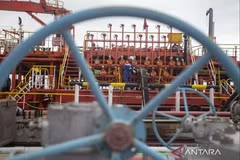
The move is part of the Indonesian Government’s efforts to strengthen national energy independence by utilising palm oil as an alternative fuel, said Agriculture Minister Andi Amran Sulaiman.

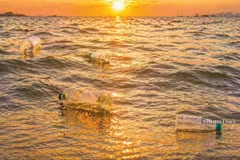
Malaysia’s growing microplastics crisis is largely self-inflicted, driven by domestic waste, weak recycling practices and everyday plastic use, said experts. (Photo: New Straits Times)

Malaysia seeks solutions to microplastic crisis

Microplastics originating from domestic waste and wastewater are increasingly entering the food chain, posing serious threats to seafood safety and the livelihoods of coastal communities.

The new mass emergency alert system SG Alert, which will be used during emergencies such as major fires, chemical or terror incidents, seen on an Apple and Android device on Apr 17, 2026. (Photo: CNA)

Singapore launches new national emergency alert system

SG Alert in Singapore uses cell broadcast technology, enabling alerts to be delivered within seconds without requiring mobile data or collecting personal information. Unlike conventional SMS, which may be delayed during network congestion or depend on internet connectivity, the system ensures fast and reliable message delivery. Alerts can be sent islandwide or targeted to specific affected areas.

Malaysia establishes ‘war room’ to ensure water security

Malaysia establishes ‘war room’ to ensure water security

The establishment of the war room reflects the Malaysian government’s commitment to shift from a reactive approach to a more proactive, data-driven one in managing national water challenges, particularly amid increasingly unpredictable weather conditions caused by global climate change

Indonesia diversifies supply sources to ensure energy security

Indonesia diversifies supply sources to ensure energy security

Indonesia is facing significant supply pressure as crude oil consumption reaches approximately 1.6 million barrels per day, much lower than the domestic production at only around 600,000 barrels per day, forcing the country to rely heavily on imports.

Indonesian-branded cosmetic and personal care products are available at supermarkets and shopping malls (Photo: VNA)

Indonesia aims to master cosmetics industry value chain

Key drivers include its large population, expanding middle class, and rapidly rising demand for beauty products, especially among young consumers. The market has reached billions of US dollars and is projected to maintain strong growth in the medium term.

The Anthropic logo is seen in this illustration taken on Mar 1, 2026. (File photo: Reuters)

Singapore warns of cyber risks from Frontier AI models

According to CSA, advanced AI models – among the most cutting-edge systems today – can significantly shorten the time needed to identify system vulnerabilities and develop exploitation tools, reducing the process from months to just hours.