Hanoi (VNA) – Malaysian Prime Minister Anwar Ibrahim said the country’s energy firm Petronas may negotiate with Russia to purchase oil to ensure sufficient supplies for domestic use.
As reported by China's Xinhua News Agency, the PM said that Malaysia’s relations with Russia remain good. “So, in the current situation, our team, including Petronas, can negotiate with Russia to meet part of our needs as a friendly nation," Anwar said.
Anwar added that Malaysia continues to practice a pragmatic foreign policy and maintains friendly ties with all nations it trades with, including Iran, which ensured that ships carrying oil through the Strait of Hormuz could pass unimpeded to Malaysia.
Early diplomatic action by the government has also ensured that the country's oil tankers were among the earliest to pass through critical routes in the Strait of Hormuz, thereby avoiding major disruptions to the national energy supply chain, he said./.
See more
Singapore seizes over 36kg of cannabis at Changi Airport
During screening, officers discovered multiple suspicious packages in his luggage. Further examination by the Central Narcotics Bureau uncovered a total of 68 packages containing 36.3kg of cannabis.
Singapore inflation accelerates as petrol prices hike
According to a joint statement released on April 23 by the Monetary Authority of Singapore and the Ministry of Trade and Industry Singapore, overall inflation rose to 1.8% year-on-year, up from 1.2% in February.
Philippines: Preparations for ASEAN Summit on track
The ASEAN Summit will take place on May 7–8 in Cebu, while ASEAN summits with partners and related meetings will be held in Manila later this year. Previously, about 650 ministerial- and senior official-level meetings scheduled to be hosted by the Philippines will be held online.
Indonesia views infrastructure as key to economic growth
Infrastructure development is identified as a key driver for sustainable economic growth in Indonesia as the country’s economy faces emerging challenges.
Indonesia forecasts surplus of eight key agricultural commodities by mid-2026
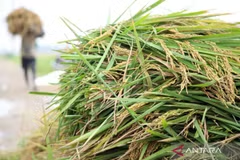
After reaching rice self-sufficiency by the end of 2025, the government now aims for a bigger milestone: achieving self-sufficiency in eight key food commodities, namely rice, corn, sugar, large chillies, cayenne pepper, chicken meat, chicken eggs, and shallots, by this June.
Malaysia targets 32% renewable energy capacity
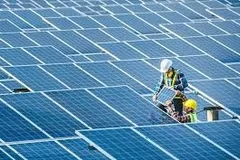
Deputy Prime Minister Datuk Seri Fadillah Yusof, who is also the Minister of Energy Transition and Water Transformation of Malaysia, said the country had achieved 31% installed RE capacity as of December 2025.
ASEAN, Russia prepare for 35th anniversary summit
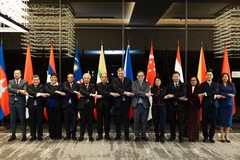
Deputy Minister Dang Hoang Giang reaffirmed that ASEAN views Russia as one of its key partners contributing to regional peace, stability and development. He proposed enhancing high-level strategic exchanges, strengthening cooperation in priority areas such as cybersecurity, including the effective implementation of the Hanoi Convention, and expanding collaboration within ASEAN-led mechanisms.
Thailand ready to share experience with Vietnam in green urban development: officials
Thailand is ready to share its experience and successful models in green urban development with Vietnam, as the two countries share many similar characteristics, including rapid urbanisation, traffic congestion, flooding, canal networks and growing demand for greener public spaces, Thai officials have said in recent interviews with the Vietnam News Agency.
Malaysia refocuses tourism on stable markets to bolster resilience
Amid prolonged uncertainty, tourism should not be viewed solely as a driver of visitor numbers but also as a vital source of foreign exchange earnings, helping to cushion external economic pressures, said a Malaysian minister.
Thailand’s economy may face recession risk
In its latest report, KKP Research noted that Thailand’s vulnerability goes beyond its reliance on imported crude oil and liquefied natural gas (LNG). Disruptions to shipping routes in the Middle East could also worsen shortages of fertilisers, affecting agricultural output, as well as petrochemical feedstocks, which would impact the plastics and textile industries.
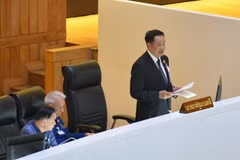
Thailand plans tighter, targeted fiscal 2027 budget
Thailand's fiscal 2027 budget is projected at around 3.78 trillion THB (nearly 118 billion USD), a 2% increase from the previous year, with a focus on targeted spending and cutting unnecessary expenses, according to Prime Minister Anutin Charnvirakul.
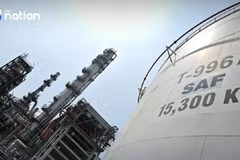
Thailand moves to trim refinery margins again as costs climb
The latest move follows a price adjustment last month that cut fuel costs by about 2.14 THB (0.067 USD) per litre, Thailand plans to further reduce prices by more than 2 THB per litre later this week.
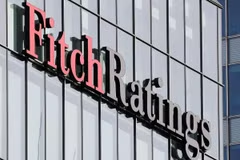
Fitch downgrades Philippines’ outlook to ‘negative’
The Outlook revision reflects rising risks to the Philippines' strong medium-term growth prospects from recent disruptions to public investment, exacerbated in the near-term by elevated exposure to the ongoing global energy shock.
Singapore unveils new roadmap to boost innovation in maritime sector
The Singapore Maritime Technology & Research Roadmap is aimed at advancing the sector’s efficiency and sustainability. It highlights priorities – including digital technologies, decarbonisation and operational integration – to boost resilience, productivity and innovation in Singapore’s maritime ecosystem. It also addresses structural issues such as manpower, land and sea space limitations.
Singapore pioneers standardisation of generative AI testing
Singapore has proposed a new international standard to harmonise testing methods for generative artificial intelligence systems, aiming to strengthen the foundation for trustworthy AI evaluation.
Indonesia warns of highly contagious measles outbreak
An Indonesian official highlighted that the main challenge in controlling measles is not the availability of vaccines, but public hesitation toward immunisation.
Singapore nurtures space talent through its education system
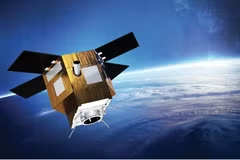
Space has become an increasingly accessible frontier for nations and businesses thanks to rapid technological advancements and declining launch costs.
Singapore buys more LNG from outside of Middle East
Singapore currently imports natural gas to meet around 95% of its electricity needs.
Malaysia boosts aid to help farmers expand rubber cultivation areas
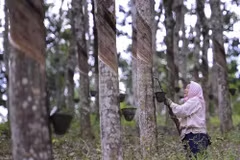
The move comes amid rising agricultural input costs and global economic uncertainty, which have made replanting increasingly challenging for small-scale growers.
Singaporean primary schools pilot AI with strict control
In Singapore, AI will be gradually introduced from Primary 4. This is done under close supervision and “low exposure”, with priority given to learning the fundamentals.